
The recent announcement that the 14,000 member Woodlands United Methodist Church outside Houston, Texas has voted to leave the denomination in order stay true to the standards of sexual conduct in the United Methodist Book of Discipline (and to 2,000 years of Christian tradition) calls for the reiteration of a crucial point about sound Christian thinking.
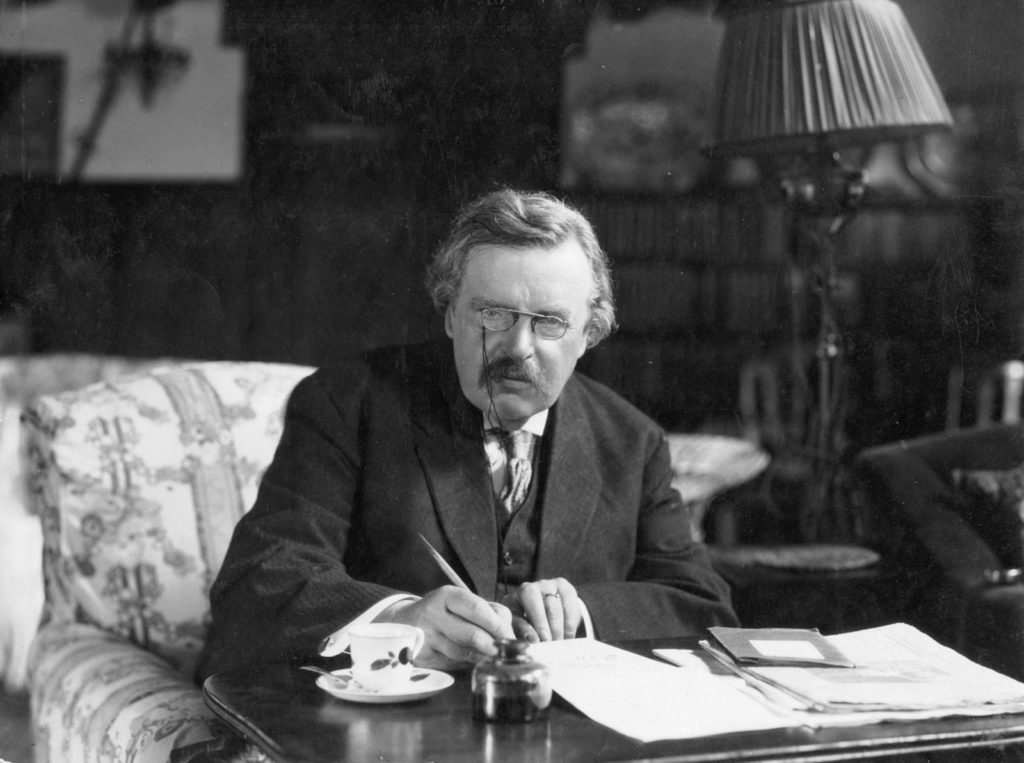
Facing a fundamentally similar kind of controversy a hundred years ago in his native England, G.K. Chesterton held a clear-eyed Christian perspective that is applicable to the current debate on sexuality. Early in the twentieth century, there was a movement to relax the divorce laws which had made ending a marriage difficult by today’s standards. Chesterton rightfully opposed this movement with a keen appreciation for the holiness of the marriage vow and a sober vision of the socially corrosive effects of easy divorce. In his book, The Superstition of Divorce, he references the opposition to his view by fellow British writer, Sir Arthur Conan Doyle, who was dismissive of the movement to preserve marriage and restrict divorce claiming it was “entirely founded on ‘certain texts’ in the Bible about marriages.”
Chesterton’s response is lucid: “[An abiding belief in the sanctity of marriage] means a whole view of life, held in the light of life, and defended, rightly or wrongly, by constant appeals to every aspect of life…anybody who holds it at all will hold it as a philosophy, not hung on one text but on a hundred truths.”
The problem with Christians debating sexuality is that the arguments tend to focus only on the textual trees without considering the metaphysical forest. Both sides demonstrate something like an epistemological autism. Like an autistic person who has no capacity to perceive social cues or body language, many Christians seem to be unable to understand the most obvious realities if they are not explicitly stated in the Biblical texts. By now, those familiar with the debate within the Church have seen or heard of the pamphlet titled, “Everything Jesus Ever Said About Homosexuality,” which is full of blank pages. This is misleading. Jesus made clear God’s ideal for human sexuality in his teaching on marriage and divorce in Matthew 19, but what if he hadn’t?
Many people talk as if homosexual behavior wouldn’t be an issue if only Paul hadn’t made such stark condemnations in Romans, 1 Corinthians, and 1 Timothy. The debate typically centers on the interpretation or misinterpretation of these texts—as in, “What Paul is really referring to in the first chapter of Romans is homosexual behavior in the context of pagan temple prostitution,” or “His condemnations of homosexual acts in 1 Corinthians and 1 Timothy don’t apply to loving, covenanted relationships.” Quite a few people on both sides of the debate seem to think that if Paul hadn’t written these passages, or if he had addressed the issue with greater ambiguity, then two men saying “I do” at an altar could be as right and normal as a baptism or an Easter morning sunrise service.
The problem here is arguing in terms of interpretive technicalities rather than factual realities. If someone believes the Bible is scripture then, by definition, its admonitions must be taken with the utmost seriousness. But we also need to stop and consider the true essence of the behavior in question and ask whether the nature of the thing could be compatible with the Christian life even if it weren’t so explicitly denounced in the Bible.
If traditional Christians thought they had misinterpreted Paul, acquiesced to LGBT activism in the Church, and affirmed same-sex marriage, would we still be able to keep our convictions on the importance of chastity? Would we be able to maintain our belief in the sacredness of the human body? Would it be thought too exclusionary to teach our children about the importance of self-control in order to safeguard sex for the holy confines of the monogamous marriage bed?
Something as morally significant as sexual relationships can never be isolated from all other aspects of the moral life. Consider the last few words in Paul’s admonition against the works of the flesh in contrast to the fruits of the Spirit: “Now the works of the flesh are evident: sexual immorality, impurity, sensuality, idolatry, sorcery, enmity, strife, jealousy, fits of anger, rivalries, dissensions, divisions, envy, drunkenness, orgies, and things like these.” Envy, idolatry, and orgies may not seem like similar things, but they are listed together because they share some fundamental qualities. They are of an essence that is qualitatively opposite of the fruits of the Spirit. In order to discern “things like these,” Christians must learn to consider the actual nature of certain behaviors even when they are not (though homosexuality is) overtly addressed in the text of scripture.
This is a point where the importance of understanding Christianity as a family becomes clear. Being a genuine part of a family means not only understanding the rules of the house but also the character of the father and mother and, consequently, the basic ethos of the family. This means family members will understand not only the specific words the parents say but also the general attitudes and behaviors inconsistent with their admonitions. Parents are most pleased when they don’t have to give explicit instruction in every situation because the children can discern “things like these.”



Comment by Terry Wiles on August 20, 2022 at 3:23 pm
Perhaps the fundamental question should be “Is Scripture the inspired Word of God pinned by mankind or are they simply theological musing of authors with some biased intent. It should make us shake with fear if we mishandle the inspired Word. If the other is true we should eat, drink, and be merry for tomorrow we die.
Comment by Richard Bell on August 20, 2022 at 7:58 pm
As we consider sexual conduct with reference to the Ten Commandments, it is obvious that the Moral Law makes no distinction between male and female, no distinction between techniques for satisfying sexual desire, no distinction between heterosexual desire and homosexual desire. The applicable rules and principles of sexual morality are the same for all these. All the Moral Law for paradigm sexual conduct is in the Seventh Commandment: “You shall not commit adultery.”
The Seventh Commandment prohibits fornication, because it is a principle of the Seventh Commandment that full expression of sexual desire is permitted only within marriage. The Seventh Commandment extends to homosexual acts. The Seventh Commandment prohibits, as fornication, homosexual relations outside marriage just as it prohibits, as fornication, heterosexual relations outside marriage. The Seventh Commandment commends marriage as an institution for persons who were not created to live in solitude and who do not have the gift of sexual continency, without denying the full blessings of that institution to anyone because of his sexual orientation.
Jesus did not declare, in Matthew 19, that the nature of marriage is union of a man and woman, nor is there any good reason for inferring such a declaration. Jesus’ teaching about marriage was specifically a response to the Pharisees’ question, “Is it lawful for a man to divorce his wife for any cause?” Jesus gently chided the Pharisees for failing to find their answer in Scripture, then Jesus answered that the marital union is, as it has always been, a perfect partnership – a partnership so perfect that it is like becoming one flesh. Jesus implied that this union is God’s blessing, as it is not the kind of thing that could be achieved by man. Therefore, union in marriage is not to be put asunder by man. The nature of marriage shows that it is made by God; therefore, destruction of a marriage by divorce, an act of man, is rebellion, prohibited.
Here is the end of Jesus’ excellent explanation, which taught us about the nature of marriage and its implications for the morality of divorce. The claim that Jesus also declared or implied that a same-sex couple is disqualified for marriage is utterly without foundation. Jesus neither declared nor implied anything about the qualifications for marriage.
What of Jesus’ explicit reference to the male and female? Jesus referred to creation of a man and a woman and to their union – the union of the man and the woman. Jesus had in mind a story in Scripture describing just that. But Jesus was driving to a conclusion about the nature of the union, not the sexual identities of the parties eligible for the union. Their different sexes are part of the story that Jesus referred to. Jesus’ repetition of that part of the story was his very natural way of directing the Pharisees’ attention to it. But different sexes of the couple is not a necessary feature of the story as Jesus used it. The only necessary feature of the story as Jesus used it is the couple’s suitability for a perfect partnership – a partnership so perfect that it may be likened to a physical merger. Here again, in different words, is Jesus’ drift: “You want to know why divorce is forbidden? Consider what marriage is. And I mean the very nature of marriage – what it has always been, what it has been from the beginning. Consider the record of the first marriage. It is written that God created first two people, the male and the female, and God said, ‘They shall be joined as one flesh, so they are no longer two, but one.’ Now, this record shows that marriage is, in its very nature, a full union made by God.”
Comment by Mike Mitchell on August 21, 2022 at 8:19 am
Regarding the comment from Richard Bell, your remarks completely bypass the whole point of my article. First of all, saying that Jesus’ teaching about the intended ontology of male and female in marriage could be compatible with homosexuality is absurd. The very notion that two men could be married as husband and husband would have been unthinkable to devout Jews.
But the central argument I have made is that, even if we didn’t have such clear teaching in the Bible that homosexual practice is contrary to the Christian ethos (you make no mention of the 3 passages from Paul), those who truly belong to Christ know the types of behaviors that are consistent and inconsistent with the kind of life he calls us to live, even if they are not explicitly spelled out in the Bible.
Also, regarding the idea that men attracted to men just want to settle down and have a wholesome, monogamous, life-long marriage relationship–this is like saying 16-year-old boys typically invite large groups of friends over late at night when their parents are out of town so they can discuss how to practice better self-discipline in order to prepare themselves to be morally upstanding adults.
If anyone doubts that the monogamous (male) gay couple is the exception and not the rule, read Robert Riley’s book, Making Gay Okay. The statistics on male homosexuals and STDS he cites from the CDC are stunning–all of which are sober evidence of the hyper-promiscuity which is characteristic of male homosexuality.
Comment by Susan Fauss on August 21, 2022 at 7:16 pm
As we look to the Bible for answers, we need to keep our belief system simple. God created a man and a women in Genesis. He didn’t create two men. When Noah built the ark, he was told to take two of every kind of living creature. Why? For continuation of the species. That is what sex was created for. In todays world, sex has become a form of entertainment rather than a basis for bringing together a man and a woman to have children and thus sustain our species and build the foundation of civilization on the rock of family. Can two men or two women have a family? Only by adopting a child that was created by a man and a woman. So this perfect plan of God did not include homosexual coupling. Why would we add to God’s plan by indicating that because he wasn’t specific he must have meant it was ok for a man to be married to a man or a woman to be married to a woman? That is purely a human justification.
Comment by Richard Bell on August 21, 2022 at 11:02 pm
You write: “First of all, saying that Jesus’ teaching about the intended ontology of male and female in marriage could be compatible with homosexuality is absurd. The very notion that two men could be married as husband and husband would have been unthinkable to devout Jews.”
Consider: the limits of devout Jews’ thinking does not imply that Jesus’ teaching is necessarily incompatible with homosexuality or with homosexual marriage. You seem to have assumed otherwise when you wrote, but you will concede that Jesus’ various teachings often went beyond the limits of devout Jews’ thinking. By the way, to assert that Jesus was “teaching about the intended ontology of male and female in marriage” begs the question that I have answered convincingly, by traditional methods of interpreting Scripture, to the contrary. Jesus’ teaching recorded in Matthew 19 was not about the qualifications for Christian marriage.
Your observations about the relatively higher promiscuity of homosexual men have no bearing on God’s will for homosexual marriage. (If the promiscuity of heterosexual men rose as high, God would not be supposed then to forbid heterosexual marriage.)
I make no mention of the three passages from Paul just because you did not expressly misinterpret them in your essay. For my convincing exposure of your misinterpretations of those passages and of other misinterpretations of Scripture by Christian opponents of homosexual marriage, together with an argument from Scripture that God wills the Church marry homosexuals just as it marries heterosexuals, ask for a copy of my essay by email to [email protected].
Comment by Bret Thurmond on August 22, 2022 at 11:09 pm
Richard Bell has been spouting his “arguments” for gay marriage on this site for years. I have yet to see where he has published his logic in a place where people can see it.
Comment by Pastor Mike on August 23, 2022 at 7:58 am
@Richard Bell. You have been asked repeatably by several readers to post your “convincing exposure” essay here (Juicy Ecumenism) for all to review and comment. But you have not done so. I will not give you my email and I’m sure that sentiment is shared by others. I guess your “convincing exposure” essay will remain “hidden away” and lost to mankind forever. What a shame.
Comment by Loren J Golden on August 24, 2022 at 8:17 pm
Mr. Bell,
I second Pastor Mike’s call. If your essay is as convincing as the hype you have put into advertising it on this site for the past decade or so, then it will surely stand up to public scrutiny. Now, there are a great many websites (hotspot, wordpress, patheos, etc.) that offer free blogsites—the perfect venue in which to publish your essay. And this is not the first time that I have suggested this to you. However, the very fact that you have not thus published it suggests that you lack the confidence that your work will stand up to public scrutiny. So, until such a time as you do publish it and make it accessible to the reading public, I, for one, have no interest in spending the time to read it.
Comment by Richard Bell on August 25, 2022 at 4:59 am
Dear Bret Thurmod, Pastor Mike, and Loren J Golden,
I am not reluctant to broadcast my essay, making it available to many at once rather than to many one by one.
My essay in its latest version has more than 32,000 words (and I am drafting another, longer, version to meet a few arguments by conservatives that I discovered recently). I had assumed that Juicy Ecumenism would not publish an essay of such length. If my assumption is wrong, I will be delighted to have it posted by Juicy Ecumenism. Tell me how to submit my essay for posting.
If Juicy Ecumenism publishes my essay, I will be delighted to read your severest criticisms of its arguments. My mind is open. As a conservative Christian, I am unhappy believing and advocating what is contrary to Christian tradition. Your severest criticisms may bring about my repenting and recanting. That would cause me joy.
Comment by Loren J Golden on August 26, 2022 at 9:23 pm
Mr. Bell,
I believe Pastor Mike misspoke. The content of an essay arguing for the grounds for an acceptance of homosexual behavior to be found within the Scriptures (tip: there aren’t any) is, at best, outside the scope of the IRD’s mission statement, “to reaffirm the church’s biblical and historical teachings, strengthen and reform its role in public life, protect religious freedom, and renew democracy at home and abroad.” At worst, it is at odds with the IRD’s vision statement, “to lead the fight rallying Christians to champion biblical, historic Christianity and its role in democratic society, and to defeat revisionist challenges.”
I reiterate: If you are “not reluctant to broadcast (your) essay, making it available to many at once rather than to many one by one,” as you claim, then follow my advice: Get a blog and post it there. Then you can advertise it all you like, providing links to it all across the internet on pages like these.
A word of advice, though: 32,000 words, in 12 point Times New Romans font on 8-1/2” × 11” paper with 1” margins all around, single spaced with 6 point spaces between paragraphs comes to about 53 pages, or enough words to fill a 100-page book. Unless your material is truly engaging, no one is going to stick around long enough to read it all the way through. I strongly recommend that you give serious thought to paring it down to your most salient and compelling arguments before you publish it.
Comment by Richard Bell on August 27, 2022 at 1:38 am
Thanks for your advice to pare down my essay! I take it kindly. Alas, the burden of my essay is showing, by traditional methods of biblical interpretation, not only that God wills same-sex marriage but that all the conservatives’ arguments against same-sex marriage by the church are unsound. The conservatives over many years have made a great variety of arguments around the so-called clobber texts, and necessarily my essay must deal with all those arguments. Gagnon’s books on the same subject are hundreds of pages longer than my essay. (By the way, in my essay I demonstrate that Gagnon agrees with me in all respects except, maybe, interpretation of Romans 1.) I cannot pare down my essay. I cannot even stop its growth unless the conservatives shut up.
Your “tip: there aren’t any” — given without having read my essay — manifests a closed mind. That sort of mind is consistent not only with IRD’s determination to reaffirm and fight for the church’s historical teachings but also with attitudes of my fellow conservatives who are public intellectuals. They have staked their prized reputations as authorities about God’s will on the view that “there aren’t any” and so seem to have hunkered down (though they would not own anxiety as a cause for their refusing to reason with me about same-sex marriage by the church.) I continue to pray that my fellow conservatives will, before identifying and espousing historical Christian teachings, identify and espouse truth. I love and serve truth as I love and serve my lord Jesus, who is the Truth.
Comment by Aric on May 17, 2024 at 10:46 am
My first thought while reading this article was, “This sounds like it was written by someone who holds a PhD from a junior college.” Sure enough…