Roughly two years ago, New York Times columnist and author Ross Douthat gave a lecture at the University of Dallas that formed the basis for a First Things article titled “Catholic Ideas and Catholic Realities”. The talk and subsequent essay described the various political camps that were forming in American Catholic circles – the the populists who sought to reform the American order from within; infamous Integralists such as Adrian Vermuele; the Benedictines taking their cue from Rod Dreher’s work the Benedict Option, and the strange group called “the Tradanistas”, who put a distinct left wing twist to the Integralist position.
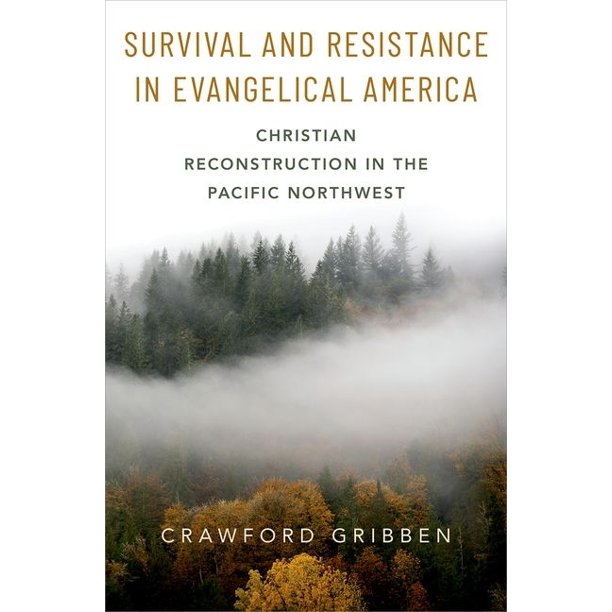
At the time, I assumed this was a solely Catholic conversation taking place. Yet upon reading Survival and Resistance in Evangelical America: Christian Reconstruction in the Pacific Northwest, I have come to realize that is not the case. Written by Crawford Gribben and published by Oxford University Press, the book details the recent migrations of conservative Christians communities to various pockets of the Pacific Northwest. Though there are distinct ideologies and denominations motivating each move – fears of decline, eschatological prediction, and desire for Christian community – the book chooses to focus on the most prominent group centered in Moscow, Idaho. There, famous – or infamous – Reformed pastor Doug Wilson leads the congregation of Christ Church. Wilson is controversial in many circles, yet his community has been steadily growing and gaining popularity, suggesting that his ideas are having a wider influence on American Protestants than many would like to admit.
The book traces the history of the politics and theology that motivate these groups to pack their things and start a new life in the wilderness of the Northwest. The central figure of this historical dive is Rousas Rushdoony, whose massive three volume series called The Institutes of Biblical Law, which is credited with giving birth to Christian Reconstructionism, which advocates for governments to make the Ten Commandments the foundation of civil law and for certain libertarian themes of economics, otherwise known as theonomy. Rushdoony in his work lists several examples of how this law would be applied; it is oddly progressive in some ways, such as the abolishment of prisons and limits on money lending, while also calling for extension of the death penalty to cover a host of offenses (Gribben, 8). Though many moving to the Northwest don’t hold to these ideas, some definitely do, and many being trained in the educational institutions of these communities hold to a host of illiberal principles that are in diametric opposition to the values espoused by the American tradition.
Though not adopting Rushdoony’s platform, many of the subjects interviewed in the book expressed goals and ambitions that aligned with Christian Reconstructionism. Gribben interviewed several students from New Saint Andrews College, a liberal arts Calvinist college that educates students in the classical tradition with a Great Books curriculum. Several expressed a desire to turn Moscow into a “Christian town” that would serve as the capitol for true, Reformed Christians. Some even considered the possibility of a national and later, a global influence as their community spread and its members set out for new lands to evangelize (54).
Yet they hope not to carry this mission out with some type of government takeover and establishment of a Christian theocracy. Rather than take a top down approach, the people of Moscow and others hope for an organic, grassroots movement that spreads locally, from county to county and across the states. As one NSA faculty member put it, “we preach the Bible, and see what happens next” (55). In a post-Christian nation like the United States, these Christians recognize that the federal government imposing laws on a godless nation will not solve anything. Instead, change must begin in the individual heart of a man who has accepted Jesus as Lord and who seeks to establish His Kingdom on earth.
The book itself is an excellent read. Not only is it entertaining and highly informative, but Gribben does a tremendous job of letting the ideas of theonomy and Christian Reconstructionism and the people who hold them, speak for themselves. He doesn’t inject his biases into his analysis or dismiss his interviewees as naive theocrats. Rather, he engages with these ideas on their own terms, accurately stating their principles and beliefs and allowing the reader to decide for themselves what they are worth.
What I found most intriguing about this book is the many parallels between the conversations being held in the Catholic world and what is happening simultaneously in the Protestant one. It appears as if the camps as described by Douthat have manifested themselves almost identically in certain Reformed circles, just with different labels. We Catholics have Integralists, while the Reformed have theonomists; we have Dreher’s idea of “the Benedict Option”, while Protestants have the American Redoubt; and Protestants in this debate see the major players in the likes of Doug Wilson and the work of Rouasas Rushdoony, while Catholics see debates between David French and Sohrab Ahmari, among others. Gribben even references certain thinkers such as Patrick Deneen and Alasdair Macintyre, who are prominent Catholic critics of American liberalism.
Regardless of how one feels about the tenets of Christian Reconstructionism and other forms of illiberalism, it would be unwise to ignore or dismiss them. Like it or not, these ideas are only growing in popularity, and as America further secularizes, more and more people will find these types of ideas attractive. We must avoid the temptation to display contempt and dismiss this movement out of hand. Instead, we should emulate Gribben’s work and seriously engage with adherents of Christian Reconstructionism if we want to provide an alternative.
But more importantly, regardless of where Christians of any denomination fall in this debate, we can at least agree with one sentiment espoused by the theonomists; politics will not save any person or any nation. Only Jesus Christ can do that. If we desire, in the words of the IRD Mission Statement, “to reaffirm the church’s biblical and historical teachings, strengthen and reform its role in public life, protect religious freedom, and renew democracy at home and abroad”, then we have to start on an individual level. Only by converting the man can we then covert society.
No comments yet


Leave a Reply