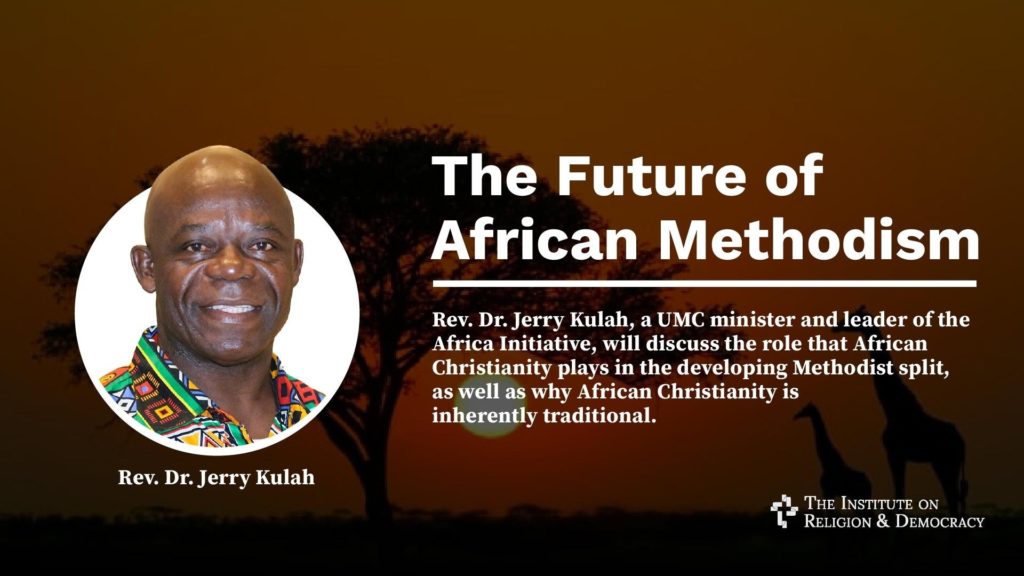
On May 31 at IRD in Washington, DC, Liberian United Methodist leader Jerry Kulah spoke about Africa’s role in United Methodist division. Transcript below.
Greetings everyone. I am the Reverend Jerry B. Kulah, the dean of the Gbarnga School of Theology [now Bishop John G. Innis Graduate School of Theology] at the United Methodist University in Liberia. I am very delighted to be here this evening. I want to thank Mark Tooley and the IRD for the invitation to be here and to share with you. I represent, like he said, the Africa Initiative. The Africa Initiative is an Association of African leaders, both clergy and laity, within the three central conferences of Africa. We are committed to fostering partnership, network, and fellowship among leaders of the annual and provisional annual conferences of Africa.
We are passionate about contributing to the holistic sustainable growth and development of the UMC in Africa. We’ve facilitated training in cross-cultural evangelization and missions, discipleship, leadership development, prayer revivals, and resource mobilization for annual and provisional annual conferences in Africa. We also work alongside African delegates for general conferences, to enhance their understanding of issues impacting the global church and facilitating their meaningful contribution in the process. By doing so, we have been able to enhance the growth of the church in Africa, and in raising the African voice within global Methodism.
This evening as I endeavor to share with you briefly about the Africa Initiative, the church in Africa, I want to commence with the scripture reference Jeremiah 6:16. Jeremiah 6:16 speaks of the children of Israel, Judah in particular, and her life as far as God was concerned. Israel was God’s people, but selected to abandon God, and abandon God’s Word. They selected to give themselves to idol worship and the cultural practices of the day that surrounded them in Judah. So God kept calling the prophets and inviting the Israelites back to Himself. In verse sixteen of chapter six of Jeremiah, God says through Jeremiah to the people, “Stand at the crossroads and look. Ask for the ancient path. Ask for where the good way is and walk in it. And you will find rest for your souls.”
That was God’s Word to them. But then as the passage continues, in verses 7, 8, God speaks about sending leaders who will sound the trumpet to remind them of the impending danger awaiting them. All of that God did, but Israel refused. The people of Judah refused. Consequently, they found themselves chained and dragged into Babylon and taunted to sing the Lord’s song in a strange land.
And I ask, “How can we sing the Lord’s song in a strange land?” We are tempted to see the Global Methodist church in this context, so what we have been doing is asking the church in Africa, speaking to the church in Africa, to stand at the crossroads that the UMC finds itself, and pursue the path that leads in God’s direction. The path that leads to the teaching of biblical Christianity, so that we will find rest for our souls. And by rest, God meant, peace, stability, His blessings, His guidance, and the ability to do what God wants us to do.
As I begin my talk, I want to say that the church in Liberia and most parts of Africa holds a debt of gratitude to the church in America. Especially to the Methodist church before it became the United Methodist Church. And we want to say thanks to the church in America, for facilitating the process of bringing the gospel to Africa and planting the seed of the Gospel in Africa. Some of the pioneer missionaries left here and came to Africa along with their caskets on the ship, knowing that they may not have the opportunity to come back to their families in America. And so we are so grateful. The first missionary to Liberia, Northern B. Cox in 1833, only survived for four months; February to July, 1833. When he knew that death was imminent, he wrote back to his home church on Edington St. NC, in these words:
“Though a thousand may fall, let not Africa be given up.”
By July, he went to be with the Lord. Realizing the gravity of his appeal to the Church in America, many followed, and planted a seed of the Gospel in Liberia and other parts of the word, beginning with Liberia in 1833. And as a result of that, we were taught Biblical Christianity. And we became committed to the teaching of Scriptures as we were taught by the missionaries. Today we go all across Africa, including Liberia, you will see a witness of their life in Africa; their graves all over Africa. A testimony of sowing the seed of the Gospel with their blood.
This brings upon us a point of deep commitment, to remain true to the BIble, to remain true to biblical Christianity. And so because we preach the Bible and endeavor to live as obedient disciples to Jesus Christ, the church in Liberia and in other parts of Africa continues to grow in leaps and bounds. The teaching of Scripture has helped us to greatly overcome the challenges of syncretism and polygamy that have been impediments to the practice of biblical Christianity in Africa.
So syncretizing has to do with combining traditional practices along with scriptural truths to be the Gospel. And that is, as a result, people being ignorant of what the Bible teaches. And polygamy has been also the practice. I come from a family of forty-seven children. My mother had eleven children, nine survived to adulthood and today we have about six surviving, left to face an uncertain future because of polygamy. But because of the teaching of Scripture, I cannot follow that path and many are not following that path. And today, we are able to practice viable, biblical Christianity in Africa.
In spite of this, we still have some challenges. One of the major challenges we have is discipleship. We want to be able to disciple the growing population of the African church with approaches that are culturally relevant and contextually appropriate. The church is growing in leaps and bounds, so that is what we are pursuing and attempting to do. Another is sustainability. We are seeking ways by which the African church might become self-sustaining, in addition to self-governance, self propagation, and self-theologizing. And thirdly, partnership; we want to establish healthy partnerships that will enable us to continue to accelerate the spread of the Gospel in Africa and beyond.
So this is where we are as a church in Africa. And as I do all of this, I want you to know that I’m speaking on behalf of the Africa Initiative. This body constitutes clergy and lay people all across the three central conferences of Africa. Why do I not speak for an annual conference or a central conference? I’m speaking for those who are concerned about the growth of the church in Africa and are engaged in the process, including all of our delegates that come to general conferences with whom we work.
So, in spite of all that we are going through and the growth of the church in Africa, we are deeply concerned about what is happening across global Methodism. And we have been endeavoring to speak to it, to create a witness across Africa, about what’s going on, in order for us to continue to keep our distinctives as traditionalist, as evangelical Christians who are committed to the teaching of Scripture and enduring to live the Christian faith and some of the current challenges that are confronting the global church are of deep concern to the African church.
One is they want the One Church Plan agenda that now governs the operations of the Council of Bishops. 2019, we were part of the process in St. Louis Missouri, where we debated the One Church Plan, the traditional plan. And after the debate, by general conference decision, we denounced the One Church Plan in favor of the traditional church plan. Because the One Church Plan, if it had passed, it would have legalized homosexuality, the practice of same-sex marriage, the ordination of gays, lesbian, bisexual, transgender people, as pastors within the united methodist church, and permitted to occupy any positon within the global church. We realized that was unbiblical and so we spoke against it, and we stood against it, and we voted it down.
But since that happened, the council of bishops has been accusing, the some members of the council of bishops who couldn’t endure the practice of same-sex marriage, the practice, all the practices that were voted against; so we are deeply concerned because we see the council of bishops, not as the kind of spiritual leadership that the book of discipline, the Bible describes them to be for the church. So we are deeply concerned as to whether they can continue to provide spiritual guidance for the growing church in Africa.
On that question we have the postponement of the 2020 general conference of 2024. We pleaded prior to the decision by the commissioned general conference, we pleaded with them, to not use the Africa situation, the difficulty in assessing visitor’s visas and the coronavirus situation as a basis for postponing the general conference, because we knew the United Church had the capacity to work along with stakeholders to ensure that delegates outside of America be able to come for general conference, or sit and interview, and come for general conference. We also offer Africa as a safe haven, as a global church, to transition the venue from America to Africa. We could have hosted the General Conference in Zimbabwe; Nairobi, Kenya; Johannesburg, South Africa; Abidjan, Côte d’Ivoire; but all our pleas were ignored. Sadly ignored.
So, a fortnight ago, about 92 leaders of the three central conferences in Africa convened in Nairobi, Kenya, to envision the next Methodism. To envision the future of the Methodist church in Africa. We deliberated on many things. The purpose was for a prayer and leadership summit. We spent time studying the Bible, we spent time praying, we spent time fellowshipping. But we also took time to reflect upon the past, understand the present, and anticipate the future for the church in Africa. We were blessed to have some of our Episcopal leaders in Africa at that meeting, and we all at the close of that meeting, came up with the following consensus, consistent with our commitment to live and practice and teach Biblical Christianity in Africa. Because as a result of teaching biblical Christianity, the church in Africa continues to grow in leaps and bounds.
And these are some of the consensus.
One, that the Africa initiative shall remain committed to its vision of a church in Africa that is Biblically committed, Christ-centered, Evangelistically functional, mission-minded, and self-sustaining, self-governing, self-propagating, and self-theologizing.
Two, that the Africa Initiative shall remain committed to its mission to train, equip, and empower pastors and leaders of the church to foster discipleship, leadership, and raise the voice of the central conferences in Africa within Global United Methodism.
Three, that the UMC in Africa should not be apart of a denomination that will change the current language of the Book of Discipline on human sexuality to legalize homosexuality, the practice of same-sex marriage, and the ordination of LGBTQIA+ plus persons as pastors.
Four, that the Africa Initiative shall continue to encourage churches and conferences in Africa to patiently wait for the 2024 General Conference, and continually advocate for the passing of the protocol for reconciliation and grace through separation.
Five, that bishops who reach retirement in 2020 across the central conference of Africa but could not officially retire due to the postponement of general conference be graciously retired and new episcopal elections take place this year. Now that the Judicial Council has ruled that the council of bishops can facilitate Episcopal elections in jurisdictional conferences, it is our ardent hope that the council of bishops will equally facilitate episcopal elections in its equivalent structure in Africa, which is the central conferences of Africa. For to fail to do so would be considered by us as a marginalization, and a gross denial of the right of the UMC in Africa to exercise its spiritual democracy of electing its new episcopal leaders as the jurisdictional conferences would do in the United States.
So these are some of the consensus that we arrived at a fortnight ago in Nairobi Kenya, and these are some of the issues that concern the church in Africa, reflected in our conversation as leaders of the Africa Initiative. And so my dear brothers and sisters, I want to thank you for the invitation to share with you briefly. I’m glad to share with you these thoughts and I’ll be happy to interact with you over the next few minutes, with any questions you may have concerning the church in Africa. Thank you very much.
My question is, how is this impacting Methodists on the ground, in the churches? Do the rank and file know about what’s going on, and is it impacting the people in the pews?
Okay, and thank you very much. The issues are really unknown to a majority of the people who are in the pews. The reason being that, unfortunately some of the Episcopal leaders have not taken up the issues to discuss at the local church’s level, district conference, or annual conference level. Some of our bishops are mute on the issues. And as a result, our people are kept in the dark. And that’s the reason why the Africa Initiative has been going all out, you know, to try and provide education for general conference delegates and for key pastors and leaders so that they will go back to their local churches, their district and annual provisional conferences, to disseminate the information.
And we continue to encourage our bishops that the good thing for the church in Africa is not to keep the information away from them, not to persecute the pastors who are trying to discuss the issues regarding the protocol regarding homosexuality, you know, but to share the information because information is power. Information is liberation, and we want to have our people liberated because they know the truth. The scripture says that in John chapter 8, “You will know the truth and the truth will set you free.” But to keep our people in the dark is not the best thing. Unfortunately that is what is happening right now, but we are doing our best to reach out and share the information.”
I had a question regarding syncretism. You mentioned syncretism as a challenge the church is facing in Liberia and in West Africa. What are some of the ways that syncretism is manifesting itself inside of churches, and how are people preaching the gospel, people pushing back against that?
Ok and thank you. Syncretism has to do with traditional practices and syncretism can be practiced anywhere, by any group of people, even here in the United States. It’s simply bringing your traditional practices to obey upon Scriptural truth. It’s like the Judaizers, who will say circumcision plus following Jesus Christ equals salvation. So that’s a form of syncretism when you bring the traditional practices for Judaism and attitude into Christian teaching.
And so in Africa the same way. Prior to coming to follow Jesus Christ, many African leaders were involved with traditional practices such as consulting the shrine, going to the oracle and trying to hear from God, and using other mediums as a mediatory channel to reach God. And then when Jesus Christ comes into the picture, we see him as that medium through whom we can now speak to God.
But sometimes, while some are trying to do that, they still come along with their bagges in the process, because of the lack of scriptural understanding. And so what we need to do is to prioritize discipleship, that is culturally relevant and contextually appropriate. So our people are able to distinguish traditional practices from biblical practices. And so that is what we are doing; syncretizing has been a challenge and we’ve been working on it and we are making lots of progress.
So my question is, I come from the Catholic tradition, and I’m not sure, I’d like your perspective on this; are other Christian denominations facing the same kind of syncretist things that your church is going through in Africa, you know, is the same thing happening to Baptists or even other religions at large; are Muslims seeing this syncretist movement within their church, within their tradition, are Jews seeing it as well? If you could comment on that, I’d appreciate it. Thank you.
Well, yeah, thanks very much. As an evangelist, in Liberia, and beyond Liberia, Sierra Leone, Ghana, Nigeria, I’ve had opportunities to work with pastors and work with church leaders, okay. From different denominations, in Liberia, from different denominations. So, we have a common need, a common challenge that we are all dealing with. So, alright, syncretism, the present syncretism is not limited to one denomination, has not been limited to one denomination, we all have been dealing with this and we see that a common need is discipleship.
Our people have come to embrace the Christian faith. But until they know what they believe and why they believe what they believe, it’s so easy to come along with your traditional past, you know. One of our professors in Africa, Imasogi from Nigeria, he emphasized discipleship very strongly because he says, “if we don’t do effective discipleship, in a time of existential crisis, our people, it’s easy for them to revert to their traditional past.”
And so that is the challenge that we are faced with and we are working at it. And right now as I speak to you, discipleship is a major concern for me that I’m pursuing right now, to ensure that I’m able to develop a document that will be relevant towards the growth of the church, in Liberia in particular, and in Africa in general.
If I understand you correctly, even though some traditionalists in America don’t want to wait for the general conference in 2024 and are moving out of United Methodism, Africa is not going to follow that path, and will remain until the General Conference meets and votes on a protocol for separation. Is that in fact the case, and as the church divides, will all of Africa be with the traditional side, or will Africa itself be divided like the American church?
Well, thank you very much. I see two parts to your question. The first one has to do with the Africa Initiative encouragement to the church in Africa to go to 2024. We are not happy that we have to wait till 2024. We wish the General Conference would have taken place this year in the late August into early September, and we still think that it’s possible if the leadership is willing to see things as we are seeing it, because COVID was considered as the situation that necessitated the postponement, also the visitor’s visas. So we still feel that the church is able to move in a direction to make sure that we can have general conference earlier than they have postponed.
Well, for looking at all the different factors associated with the general conference, in Africa the general feeling is that we don’t want to be seen as a breakaway, we want to continue to remain apart of the church, and go continue to support what we all agree upon, the protocol of reconciliation and grace through separation. So we go to General Conference and make the decision to amicably separate. Because we amicably separate, we are not enemies; we are brothers and sisters, we continue to work together. We don’t hate anybody, we just don’t have the same understanding, belief and practice about Scripture. And we think that it’s so critical to make sure that you can serve God, you know, completely as you understand Scripture, so that you don’t continue with conflict.
However, having said that, we do not, we don’t have the authority to stop anyone from going ahead, to maybe move away and start a new denomination or become a part of a new denomination. Because we all don’t wear the same shoes, we all don’t “feel the same pinch in the same shoes,” like we say in Africa. For example, in Liberia, my bishop is a traditionalist, the entire conference is traditionalist. In Côte d’Ivoire, the entire conference is traditionalist, in Sierra Leone the conference is traditionalist, in Nigeria the conference is traditionalist. I can speak for the West Africa Central Conference because they’re where I come from. Africa Central Conference, almost all of them are traditionalist, okay?
Except for some key leaders who have alliance now with progressives in America and are doing some things otherwise. The same for the Congo. We have some progressive leaders, but it does not mean that the pastors and the ordinary people are progressive. However, the situation for Liberia, Côte d’Ivoire, Nigeria and Sierra Leone, are quite different from what’s happening here in America.
So if the American church chooses to not wait, we cannot stop them. We do not have the authority to stop them. Neither do we have the authority to stop anyone in Africa. We could not hear from our brothers and sisters in parts of Africa, especially in the Congo, who say to us, “Yeah, you are saying to us that we should wait till 2024. But why should we wait, when we have been expelled by our bishops from the United Methodist Church? And the council of bishops knows about it, and has done nothing about it? Why should we wait, when we are being kicked out of our job, and kicked out of the parsonages where we are staying, we are not even permitted to go to church. So why should we wait? Alright so you are telling us to wait. We think we might want to go ahead and get church started or be a part of the new denomination that was just birthed because it’s useless to wait.”
So, that is what we hear from North Katanga, where pastors are being persecuted, and names deleted from that delegation’s list and expelled from churches and all of that. That’s what we even hear from the Central Congo where a pastor was even jailed for sharing information on the protocol and homosexuality. We hear that in other parts of the Congo, and they’re saying to us, “Yeah, you are encouraging us to wait. But we are not too sure we want to wait because we got nothing to wait for.” So this is the situation with some of the churches in Africa.
Then also, your second question had to do with, can you please remind me what your second question was about…
That in five to ten years, when the church has divided, and the more liberal part of the United Methodist Church in the U.S. has changed the sexuality teachings, will all of Africa, will almost all of it be in the traditional global church or will Africa be divided?
Well, thank you very much. At the moment, Africa is not divided on the major issues. What are the major issues? We want to practice biblical Christianity, and the progressives and liberals are saying, they have a progressive mindset, and there are better things than what we have now, and the Bible has probably become obsolete and irrelevant for the needs of the church now, and move ahead and do other things and follow maybe cultural Christianity wherever.
And we say no. And that’s, those are the issues, and all of Africa has a common consensus on this, the issue of homosexuality. The African church has a common consensus on remaining biblical, as far as marriage is defined, between one man, and one woman, not two consenting others. Not a man and a man or a woman and a woman. So, we have a consensus on that, and the consensus is not only limited to the church. Politically, we have a consensus almost all across Africa, and culturally, we have a consensus almost all across Africa, and scripturally, we have a consensus.
So, those are the things that define us as a traditional Evangelical church in Africa. So, at the moment we are, but I can let you know, as pastor and leader of the Africa Initiative and leader of the three central conferences, I want you to know and pray for us. There is a subtle silent invasion of the church in Africa by the progressives. And sometimes we wonder whether the delay of the General Conference is a strategy to ensure that there can be a massive silent invasion of the church in Africa to the extent that you will have a split in some of the annual conferences so that when the separation takes place, you will still have a presence of the church that aligns with the progressives and the liberals, and then you will have the traditional church.
So, I don’t have any idea if this will happen, but we are very concerned that there is a silent, subtle invasion. Why is this the case? Africa generally is poverty stricken. Not as if we don’t have resources; for example, Congo, one of our largest annual conference areas or Episcopal area, it has a lot of wealth. But the wealth is not benefitting the ordinary people. Alright, the political leaders and other leaders are using the wealth, and so there’s abject poverty across Congo. There is abject poverty across most parts of Africa. And so leaders, some leaders, are easily persuaded by resources, in order for them to change their traditional stance.
So right now, as I, as I speak to you, there are some bishops in Africa who are ill treating their pastors and leaders who disagree with the progressive One Church Plan, because now they are aligned with friends and fellow bishops, and other people in the United States to silence their leaders who are promoting, providing information on human sexuality to provide education for the people in Africa. So this is the dilemma we are faced with, and only God can help us.
And we are going to pray, we’ll continue to share information because information is power, information is liberation. So these are the challenges. So this might possibly be the case, where in some annual conferences, based upon the silent, subtle invasion that is taking place might eventually lead to the splitting of the denomination so that you have some people following the current bishop who has an alliance here to maintain a progressive presence in the church in Africa, but I can tell you they will not have a successful publicity; I can tell you that for sure.
The church in Africa is determined to remain traditionally evangelical because we see the fruits of Christianity in Africa. And so even if that were to happen, I submit to you that it will not last. The political system in Africa will not allow it to last, and the cultural system of Africa that is consistent with the teaching of Scripture will not allow that to last. And so that’s how I see it and I’m praying that God will help us and our people will know the truth, and the truth will liberate them. Thank you.
How in terms of cultural relevance, how in terms of promoting traditionalism, how are you using technology to promote that message, so that it reaches younger generations?
Right, well thank you very much. Technology has taken a foothold in some countries in Africa, but not all of them. And because of the poverty-stricken condition in Africa, electricity is a huge challenge, even access to the internet is a huge challenge. But the young people like yourself, are doing everything to keep abreast of what’s going on through technology and otherwise.
So what we do every month is have a Zoom meeting. A Zoom meeting with leaders, key leaders across the three central conferences of Africa, and we share information in hopes that they will take this information, disseminate them, into the towns and villages. That is what has been happening in the towns and villages where there is no electricity, and where there are no other legs for people to have access to maybe the internet and all of that. But in a city, where we have access to these facilities, the young people are equally on board.
Alright, but some of them are very very angry, so that they went to the General Conference in 2019 and voted for the traditional church. And now in Africa, the name the United Methodist Church is well-respected and honored by the political leadership in almost all the African countries and by the ordinary people in the community because of the services we render.
Now, I want to proclaim the Gospel by providing wealth for the community, providing education, providing hospitals and clinics all over the place. They wonder why we should abandon the name United Methodist when it has so much value. That would probably be the opposite in America where people do not want to identify with the name United Methodist because it means something else, and so we’re struggling to provide clarity to them and to help them understand that we were not initially called United Methodist.
You had a Methodist Episcopal Church here, and later on came into amalgamation with EUB, to be called, so as important as the name is, as good as the name is, it is not more important than the biblical and scriptural values that we bear. So if it means we abandon the name because of our traditional beliefs, we may have to do so. But just to let you know some of the issues that are going on, when they think about what’s happening, and why we should abandon the name and why those who were defeated are taking over the name and keeping it, and doing the different things that they are doing.
But they are getting on; the young people are getting on, and it takes a lot of investment into time to disseminate information, provide clarity, and this is what we are doing at general conference. We are just coming from Nairobi, inviting the delegates and bishops and other key leaders to know the information at that meeting where we invited the Global Methodist Church to come and give us their package. What is it about the Global Methodist Church, so that the African church has options as we move forward, and then we also think very strongly that why we are, we want to see the General Conference happening as soon as possible, and don’t have to wait until 2024. If those who are in authority still insist that we would wait till 2024, we will endeavor to see it as a blessing in disguise in order for us to be able to work very hard towards the sustainability of the church in Africa.
Because that one challenge we have had, the global church, the way the church had operated in the past, we’ve had partnerships here, there that have supported major capital projects in Africa, but because of the current situation, many of the partners have abandoned the partnership, and don’t want to help churches in Africa anymore. But by the grace of God, we are a resilient people. We’ve gone through many difficulties, for like Liberia went through civil war from 1989 to 2003, we survived it. When we went through the Ebola crisis, we survived it. The coronavirus came, and God helped us, and it was not alarming in Liberia and parts of Africa. We survived it.
We can survive the current situation but we need to put our hearts in order, and determine ways by which the church in Africa can be self-sustaining, and not depending on resources from overseas. That does not mean that we will not still foster partnership; we will foster partnership because we want to be a global church. We want to be a part of a global church. We want to be a part of a global church that is biblically committed, Christ-centered, Holy Spirit empowered. You know, vision-driven and mission-minded.
Dr. Kulah thank you for coming from such a far land, here to Washington. My question for you is: Do you have any examples of, or thoughts of how missional partnerships have broken down? When the relationship between Africa and some of the US progressives has struggled since 2019? If there’s a breakdown, how would those partnerships with evangelicals in America, Methodism, get connected with Africa? That’s three questions, I think.
Yes, well, thank you very much. I can tell you for a fact that several partnerships have been broken down. After the General Conference of 2019, one of the leaders of the progressives was so angry, he said, “Well, let them go with their votes, we will go with our money!” He made that statement. And then I got to understand that he does not understand missions. And he defines missions as money, maybe a father-son relationship–the father has the resources and the money and sends it to the son–and does not see that if God has blessed you with financial resources, if God has blessed me with the gift of evangelism and discipleship to raise members in the church and God blessed you with resources, and we put those together, we can accelerate the spread of the Gospel.
He did not see it that way. He thought that he’s in a more privileged position, so if we voted down the One Church Plan, we can go over with our vote for the traditional plan and he and others will go with their money. At the Tampa conference on the 12th, a lady being very annoyed because we voted down the progressive plans, she walked up to the finance people and said “Look, how much is the central conference contributing to the run of the global church?” And the man said, “Well, the American church contributes about 99% and the Central Conferences including Africa contributed about 1%.” And the lady was so annoyed and she said, “Then let them put their mouth to where the money is.” In other words, all the practices that they are trying to bring into the church, that are unchristian and unbiblical, the African church should not speak to it, because they are not providing financial resources.
We do not see that only as an insult, but as a challenge to the church in Africa, to wake up the reality of the time; that if we do not do what we need to do, people might want to use financial resources to compromise the Gospel; to make us compromise the Gospel in Africa. And those benefactors who are responsible for the presentation I made in 2019 on the 23rd of February prior to the vote that was taken on the 26th of February; they say to the progressives and the liberals in America, that we will not compromise the gospel for American dollars. I said that not because we do not need financial resources to support our work in Africa, but if financial resources from America will serve as a price tag for compromising the Gospel, we don’t want such dollars. And that’s the message I was trying to pass on.
I have been a dean for the Bangalore School of Theology. We have had partners here in the U.S. who were supporting us annually with some resources. But then one of the pastors in the U.S. asked me about my stance, and why I was doing what I was doing. When I shared with him, from that day, the partnership ceased. And then following my presentation, another presentation I made, one of the conferences in Europe had the audacity to write to my bishop and say, “Well, I want to know whether the position of Jerry Kulah, is the position of the Liberia annual conference, because that will serve as a determining factor for whether we can continue partnership with the Liberia conference or not.” Trying to threaten my conference because of our traditional position!
And so I could go on and give you lots of other examples, not only of Liberia, but even the Kenya and Ethiopia annual conferences; and other conferences in other places in Africa have had those challenges. But we have not relented. We have continued to stand resolute, we continue to move forward looking unto Jesus who is the author and perfecter of our faith.
Now going forward, as I mentioned, we need partnership. We need partnerships that will be mutually benefitting. We need partnership because that is what the church is all about. I was studying 1 Chronicles chapter 19 about the Davidic army going against the Ammonites and when Joab the commanding general made a very powerful statement. When he saw that there were battle lines before him and behind him, he invited Abishai his brother who was the deputy commander and he said to him, “Take on the Ammonites and I will take on the Arabians, and let’s fight bravely for our people and for the city of our God, and let God’s will be done. If you see that the Arabians are defeating me, you will come and help me and if I see the Ammonites are defeating you, I will come and help you. But let’s fight bravely for the sake of our people.”
And so that is how I see partnership, mutually benefitting, working to benefit our people; the people whom God has entrusted to our care, to disciple. To coach and mentor, and make leaders of leaders, who can reach out, and make more disciples of Jesus Christ. So that someday God’s kingdom will be established here on earth as it is in Heaven. That’s partnership, and I trust that as we move forward, traditional churches and leaders here will consider partnering with Africa Initiative, will consider partnering with annual conferences across Africa, so that we would, together, continue to accelerate the spirit of the Gospel of Jesus Christ. Making disciples, obedient disciples, obedient to Jesus Christ, consistent with the word of God. Thank you.



Comment by John Kenyon on June 3, 2022 at 6:16 pm
Looks like Kulah has stimulated the growth of a hair on one of Beaver’s balls,
Comment by Jeff on June 3, 2022 at 11:09 pm
Come on back when the alcohol and drugs wear off, John.
Comment by Donald on June 4, 2022 at 6:46 am
Praise God for Dr. Kulah!
Comment by David on June 5, 2022 at 4:15 pm
I do not recall any proscription against polygamy in “God’s Word.” Indeed, multiple wives appear with Jacob (Gen. 26). Of course, the Bible is a cafeteria with some things taken and others not.