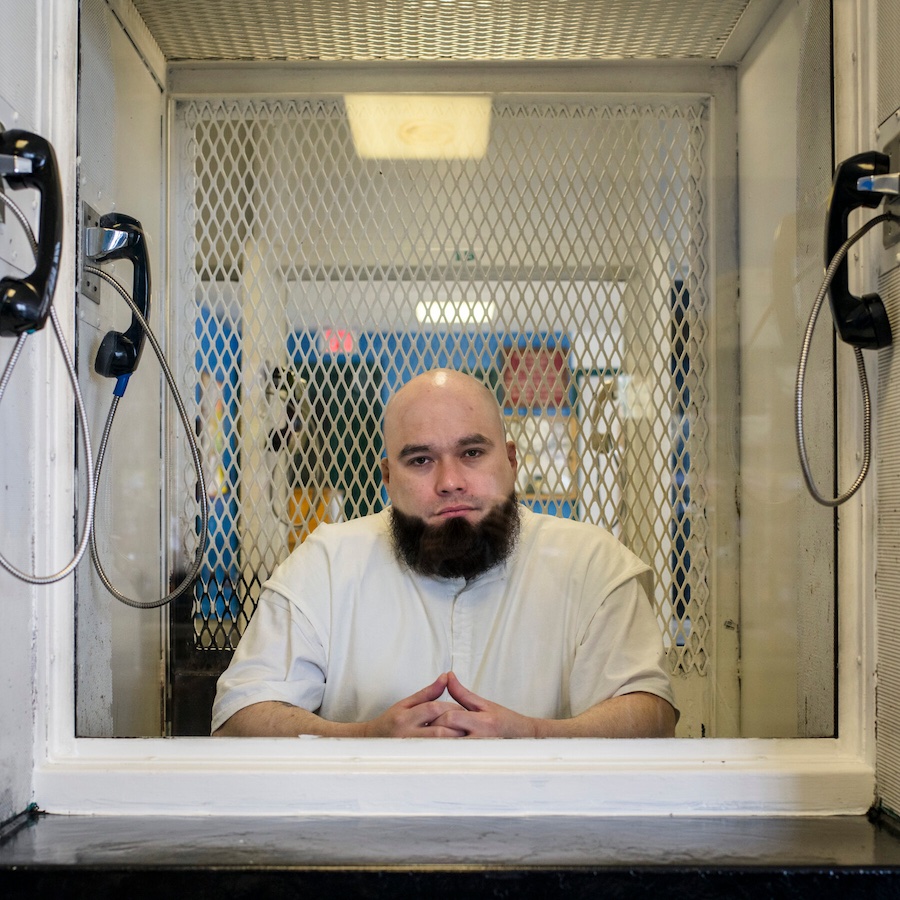

A Texas death row inmate will be allowed to have a pastor lay hands and pray over him while he is executed, according to a Supreme Court ruling issued Thursday.
Religious liberty remains a foundational distinctive for the Southern Baptist Convention, and the denomination’s public policy office, the Ethics and Religious Liberty Commission (ERLC) took an interest in the case.
John Ramirez was found guilty in the 2004 murder of Pablo Castro, and was sentenced to death by a Texas jury. Before his scheduled execution on February 2, 2017, Ramirez filed a prison grievance requesting his Southern Baptist pastor be able to “lay hands” and “pray over” him during his execution. The ERLC was part of that original request.
“There is little evidence that spiritual advisors present underlying security risks that would necessitate banning them from engaging in audible prayer or touching the prisoner,” write policy staff of the ERLC.
Texas denied the request, which Ramirez appealed, arguing that the refusal violated the First Amendment and his rights guaranteed by the Religious Land Use and Institutionalized Persons Act of 2000 (RLUIPA).
The RLUIPA protects individuals, houses of worship, and other religious institutions from discrimination in zoning and landmarking laws. The Federal Code states “No government shall impose a substantial burden on the religious exercise of a person residing in or confined to an institution.”
An ERLC-endorsed brief argues that the state failed the “least restrictive means” test established by the RLUIPA.
In an explainer published by the ERLC, The Least Restrictive Means test is described as “a standard imposed by the courts when considering the validity of legislation that touches upon constitutional interests. If the government enacts a law that restricts a fundamental personal liberty, it must employ the least restrictive measures possible to achieve its goal.”
In response, the State of Texas banned prison chaplains from its execution chamber after the U.S. Supreme Court ruled that the state could not execute an inmate without allowing a Buddhist chaplain into the chamber to pray over him.
After the District Court and Court of Appeals declined, the Supreme Court granted certiorari (review of the lower court decision).
Chief Justice John Roberts delivered the majority opinion of the court after five months of deliberations, granting approval for Ramirez to have his pastor present.
Roberts cited examples of similar prayer traditions throughout history, writing “As for audible prayer, there is a rich history of clerical prayer at the time of a prisoner’s execution, dating back well before the founding of our Nation.”
Although Texas allowed prison chaplains to pray with inmates throughout its history, only recently did the state prohibit it, claiming that “audible prayer might impede their ability to hear subtle signs of trouble or prove distracting during an emergency.” Prison officials also noted that “allowing spiritual advisors to pray aloud during executions could be exploited to make a statement to the witnesses or officials, rather than the inmate.” The state of Texas argued that the statements could cause further trauma to the victim’s family and interfere with the execution.
Respondents argued that allowing a pastor to touch the inmate would place the clergy in harm’s way, stating “the inmate might escape his restraints, smuggle in a weapon, or become violent.” The respondents also argued that permitting the pastor to lay hands on the inmate could result in the tampering of restraints or pulling out the intravenous line.
“We do not see how letting the spiritual advisor stand slightly closer, reach out his arm, and touch a part of the prisoner’s body well away from the site of any IV line would meaningfully increase risk,” Roberts wrote.
Associate Justices Breyer, Alito, Kagan, Gorsuch, and Barrett joined Roberts in the opinion. Associate Justices Sotomayor and Kavanaugh wrote concurring opinions, while Thomas dissented.
In Sotomayor’s concurrence, she explained why clear rules are needed to govern the “presence of spiritual advisors at executions.”
“The RLUIPA requires commitment on both sides to achieve a timely resolution of disputes… Incarcerated individuals should know that delays in raising their requests can result in denial. They should not, however, be penalized for delays attributable to prison administrators,” Sotomayor wrote.
Kavanaugh’s concurrence continued the thoughts of Roberts and Sotomayor, adding language to three different areas: the recent history of litigation involving religious advisors in execution rooms, the difficulty of applying RLUIPA’s compelling interest and restrictive means standards, and the state execution procedures going forward.
Thomas dissented, “Because I think Ramirez’s claims either do not warrant equitable relief or are procedurally barred.”
“Congress created a potent tool with which prisoners can protect their sincerely held religious beliefs. But, like any tool, it can be wielded abusively. And few have a greater incentive to do so than death-row inmates” argued Thomas.
Following the 8-1 decision, ERLC Acting President Brent Leatherwood praised the ruling, “this is a significant affirmation of religious liberty. The Supreme Court affirmed that religious freedom does not end at the execution chamber door.”




Comment by David on March 30, 2022 at 7:15 am
A better decision would have been to strike down the death penalty altogether. Much of Europe and a number of US states consider it barbaric.
Comment by Jeff on March 30, 2022 at 12:38 pm
Hey David, how about this? We outlaw abortion and the death penalty and euthanasia in one single federal law! Are you in?
Comment by David on March 30, 2022 at 3:50 pm
A fetus does not have the same status as a born person. A large percentage, if not a majority, of human conceptions, perish in the first six weeks. God, by his actions, clearly favors abortion assuming he is involved in reproduction. Voluntary euthanasia is a personal choice that is morally justified if there is no hope of recovery and great suffering. It is not for cases when a person simply feels sad.
Comment by Jeff on March 30, 2022 at 5:48 pm
So you, David, would think nothing of murdering an innocent baby one day before she was to be born, and set free a murderer that killed ten innocent babies one day after they were born.
Glad you are not in charge!
Comment by Steve on April 2, 2022 at 9:52 am
“Does not have the same legal status” was pretty much the reasoning behind the Dred Scott decision. Just substitute the word “fetus” for the phrase “black man”.
Comment by George on April 3, 2022 at 11:52 pm
Has the SBC become woke ? Why is the proximity of the spiritual advisor so important as to delay justice for the innocent victims? I believe people’s hearts can be changed and God’s forgiveness shared with even the worst criminals but give me a break !!! What is next ? There is no telling. These condemned individuals have committed the worst sort of crimes . Caused indescribable pain to victims and to their families. Then the wheels of justice is stopped for this ? The families in most cases never had a chance to hold the hand of their loved one at the end of their lives. This is just more woke liberal gobble-de-goop. This is as much about the spiritual advisor who wants to be able to touch the condemned as they die. Like it makes a difference? Please, spare me.
Comment by George on April 4, 2022 at 11:32 pm
And furthermore, I really doubt our scotus has any idea of the can of worms they have opened up with their I’ll advised decision. I believe most of the justices are Catholic and visualize a priest quietly and reverently saying a prayer while touching the hand of the condemned. I really doubt that any of them ever witnessed a Pentecostal preacher all worked up and full of the spirit putting on a show . I can see it now. Dancing and prancing and screaming as well as pounding his hand on the condemned man. It will be a circus of distraction for those trying to do their job and what about the family members of the murder victim. And don’t think this won’t happen. Don’t forget the warlocks and witches.
The devil worshipers too. We must be fair and let all spiritual advisors in on this. What were they thinking ? They weren’t.