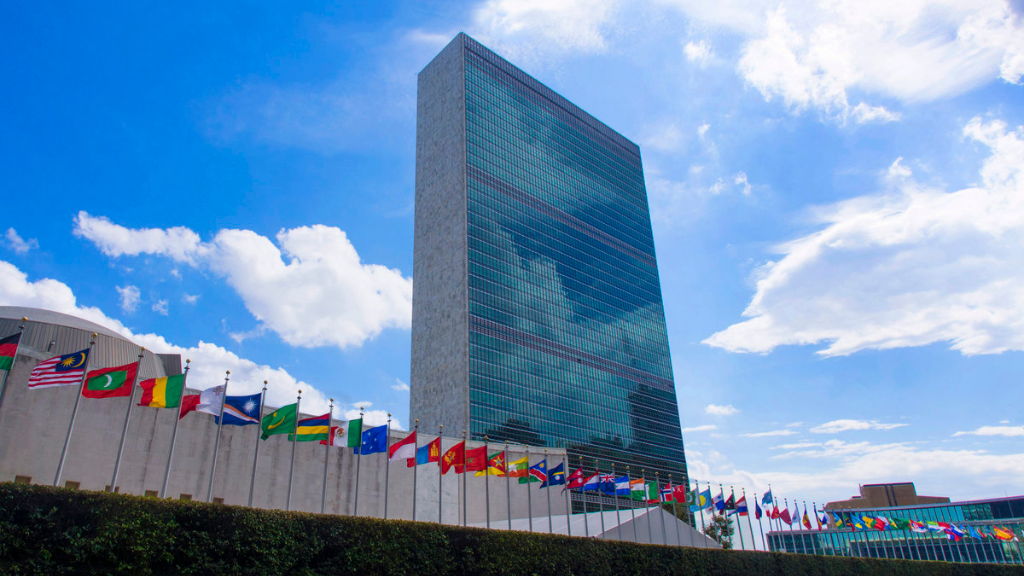
The Richard and Betsy DeVos Center for Religion and Civil Society and the Alliance Defending Freedom presented a panel discussion on emerging threats to religious freedom from progressive policies at the Religious Freedom Institute’s 2021 Religious Freedom Summit on July 13.
Joy Mdivo of the Evangelical Alliance of Kenya discussed the insidious efforts in Kenya to use the law to advance the sexual revolution, while simultaneously denying that this is happening. Kenya, it was noted, is a gateway to sub-Saharan Africa, and apparently is targeted as a way of imposing the sexual revolution and its axiom of moral autonomy on a region of the world still strongly committed to traditional sexual morality and the right to life.
The driving force in this intrusion into African society is the now secularized West, United Nations agencies and non-governmental organizations (NGOs) who consider the sexual revolution and its doctrine of moral autonomy to be their gospel. She referred to this as “ideological colonization.” It is a different kind of disagreement with the West than non-western peoples had during the colonial era, when they were ruled by Western governments. No longer is conflict about political control of a region by a colonial power. Instead, “we are seeing more and more attacks on our conscience.” It is about the use of foreign aid by western countries or international agencies in the interest of “helping” developing countries. Pro-abortion, pro-LGBT, and generally policies that favor non-marital sex are advanced in the interest of “improving health care.” One gets “a slap on the wrist if one disagrees … [Yet] religious liberty is one of those liberties that has been hard fought through history,” she said. The difficulty today, in Africa as in the West, is that it is opposed by a concept of “health” developed by Western elites opposed to traditional religious and moral beliefs.
Foreign actors in Africa not uncommonly look “for cultural change using legislative solutions … the very laws are being used to change the culture.” An insidious way this colonialism advances is by the use of attractive language. Mdivo called this “U.N. language.” The code words in this language can then be “expounded on” to require the sex related and abortion policies common in the West. Many Africans do not understand what these words mean. “Inclusive society,” or “health” would be examples. Thus, while Kenyan law declares human life to exist from the moment of conception, it also allows abortion in the interest of “health.” “Health” finally is understood to mean (as is the case in the United States) simply mental distress at an unwanted pregnancy. The U.N. and NGOs both use attractive terminology to advance the LGBT and abortion agendas. There is often a lack of awareness that this is happening. But the general environment introduced by comparatively small changes can result in a change of values. For instance, contraception is now freely available, beginning the de-coupling of sexual intercourse from child bearing. More awareness and vigilance of the intrusions of the new sexual colonialism is needed, she believes.
Thomas Henriquez of ADF International discussed the situation for religious freedom in Latin America relative to the sexual revolution. He said that religious freedom is a doctrine which is underdeveloped in Latin America. Political and social rights, on the other hand, are better developed. In the United States, church autonomy was strongly protected by the Hosanna Tabor decision in 2012, which said that religious bodies could choose their own ministers and religious teachers entirely by religious standards. But in Latin America, this freedom is “very much at stake.”
Possible action from the InterAmerican Court of Human Rights currently threatens religious freedom in two particular areas, parental rights and church autonomy, Henriquez said. These are both involved in a current case before the court, Sandra Pavez vs. Chile, which involves a religious education teacher in a public school who taught courses in Catholicism (in Chile all religions represented in a student body may have teachers in public schools charged with teaching that particular religion to students whose parents consent). Such teachers must be certified to teach by religious authorities in their particular religion. Pavez had taught Catholicism for twenty years when, in 2007, diocesan authorities became aware that she had entered into a same-sex relationship. The diocese then revoked her certificate to teach religion, although this left her ability to teach other subjects unaffected. She then sued. Pavez lost her case in Chilean courts, including in Chile’s Supreme Court, but unlike the United States, it is possible in Chile and in other Latin American countries to appeal to international bodies.
The Inter-American Commission on Human Rights agreed that she had suffered illegal discrimination, even though she was teaching specifically Catholicism, not a secular subject, or even comparative religion. If there is a final decision from the Inter-American Court of Human Rights that sexual orientation may not be discriminated against in the case of religious teachers, it would gravely imperil the right of religious bodies across Latin America to set their own religious standards. A decision for Pavez could push religious education with parental consent out of public schools, but would also have the implication that private religious schools cannot set their own standards, since it is discrimination in the choice of religious teachers that is being considered. Currently, religious authorities and parents have the power to determine how religious education is conducted.
Also at issue in Chile is the Comprehensive Rights of Children bill, which would mandate “comprehensive” sex education for all children. “Comprehensive sex education” really teaches the normalcy of non-marital intercourse, and thus contradicts much religious teaching about sex. The push in Chile and other Latin American countries is thus to make sex education of children secular and non-binary. This, Henriquez said, clearly contradicts international standards that “all people have a right to have their children educated in their moral and religious beliefs.”
Finally, the advent of gender ideology is causing grave difficulty for religious freedom in Mexico. Baptismal certificates indicate a person’s natural sex, and determine eligibility for marriage, and any other sex related matter in the church, such as ordination to the priesthood. However, people are now “demanding that the Catholic Church change their baptismal certificates” to reflect their self-determined “gender identity,” Henriquez said. “Live and let live … is obviously an illusion.”
Bernard Randall, an Anglican priest and chaplain in Great Britain provided another account of how attractive language is being used to advance the sexual agendas of the Left. He taught in an Anglican school, and the problem he recounted began with the implementation of a program to “prevent homophobic bullying in school.” Preventing bullying is hard to argue with, but as many have come to understand, what a program of this type means in short order is that there can be no opposition expressed against homosexuality and gender identity. The program was designed to “educate and celebrate” SOGI identities. People were required to speak to “smash heteronormativity.”
Randall then delivered an address in chapel in which he said it is legitimate to believe, as many people do, that biological sex is real, and that marriage is properly between one man and one woman. For that, he was fired. He was reported to the police as a potential terrorist, and to child protection services. All this because he was a “Christian chaplain, at a Christian school, saying Christian things.”
Randall was eventually re-instated, but censored in what he could say. Currently Christian Concern and the Christian Legal Centre are helping the Anglican priest in his lawsuit against an Anglican school, an institution of his own faith, for religious discrimination. Randall said that the extremism of LGBT ideology must be stopped, otherwise even people who deviate even moderately from its party line will be persecuted. He said that Western countries must model religious freedom consistently themselves if they are to advocate for it in the non-western world. He observed that “Christianity … gave up on heresy trials a long time ago, but the woke still think it’s the way to go.”
In a question and answer session, it was observed that the world is becoming a global village. The globalist agenda in favor of social liberalism is very organized. The struggle over sex, marriage, the family, and the right to life is one-sided. What, it was asked, can be done about this? Henriquez said that diplomatic action and the ability of social and religious conservatives “to fight in courts of law” is key. Even so, it may be hard to “stand up to the weight of progressive ideology.” Randall responded that LGBT ideology is actually a religion. Treating it as such would make engagement with it easier than confronting what is presented as “unquestionable fundamental rights.”
It was asked why religious freedom is particularly important. Randall responded that religious freedom is a “canary in the coal mine. It tells you what’s going on in society.” The loss of religious freedom is indicative of the potential loss of other fundamental rights. Mdivo said that prohibiting discrimination on the basis of religious precepts really destroys religious freedom, because people cannot live their lives on a religious basis. Randall added that what is happening now is that the state is really persecuting “heretics.” Henriquez said that we should be ready to enter into dialog with others about religious freedom. He observed that every major religious group signed on to the amicus brief in the Perez case. Mdivo said in this regard that all religious groups in Kenya worked to defeat the groups advocating “reproductive health.” They are also working with “like-minded groups in other countries to make them aware of what is going on.”
What is going on is that a Western cultural elite, acting through international agencies, is endeavoring to destroy the sexual morality known (with local variations) from antiquity, and set a global standard of moral autonomy in sexual matters, really on the basis of their own moral intuition. One cannot speak of evidence in a project to change humanity. Defenders of religious freedom must point out that this is the true imperialism and colonialism. People should be free to follow their conscience in obedience to God.




Comment by David on July 23, 2021 at 8:59 am
The fact is that is it mainly Evangelicals that are pushing their agenda in Africa. Here are but a few articles on the subject.
https://www.thenation.com/article/archive/its-not-just-uganda-behind-christian-rights-onslaught-africa/
https://www.opendemocracy.net/en/5050/africa-us-christian-right-50m/
https://www.vox.com/2014/5/19/5724166/the-story-behind-how-american-evangelicals-imported-homophobia-to
https://harvardpolitics.com/globalizing-hatred/
https://www.dw.com/en/why-is-homosexuality-still-taboo-in-many-african-countries/a-51528737
Comment by David S. on July 23, 2021 at 3:33 pm
“She referred to this as “ideological colonization.””
I wonder Ms. Mvido finds as great a irony in her observation as I do. While the article speaks more to the political left (I can no longer refer to any of them as liberal or progressive because it is insulting to classical liberalism and progressivism), the theological left loves to decry the colonization of religious and social life during the European Age of Empire on indigenous peoples in the Americas, non-Muslim Africa and Asia, and Oceania. They proclaim that religion and ethnic societies must be decolonized. Yet, as evidenced by the pending break-up of the UMC, they are now engaging in a cultural imperialism and colonization of their own, thus engaging in the exact same practices that they decry.
We should seek to encourage nations to treat all citizens fairly, including SOCGI citizens, but in so doing, we should also ensure that basic rights, including the ability to hold to one’s religious beliefs and freely express them without fear of retribution is maintained. The activist left – both political and theological – seem to love to cry freedom of speech and expression until, like the extreme right, they get into power and influence. Then, its freedom for me, but no freedom for you.
Comment by Rick Plasterer on July 24, 2021 at 1:01 pm
David,
ADF International and other groups would not be in Africa or other non-western countries without an international effort to mandate acceptance of homosexuality, transgenderism and moral autonomy in general against an unsuspecting and unwilling populace. The LGBT agenda is no part of “fundamental rights,” but an arrogant assertion of self-will against both God’s will and human experience from antiquity. And in that regard, it denies the most basic of all rights, the right to obey God and follow our consciences. It requires action against conscience, which is obviously evil.
Rick