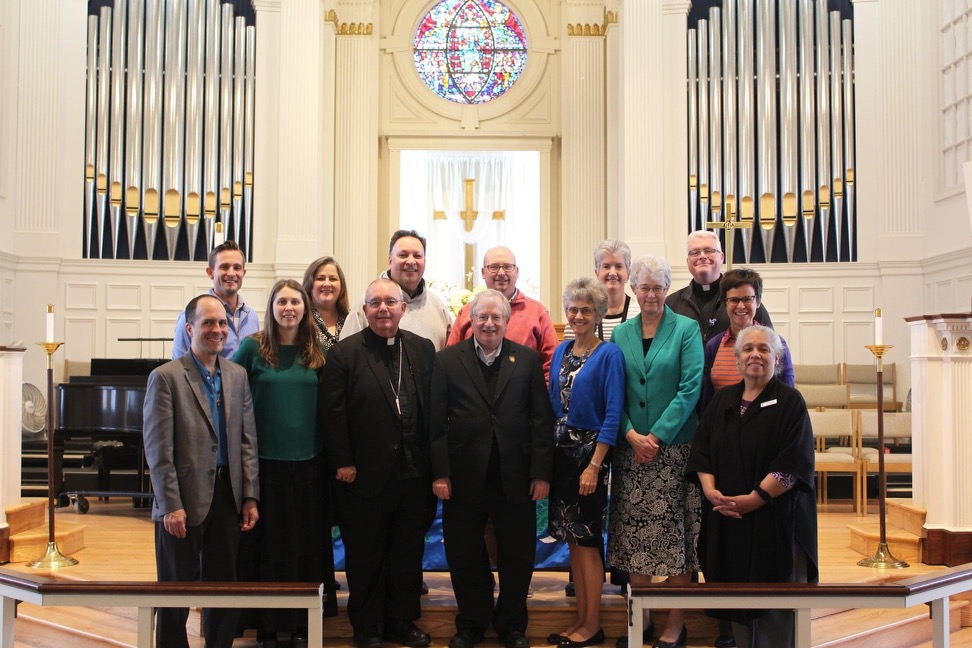
Once historically at odds with one another, Roman Catholic and United Methodist Christians have found significant points of common connection and shared appreciation, according to members of the official Methodist-Catholic Ecumenical Dialogue.
Established in 1966, the dialogue has continued across 50 years. The current round, meeting twice yearly, has been tasked with exploring areas of convergence and divergences through the lens of the mutual recognition of common Baptism. This includes examination of the Lord’s Prayer and Apostles’ Creed, as well as the feasibility of creating shared rites and prayers.
Wesley Theological Seminary Associate Professor of Church History and Methodist Studies Dr. Ryan Danker was joined by three other dialogue participants on the June 10 Secondhand Religion podcast.
Georgetown University Global Ethics Professor Fr. Drew Christiansen, Diocese of Memphis Bishop David Talley, and Notre Dame Associate Professor of Theology Dr. Kimberly Belcher each shared about their experiences across six years on the Methodist-Catholic Dialogue.
Asked, “what launched your interest in all things ecumenical?” Christiansen credited his mother. As a young teen, she became a leader in her parish and strayed away from the Irish-American norm since she “was not afraid of going to a service in a Protestant church, unlike others.” Christiansen cited experiences at Yale, Berkeley, Notre Dame, and the International Catholic-Mennonite Dialogue in making his first dialogue successful because “the hand of providence has been there leading [him] along.”
The next question was directed to Talley, “what is the goal of the ecumenical movement?” The Memphis bishop shared that he became the Chair of the Bishops Committee for Ecumenical and Interreligious Affairs in November 2020. The purpose of the committee is “to realize what the prayer of Jesus said in John 17:20-21… that we are one as the Father is in the Son and the Son is in the Father and that he is drawing us to a dynamic of love, trinitarian love, and a relational love.”
The following questions were about the dialogue and the panel’s experiences on it. Each pointed to division and difference in belief as low points, but the good outweighed the bad.
“Camaraderie, love, and affection” was a highlight of Danker’s experience. Christiansen focused upon the “spiritual friendship that was cultivated with one another,” and because of that, it was “so easy and natural” for them to craft a final document. Talley cited discussion of “the mystery of Christ and the mystery of God’s love for us” with both Methodists and Catholics as an inspiration showing Jesus unifying everyone involved.
The Memphis bishop shared from his personal experience on how the dialogue helped develop a spiritual friendship because, even as he and his family have different religious beliefs (Baptist and Roman Catholic), “they all share Jesus.”
Belcher expressed church unity as her hope of entering into the dialogue with United Methodists. The Notre Dame professor wants “to figure out how to take the history of agreement and push [baptism, eucharist, and ministry groundwork] forward and make it part of people’s lives.”
Christiansen stated that even if he does not know what ecumenical unity might look like, “different liturgical cultures will come together… and will slowly find a way to open their hearts to one another through the Holy Spirit.”
In conclusion, participants were asked about their hopes for the Methodist-Catholic dialogue.
Danker’s hope is “for it to continue and include other forms of Methodism” because he wants a growing wider group of Methodists to be able to have a prosperous experience with Roman Catholics. Belcher “would like both groups to learn and reflect what it means to be a church together and not two churches alongside one another but one church together.” Both Christiansen and Talley concurred with Belcher’s answer and that small groups must continue and “have a place within the parish, diocese, and larger church” to continue Christ’s vision for us.
The entire podcast conversation can be accessed on YouTube here.
No comments yet



Leave a Reply