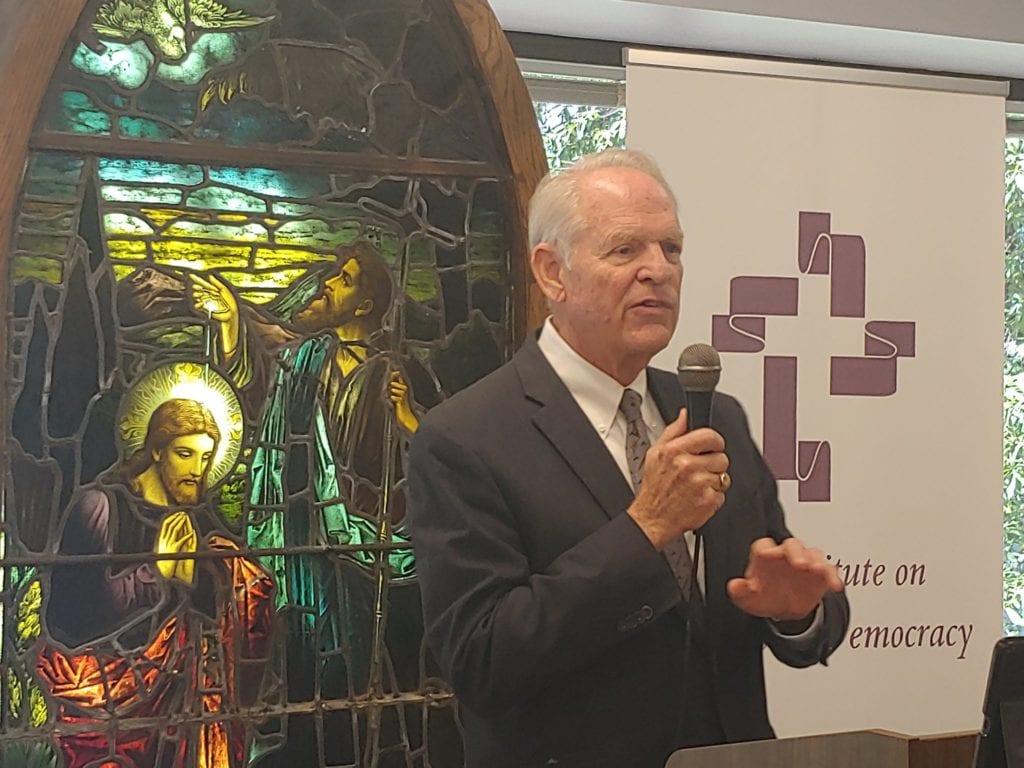
The Rev. Dr. John Yates, longtime pastor of The Falls Church Anglican, shares the remarkable story of his parish’s departure from the Episcopal Church, their wilderness years, and construction of a new sanctuary with thriving congregation. This lecture honors IRD’s late president Diane Knippers.
Tooley: Welcome to the annual Institute on Religion and Democracy Diane Knippers Lecture, which we’ve been convening I believe for 10 years to honor the late and so much beloved and remembered Diane Knippers, who worked for IRD for over 20 years and was president of IRD, my predecessor, for about 12 years. So, this lecture and event honors her memory, and especially recalls her commitment to the renewal of the churches in America, especially to their social and political witness. Typically, this event is in the evening with a large crowd followed by a sumptuous reception. Today, we have a small but very intelligent and attentive crowd and not a lot of sumptuous food, but we do have high spirits. And we are broadcasting this event live, and the video will be posted afterwards. Our speaker for the Diane Knippers lecture wonderfully and appropriately is the Reverend John Yates, longtime pastor of the historic Falls Church in Falls Church, Virginia, whose story, his story is remarkable, but his story is intertwined with the story of his congregation from which he retired two years ago?
Yates: Last year.
Tooley: Just one year ago. In that the Falls Church Episcopal left the denomination in fidelity to biblical beliefs and lived in the wilderness, so to speak, for a number of years without their building, having lost it in litigation. But wonderfully survived and thrived and has built an incredible new sanctuary at a very high-profile location in northern Virginia. So, it’s a wonderful ending to the story, but of course the story is ongoing. So, John Yates oversaw that process to a very satisfactory particular conclusion. And Diane Knippers during her lifetime knew and admired John Yates. So, she would be delighted that he is giving this talk today about the story of the Falls Church as part of the Diane Knipper’s lecture. So, John, we very much appreciate you joining us for this event. There possibly will be a chance for questions afterwards if we can uh master the Zoom technology to allow for that, and of course for those, the small audience we have here in the office, obviously there could be questions and comments from them. So, thank you, John.
[Applause]
Yates: Let me take that from you.
Tooley: And I think if you could hold the microphone that would be nice, but if you can’t don’t worry about it.
Yates: I’ll see what I can do. Well, I’m honored to be with you all and to be with you online today. I’m grateful for the opportunity to tell this story. I’ll try to, I’ll try to move through it in a way that will just touch the backs and give honor to God, because that’s the purpose of the story— to give honor to God. So, let’s go back to the beginning. The Falls Church is a very old Episcopal church in Falls Church, Virginia and it was established in the early, George Washington’s father was a member of the vestry at that time when they built the original church. And then when the termites got to the original church and they had to rebuild it, his son George Washington, our president, was on the building committee that made the decision to rebuild. Lots of history— Francis Scott Key used to come out from Georgetown in the early 1800s to lead morning prayer services at the building. Civil War soldiers are buried in the graveyard. So, it’s a historic and much-loved place. The town was named after it.
In 1979, my wife and I moved here from Pittsburgh, and I was called to be the rector of the Falls Church. About 10 years before that my wife and I had felt led by the Lord to commit ourselves to a lifelong goal of trying to bring about renewal within the denomination that we have both grown up in in North Carolina, the Episcopal Church. And I am 32 years old when we arrive. I’ve never been a rector before. We’ve just had twin daughters, so we had five children seven and under. It was quite an undertaking. That same summer that we arrived, the Episcopal Church held its general convention. And I was oblivious to everything that was going on at that convention, but something important happened at that convention.
On the very last day of that gathering, a resolution was passed known as the Dennis Canon. And the gist of it was that it declared that all church properties belonged to the Episcopal Church. Now, how that ruling was passed is questionable, many have said that it was done in an irregular way, even an illegitimate way according to the canons of the church, but there it is. That became the custom, that became the thinking of the church. I was basically unaware of this as a young rector with an expanding family, and when I did hear about it, I was told don’t worry about it — it won’t stick. It’s an illegitimate ruling. The property of the Falls Church, the deeds are all in the name of the mastery of the church, and we never dreamed that there would ever be any contention about who owned the property.
So, The Falls Church was at that time a quiet, small congregation of good and decent faithful people.They love their old colonial chapel, and we soon came to love it as well. They said they wanted renewal. They said they wanted spiritual renewal, and they hoped that we could bring it. We were committed to that. So, there we were. The 80s were years of hard work for all of us. My goal was to get to know the people; come to love the people. My goal was to evangelize where I felt it was appropriate. We wanted to establish a sense of the authority of scripture in the church, and we wanted to expose this little church to evangelical Anglican leaders.
So, from the beginning, we had people in our church like Jim Packer, John Stott, and many others God blessed during the 80s. We had, we had much growth. Soon our small facilities were overcrowded. We were holding multiple services concurrently. People were turned away from worship services. We went to the bishop and said, “What about planting a daughter church?” He said, “We don’t do that here in Virginia.” And so, ultimately, we decided to attempt to build a new church. And in the late 80s, we built a wonderful new church building that we loved. It had a copper dome on the top, and it was in the round, and we called it lovingly “the EpiscoDome.”
It was a great, still is a beautiful place. So, we built a new church that we loved in the 80s we built a staff. We had a sense of God’s favor; however, there was a sense of foreboding at that time in our diocese, the diocese of Virginia, and the Episcopal Church of the USA. There was a sense that a battle was coming — a theological battle. And I just made an observation that I’m sure you’re familiar with, but in mainline denominations when unusual growth occurs in one parish, and particularly when it’s of an evangelical flavor, and it almost is of evangelical flavor if it really grows significantly,but when that happens the result is almost always a growing sense of resentment on the part of the other churches in the area towards that one church.
And if you are in that church there’s a sense of being marginalized off to the side and not included in the important decisions of the day. And that certainly was our feeling. I’m sure a lot of you experienced that yourselves. Well, so, we get to the 90s and God’s blessings continued. Our commitment to disciple young people in the church blossomed into an amazing huge ministry to young people, hundreds of young people involved, and at that time we started something called The Falls Church Fellows, which have been going now for almost 30 years. This is a year-long program to develop young men and women to disciple them just out of college, and they come, they become a part of our community. We teach them; they take theological courses. They get credits. We expose them to people who are serving God in the workaday world as well as in the church. And that has been a mark of our church, raising up leaders for the future church.
A handful of us worked as hard as we knew how to encourage our bishop at that time to stand up for biblical orthodoxy and biblical ethical principles, because in the 90s and late 80s a series of episcopal bishops were rejecting various basic tenets of the Christian faith and were embracing moral practices which the church had always condemned. It was a rejection of biblical authority in the 50s and 60s, and drank the poison, and the poison was a rejection of the authority and truthfulness of the word of God. They drank that poison in the 50s and 60s, and by the 90s, the church was beginning to die. And you could see it happening.
Denominational shrinkage was dramatic in Virginia. Our bishop was mainly concerned to keep us all together, and so unity above all else was his concern, saying our theological differences, our differences about ethical issues were not all that important you didn’t think. And in a famous statement at a large gathering, he was talking about the importance of unity in the church and he said, “If I have to choose between heresy and schism, I will always choose heresy.” And we knew what we were dealing with at that point.
The same bishops who were turning away from orthodoxy about that time approved in a formal church court of law that we have no reason to approve, we have no reason to oppose same-sex relationships in our church. So, that became a matter of principle in the mid-90s in our church. Well, you move up to the first decade of the 2000s, it was a time of intense activity in our own geographical area.The Diocese of Virginia, about 186 churches, a lot of activities surrounding internal disagreements that were both theological and ethical particularly in regard to sexual practices.
In 2003, the Episcopal Church consecrated as a bishop a partnered homosexual who had left his wife and his children and eventually married his partner. He was consecrated as a bishop in the Episcopal Church — that was a big turning point for a lot of, that was sort of the straw that broke the camel’s back, because it was such a dramatic turning point. Many orthodox congregations by that time now were struggling with remaining in the denomination. The Falls Church and a number of our sister churches in the area were right in the middle of a difficult situation.
Our church was also in the middle of another building campaign by then, and we concluded that we had to change our vision. Rather than trying to stay in and renew a denomination,we began to aim towards establishing a new orthodox Anglican presence in the U.S., and we put aside our building program. I didn’t want to, but the people said, “John, this is not the time to be building.” And they were right. You know, many times I was wrong and the people were right. They’re encouraging and listening; I want to say listen to your people.
At that time there were several large gatherings across the country to consider the future. We established a Virginia coalition of orthodox churches.That sort of thing happened many places across America, and it was a time to pray to seek God’s guidance. We consulted with Anglican leaders around the world. We went first to Anglican leaders in the Church of England. It was hard for them to understand, and they just felt like you should stay in whatever the changes were. However, the Anglican leaders in Asia and Africa understood the situation, and they encouraged us to move forward. And in three intense years between 2003 and 2006, many of us were seeking discernment from God. Most of us had grown up in the Episcopal Church. We loved it like a mother. We knew it had gone astray. We had done our very best to try to change the direction of the mothership, but it became clear that the direction wasn’t changing.
I was personally a part of a small group appointed by the bishop of Virginia to explore just what might be done about churches that were pondering leaving the denomination. That group worked very, very hard, and we had many, many thoughtful meetings. By 2006, our bishop in Virginia reluctantly agreed to a thoughtful protocol for churches that felt they might consider separating from the denomination. A series of steps were developed that the bishop agreed was a fair way to approach this question.
Now, this course was not about great controversy. In the Falls Church over a period of many months, we followed the bishop’s protocol — his requirements — to the letter, and decided eventually to take a vote of our parishioners to decide to hear what they wanted to do. We set the date for the vote. Two or three others of our beloved sister churches in the northern Virginia area were voting on the same day. Two days before the vote, I made a visit to the bishop of Virginia, and he completely pulled the rug out from under us. He said we have a new Presiding Bishop who was a woman, who had never even been rector of a church. She was on the far left theologically. Anyway, she had said that to the Bishop of Virginia, “You must not allow any churches to follow that protocol.” So, he said, “I’m sorry, John, but new sheriff is in town and the deal is off.”
Well, we had two days to decide what to do. We notified the congregation immediately. We met for prayer and deliberation, and we decided that we needed to vote about this. We took the decision to the congregation and over 90 percent of our congregation voted that day to leave the Episcopal Church, and over 95 said if we did leave, we should keep the property. It was ours. When we notified the Bishop of Virginia, he revoked my ordination status immediately. He declared our church “abandoned property” and he sued us. He was unwilling to negotiate in any form. We believe four things at that time. We believe first of all that we’ve been seriously misled. Secondly, we believe that the property belonged to the church and not to the diocese. Three, we believe we had an extremely good legal case. But four, we were willing to give up the property for the sake of the principle. But we believe we should contest the issue.
So, this began six painful years of very costly litigation. I think there were about a dozen churches involved in that litigation. This church was sued separately. In 2008, the circuit court of Fairfax County ruled in our favor. In 2010, the Virginia Supreme Court said that the first ruling was faulty, and they sent it back down to be considered again. In 2012, the Virginia Supreme Court ruled that we must leave the property. We applied to the Supreme Court of the United States, asking if they would consider it, but they turned us down. So, we were required to leave in a couple of months and leave absolutely everything, and that was devastating for sure.
I will never forget, I was in Massachusetts speaking to the Anglican bishops, I can remember exactly what I was teaching them about that day, and in the middle of the talk I saw my dear friend and brother Bishop Martyn Minns answer his phone in the back of the room. And I saw his face go white, and I knew we had gotten news. I ended that talk as quickly as I could and rushed to Martyn. And he said, “John, they’ve ruled against us. They’ve ruled against us.” And there was nothing we could do. It was a confusing time. After such careful thought and so much prayer for God’s guidance, we certainly didn’t understand the decision, but neither did we despair.
We honestly believed that God was in control. And, you know, in times like that, you go to God on your knees and you ask, “God help me to understand this. Give me a way of understanding this, Lord.” And I was led to the 13th chapter of John — the story of the last night with Jesus, with his disciples. And if you remember, at one moment he was down on his knees washing Peter’s feet. And you remember Peter said, “Oh no, we don’t have any of this. This is not proper.” And remember, Jesus said, “I will wash your feet.” But then in verse seven he said something amazing. He said, “You don’t understand what I’m doing now, but one day you will understand.” And that became a word of confidence and truth for us that we held on to. We had no idea what God was doing, but we believed that we would know. We would understand eventually.
We agreed that we would not entertain any complaining. We would not grumble. We would not say a word of criticism towards the fiscal church. We turned over the keys of our buildings in the spring of 2012. We had determined to leave things in the best condition possible. I remember, I remember vacuuming in my office that day, trying to clean everything up before we left, and just before we left, my daughter came in with a big cake and she said, “Dad, if it’s all right I’m going to leave a cake on the desk of the rector who will be moving in tomorrow. I just want him to know that we were praying for him.”
We had such a remarkable response among our people. We had over 4,000 people in worship on our last Sunday. The congregation was peaceful. They were trusting. They were sad, but they were joyful all at the same time. In fact,there was actually a sense of anticipation that you couldn’t explain, but there it was. And that began a seven-year period of wandering, going from one home to another — hotels, high schools, middle schools, other church buildings, playgrounds,parking lots. We didn’t have any worship space. We didn’t have any office space. We didn’t have any meeting space.
Sadly, we had to let some beloved staff members go in the midst of all that. It was a hard time. We had, we had one experience that I’d just like to take a minute to tell you about that encouraged us so greatly. Just before we had to leave the property, the chair of our altar guild came in to see me and she said, “John, when we move out, what are we going to do for communion silver?” We had to leave all the communion vessels there. We had to leave all the prayer books. I had to leave my vestments. We’d leave all the furniture. We had to leave all the books. We had to leave everything. We couldn’t take anything with. She said, “What are we going to do?” I said, “Well, I don’t know. Go to some second-hand store and buy some crystal, you know, that we can use. I don’t know what we’re going to do, but God will provide.”
A few days later, a staff member came into my office and he said, “John, there’s something I think you should see.” I said, “Rick, I’m pretty busy. What?” He said, “Just trust me, brother. You need to see this.” So, he led me down the hall. He took me to a classroom, and a long, long table was spread out. A table about 12 feet long, and that table was covered with antique communion silver. Where had he come from? An older gentleman, an unusual gentleman, a faithful believer who cared a lot about the future of the church, had read our story. He was a collector of antiques. He had this amazing collection of old church communion silver, and when he read what had happened, he determined he would give it to us. There was more communion silver on that table than we could ever use. We kept what we wanted and we gave the rest to our daughter churches, cleaned it up, had it re-silvered. And you would think we’re the richest church in the world now if you could see that beautiful communion silver. That was such an encouragement.
In one small way we knew that God was going to meet our needs. Even the missions money that had been given by people given specifically with the proviso that that money could not be used for the Episcopal Church, even that money was ruled by the Supreme Court of Virginia to go to the denomination. So, we really had nothing. We didn’t have a plan, either. I mean, you know, I’d always thought it would be fun to plant a church, but I couldn’t imagine how you could plant a church with that many people all thrown out on the street unexpectedly. So, we worked closely with other churches that were in the same predicament. We eventually submitted to the oversight of various Anglican bishops in Africa, and they were our counselors. They gave us wise guidance.
The congregational response to all this was just, it was magnificent. They were faithful. They were confident. They were encouraging. And they were generous at a time when it was certainly needed. During all this time, the local Falls Church newspaper, under the leadership of a dedicated and extremely progressive editor, never missed an opportunity week in week out to criticize, condemn, to tell untruths about our church. They rejoiced and they celebrated when it was announced that we had to leave the property. I was constantly described in that paper in the most derogatory terms, as a dangerous, divisive, even wicked presence in the community, because of my thinking about the Christian faith. It was a hard time. My life was threatened. There was a period of time when I had bodyguards protecting me.
But unexpectedly during this difficult time, the church continued to grow. We were now three to four thousand people. New people seem to be drawn to come and join us in that time of wilderness, wandering. But during the time of litigation — all the confusion — we had begun sending out young pastors who we had trained along with some of our best people, to plant new congregations. And when we lost our property, we believed we should continue to try to do this even though we had no home ourselves. We worked with others across the nation to eventually establish a new Anglican Church, and many new Anglican churches. And in 2009, the African bishops released us, who had supervised us, they released us, and that was the beginning officially of ACNA, the Anglican Church in North America.
Today, we have about a thousand congregations. Our church had actually planted 10 daughter churches during those years, eight of whom are thriving now—from Maine to Richmond to Washington, DC to Williamsburg to Arlington, Alexandria, Vienna, Virginia, Winchester, Virginia. One of our Anglican bishops in an article described what had happened, and I just want to read it to you, because none of us had thought about it in this way until we read what he said. This is in 2012. He said, “I’m so very thankful for the witness and leadership of the Falls Church in northern Virginia. When the crisis hit the Episcopal Church in 2003, the Falls Church responded about planting a church among the poor in Washington, DC.
When The Falls Church left the Episcopal Church in 2006 and was sued, they responded by planting another church. Millions of dollars were drained away in litigation. Before they received a first-round victory in court,their response was to plant two more churches. Then the positive ruling was reversed on appeal, and they were sent back for another trial. They responded by planting another church. This time they lost at trial and they were forced out of their building.This spring their response, you guessed it, has been to prepare to plant another church. This summer after sending our clergy and parishioners to plant six churches, The Falls Church has grown by over a third in nine years, and the combined average Sunday attendance of The Falls Church and those six church plants is more than double what the Falls Church was in 2003.”
None of us realized what had happened and how unusual it was until we read his article. We hadn’t expected things to develop this way. Don’t give us any credit for farsighted thinking. We were just moving along in a bumbling way, doing the next thing that seemed right, and eventually, eventually there was another great surprise. And I’m almost done now after extensive search for a new home and three or four serious but unsuccessful bids for property — God led us to purchase a huge office building on a large, lovely, big boulevard that goes into Washington, DC, Arlington Boulevard. And adjacent to that building, which the building houses our church offices and there’s meeting space and classroom space in the building but we lease out most of that building primarily to medical practices and that is a major resource for paying a mortgage on the office building, but adjacent to that building we’ve now built an absolute, a stunningly beautiful new white church as well as a six-story parking garage that holds 552 automobiles, which was required by Fairfax County.
And all of this was completed and I just want to be clear about one thing, we certainly did not get everything right. We made mistakes. I made mistakes. But God forgave us and we learned. I learned from my mistakes. God has led us forward. We lost everything. We had no idea what to do. All we could do was pray and yet, in the fall of 2019, a new church home was completed and a fine young rector took over, and I was able to step aside after 40 years. At last, we were in a stunningly beautiful new church home built in the glory of Jesus Christ and the nation’s capital, and then six months later COVID-19. Things are never easy, really. They’re never easy in the kingdom of God.
If I may, I’d like to close by sharing four principles, four simple principles, that we learned during this time. And I’m sure there were many more, but these are the main ones. The first is that adversity unites and strengthens God’s people. The second is, God often surprises and disappoints us, but we must not let this discourage us because God provides when the time is right. Over all disciplines and surprises, he’s still the Lord. We can trust him. The third principle is this — the people of God move forward best on their knees. That’s the way forward, through prayer. And believe me, we spent a lot of time on our knees, and I trust that that’s a habit that will never slacken off in years ahead. And the last principle I would say when God’s people are convinced that God is meeting them, they can do and they can give much more than you would ever think would be possible.
So, you know, if I could somehow go back and relive this whole time, people often say, “If you had known what was going to happen, would you have gone through all of that loss and pain and disappointment?” And my answer is always resounding absolutely. I wouldn’t change a thing. We’re much better off, stronger people because of it. And I have in my own little way interviewed many, many people in the church, and I’ve asked that question, and I’ve never yet found one person who said, “Well, I don’t believe I would do what we did.”
I think there’s unanimity that we did what we thought was right and God honored us and blessed us. So, I am frankly so excited to see where God is going to lead our church in the years ahead. And if you are in our area, Washington, DC, you come out on Saturday night or a Sunday morning to 6565 Arlington Boulevard and you join us in worship. Amen. Thank you very much.
[Applause]
Tooley: Any questions or comments for Reverend Yates?
Yates: Happy to answer any questions if anyone would like to raise some.
Walton: I’ll ask one. Obviously, it goes without saying that 2020 has been a challenging year for many people, but when I think back to some of the experiences that some of our Anglican partners in the global South have had to endure, it seems like they’ve been through some significant increased things. I’m especially thinking about some of our Nigerian friends have shared with us in regards to struggles with violence in those areas. What are some of the things, you’ve met a lot of different global South clergy and bishops, what are some things that have stuck with you from their stories that you would want viewers to know who are undergoing moments of trial?
Yates: Well, what have we, the question is, what have we learned and observed from Christian leaders in the global South? Two-thirds worlds who have faced real persecution over the years, what have we learned from them that encourages us? Well, it seems to me that I have seen particular leaders raised up in the midst of these times who had the courage and who had the ear of the people who were able to call their people to faith and to non-violent response to wicked violent persecution. God seems, it’s been my observation, to give grace, extra grace, to those persecuted believers when they need it. And to me, it’s a miracle of God. I, we, are learning from our brothers and sisters in those parts of the world where they are persecuted. And I think, I think another thing I’ve observed is that there is this spirit that you sometimes see that is, it’s an attitude of “yes this is terrible, but we were promised persecution, why should we be surprised? We’re going to go through it because God promised we would, but he promised he would be faithful to us. And we’re going to walk through it as best we can. If we die, we die.” It’s that spirit that we’ve seen through the ages among the true church that never ceases to amaze us.
Tooley: I think we can receive online questions, John, if you weren’t looking to the screen.
Yates: It’s great. I can actually see some faces online. If any, if anyone there would like to ask a question. But you probably can unmute yourself and ask a question or make a comment if you’d like. Oh yes, the question is what happened to The Falls Church Episcopal? Well, it’s still there. And it’s, I don’t know that I would use the word vibrant, but it is a viable congregation. And it’s, in the community, it’s known now as a church that is sort of embracing much of the new progressive agenda. For several years until just recently, they had a rector there who actually was a very fine man. When he came, we both made a priority of getting together. We felt like it might be awkward, but we ought to know each other and just say that we were friends. And we actually over the years met together several times, and I liked him very much. We were poles apart theologically, but a good man. And he’s now retired, and now I’ve retired. So, I don’t know what the future is.
Wright: For Christian leaders in other denominations or around the world, what are some things that they should be watching out for that might be the beginnings of their network of churches or their denominations going down the wrong path?
Yates: The question is what should church leaders be looking for in their larger church body as signs, or even within their congregation, as signs that people may be going down a dangerous path theologically. I think what you see is a growing laissez-faire attitude towards historic, some historic Christian practices and some historic Christian doctrines. The attitude that, “Well, Saint Paul did the best he could with what he knew, but we know a whole lot more now than he knew, and so we can come to other conclusions.” I’ve heard that many times. I just don’t believe that a man that far, the holy spirit of God, was limited when he was making moral decisions. I think also an inordinate fear of taking, and what could be an unpopular, stand in this age that we live in. I mean, we say here in America that we’re, you know, toleration is everything. That we’re just tolerant and, but we all know that if in this timeline age, if you’ve taken a position that doesn’t go along with where, you know, the thinking culture is going now, that there’s not, you don’t experience much toleration. And a lot of people are fearful of that. I’m very concerned that the church will lose its passion for evangelism because evangelism is not popular in this age.The young people, the young people have grown up in a time when it has become more and more important to fit in with the thinking of the day. And they are afraid to go against the thinking of the day, unless they’re very unusual young people.And so, that is a, that is a worry, too. Anything else?
Melton: We have Mark who is asking, “What encouragement did you receive from other denominations during the time of tabernacling of the Falls Church?”
Yates: Encouragement from other denominations — I meant to say something about that. It was unbelievable. You know, a few years before we lost the property, I introduced myself to the Catholic bishop of Arlington, and I said, “I just want to know you and I want you to know me.” And he knew all about our situation and I said, “If we were to ever lose our property, I’ve only found one high school in northern Virginia that is large enough for our church that’s not already committed to some other group renting their facilities on Sundays.” And I said, “If we ever come to the place of needing a school to meet in on the weekends, I wish that you would consider our needs and look favorably on us.” And he said, “Well, thank you. We’ll help in any way we can.” So, the last couple of years that we were homeless, he was able to open up O’Connell High School in Arlington, and that was that. We paid dearly for it financially, but it was a great place for us to meet. We were able to help them out, help them to get some of their facilities renovated. The Roman Catholics were very helpful. The Baptists were very helpful, Columbia Baptist Church and other Baptist churches gave us the use of their space time and time again. Some of the Presbyterian churches. A local evangelical free church. A number, there were 14 or 15 different churches that allowed us to come in and use their facilities. And we learned that we were all together in this battle, and they supported us, and we wanted to support them. That was one of the best lessons we learned.
Melton: And there was one other question from Thomas Wilson, asking, “What kind of relationship exists between Falls Church Anglican and more conservative parishes that have remained in the Episcopal church in the DMV area?” He’s thinking especially of All Saints Church.
Yates: Yeah, what kind of relationship have the churches who left maintained with orthodox churches that have stayed within the Episcopal church? Good question. I think that the relationships have been informal. You mentioned one church in Washington, DC. The Episcopal rector of that church is a good friend of mine. In fact, several members of our church who live in that part of Washington eventually went back to that Episcopal church because he’s such a fine and godly rector. And I am in touch with a number of Episcopal clergy who are orthodox who’ve stayed in and, you know, we support one another. We understand, they understand why we left. I understand perfectly why they felt they couldn’t leave. So, I would say that while I don’t know of any formal networks that link those that stayed in and those that left, there are lots of close relationships.
Tooley: Just one more question, Mark, from John Owen.
Melton: I don’t see it on the chat. I saw John Owen raise his hand.
Tooley: His question was, “Some believe you don’t leave as long as you still have the freedom to preach the gospel.”
Yates: Yes.
Tooley: His question to you all was, “Did you think at some point you would lose even that freedom if you stayed in the Episcopal church?”
Yates: I don’t know if you could hear that question. The question was, “One position about leaving the church is you should stay in until your freedom to proclaim the gospel is taken away, and did we fear that we would lose that freedom?” I don’t think we feared that we would lose that freedom anytime in the near future, but every year we saw our denomination making major decisions that we felt went against the teaching of scripture. It became harder and harder to say, “I am an Episcopal priest.” It became embarrassing to say “I’m an Episcopal priest” in some circles. And the fact that some people took that position of staying in, we honored that. We understood that a number of the English clergymen took that position. But for us, we felt like the line had been drawn, and we really didn’t have a choice but to go forward. So, thank you for these good questions. It’s been good to be with you. Oh, one last question. One more.
Guest: John, as IRD has been letting us know in the newsletters, many other denominations have been going through the similar issues that you have described. The Episcopal church, and now Anglican, has gone through. To what extent has our experience informed them? Have they been coming to us to get guidance?
Yates: On to what extent has our experience informed the thinking of others in denominations who are facing the same problems, there’s been an awful lot of conversation back and forth between us and people and other denominations that have faced the same thing. And I think that our experience, which by the way hasn’t been uniform, the most recent legal decision in South Carolina was that the Anglicans were going to be able to keep their churches. So, it hasn’t been a uniform decision, but I think our experience has been a real word of warning and has caused some churches to say, “We’re just going to leave. We’re not going to contest the ownership of the building. We don’t think that’s the right thing for us. We don’t want to do that.We’re just going to go ahead and step aside.” Others have seen our experience and have decided that they’re not quite ready for that. And they don’t deal with it. So, it’s been instructive. I think that was the last question. Mark, I’ll turn it back over to you.
[Applause]
Tooley: Thank you, Reverend John Yates for a, as expected, wonderful presentation about a remarkable story. The video of this event will be posted hopefully later today, along with a transcript. So, I’m sure there’ll be a large and appreciative audience for that. And thank you all, whether online or in person, for attending this annual Diane Knippers lecture. Bye.

Comment by Duane Miller on October 8, 2020 at 12:13 pm
Very interesting material. Very sad that the bishop of Virginia totally caved to the PB. Why would he do that? He is the bishop? The PB is not an archbishop.
Also, what is the status of Falls Church Episcopal today? They kept the property, ok. Have they been able to rebuild a congregation? Are there still regular meetings? It is a parish or a mission?
Blessings from Madrid! (Pray for us, please.)
Comment by Jeffrey Walton on October 9, 2020 at 2:44 pm
Hey Duane, that’s a good point that the PB is not an Archbishop. PB Frank Griswold deferred to local diocesan officials on negotiations with departing congregations (hence why Christ Church Plano was able to peaceably depart with property from the Episcopal Diocese of Dallas in 2003). The election of Katharine Jefferts Schori as PB in 2006 changed all that, with a new policy inserting the national Episcopal Church into litigation and forbade even the sale of properties to Anglicans. Some argued that she overreached her authority, but there was not a significant pushback within the House of Bishops. As for Falls Church Episcopal, it has rebuilt a congregation and is a parish in good standing within the Diocese of Virginia. With an average Sunday attendance of about 300, it is a fraction of the size of the church before the split (or the Falls Church Anglican today) but it is stable and (after about eight years in the property) the Episcopal congregation has at last reached the point of being financially self-supporting. I can say that most progressive Episcopal parishes would be thrilled to have the attendance — and young families — that TFCE ministers to. I disagree with some of their theology, but practically speaking, former Rector John Ohmer did a commendable job. I think TFCE is now larger than Falls Church Presbyterian, Christ Crossman UMC, or any of the other liberal mainline congregations in the city of Falls Church. Yes, it’s smaller than Columbia Baptist, St. James Catholic Church or TFCA, but glancing at their ecumenical partners, I don’t think TFCE views those as its peer group.