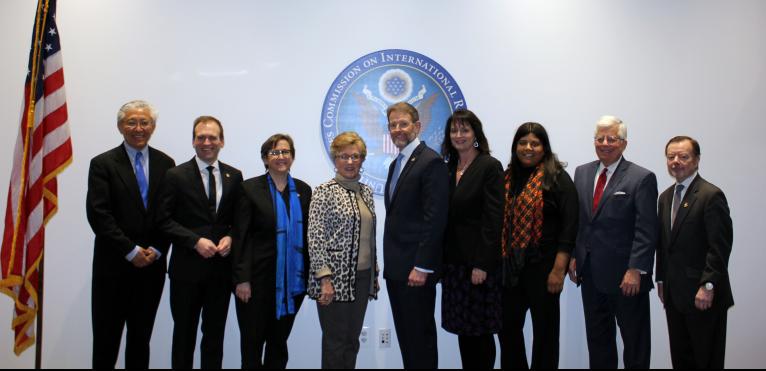
On September 16th the United States Commission on International Religious Freedom (USCIRF) held a hearing on religious liberty in Russia and several Central Asian States.
In this virtual hearing, USCIRF Commissioners were joined by four witnesses. Chairman Gayle Manchin, and Vice Chairs Tony Perkins and Anurima Bhargava, also invited U.S. Rep. Joe Wilson (R-SC) to testify. Wilson is Ranking Member in the Helsinki Commission.
The witnesses included Associate Director of the International Center for Law and Religion Studies at Brigham Young University, Elizabeth Clark; Associate Professor of History, Middle Tennessee State University, Emily B. Baran; Director of the Illegal Anti-extremism Section, SOVA Center for Information and Analysis, Maria Kravchenko; and Director of the Eurasia Center at the Atlantic Council and former U.S. Ambassador to Ukraine, John E. Herbst.
Follow Up from the 2020 Annual Report
On April 20th the Commission released its 2020 annual report. The International Religious Freedom Act of 1998 mandates these annual reports. Russia, Turkmenistan, and Tajikistan were rated as Tier-1 CPCs (Countries of Particular Concern) in the 2020 report. Uzbekistan and Kazakhstan were moved from the CPC to the Special Watch List (SWL). Both of those countries have made significant improvements in the general religious liberty climate.
At the September 16 hearing many of the speakers were deeply concerned by religious restrictions on the Jehovah’s Witnesses. Other topics of concern were Russia’s actions against Ukraine and the ongoing use of Soviet-era laws in Tier-1 countries. There was also encouragement testimony of how the governments of Uzbekistan and Kazakhstan have improved religious freedom in their nations.
Areas of Concern
Dr. Emily Baran’s testimony was focused on the plight of Jehovah’s Witnesses in Russia. She said that the Russian Government is silencing the voices of that faith group. And according to Professor Elizabeth Clark, under Russian anti-extremism law the Jehovah’s Witnesses’ translation of the Holy Bible is “not a Bible,” and is therefore illegal.
Another issue highlighted was the proxies in the breakaway sections of Ukraine. Congressman Wilson informed the Commissioners about legislation he introduced during this session of Congress. HR5408, the Ukraine Religious Freedom Support Act, targets specific issues in the Donbas region of Ukraine. This area is illegally occupied and controlled by Russia. The bill has a provision to ban any Russian official found responsible for religious freedom violations from entering the United States. And it requires the President/State Department to take into consideration Russia’s violations within territory of Ukraine that it occupies or controls – not just Russia – when determining whether to designate Russia as a Country of Particular Concern.
Witness John Herbst’s testimony also focused on Ukraine. He explained that the Kremlin’s religious policy in Russia is “worthy of concern.” “But its policy in Crimea and Donbas is particularly troublesome,” he continued. He described religious freedom restrictions and persecution for both Christians not associated with the Moscow Patriarch and for Muslims – particularly Tatars.
Another regional concern discussed was the continued use of Soviet-era laws designed to deter critical voices. Turkmenistan still uses this legislation for example. “The Soviet legacy of control, instrumentalization of religion, and viewing religion as a security threat . . . remain dominant in this region,” Clark stated in her testimony.
Areas of Improvement
The good news? Not all the news coming from the region is negative. The climate for religious liberty has vastly improved in Uzbekistan, for example. Tolerance of other faith groups has been increasing in the country over the last couple of years. This change led USCIRF and the State Department to change Uzbekistan’s from being a CPC country to being placed on the Special Watch List.
Earlier this month Uzbekistan introduced a draft law pertaining to freedom of conscience and religious organizations. Compared to the laws of Uzbekistan’s neighbors, this legislation is extraordinary. The stated purpose is to ensure freedom of religion and conscience regardless of the individual’s views towards religion. It will also regulate relations between authorized state bodies and religious organizations in order to preserve inter-confessional and inter-ethnic harmony.
Here’s hoping these strides forward for religious freedom in Uzbekistan will be matched by its neighbors with some of their own. There are some signs that Tajikistan may be moving in the direction of more religious freedom as well.
Fortunately, we have USCIRF and other religious freedom advocates to continue to monitor events in the region of Russia and Central Asia. As with other parts of the world, the attitude toward religion and religious freedom is a mixed bag. Where the religious freedom climate is improving, we should offer commendations and more encouragement and incentives. In other areas, where achieving religious freedom is an ongoing challenge, we must stay vigilant and honest in our warnings through the tools provided in U.S. law through the International Religious Freedom Act because if we are silent about oppression, we will be complicit in the abuses.
No comments yet


Leave a Reply