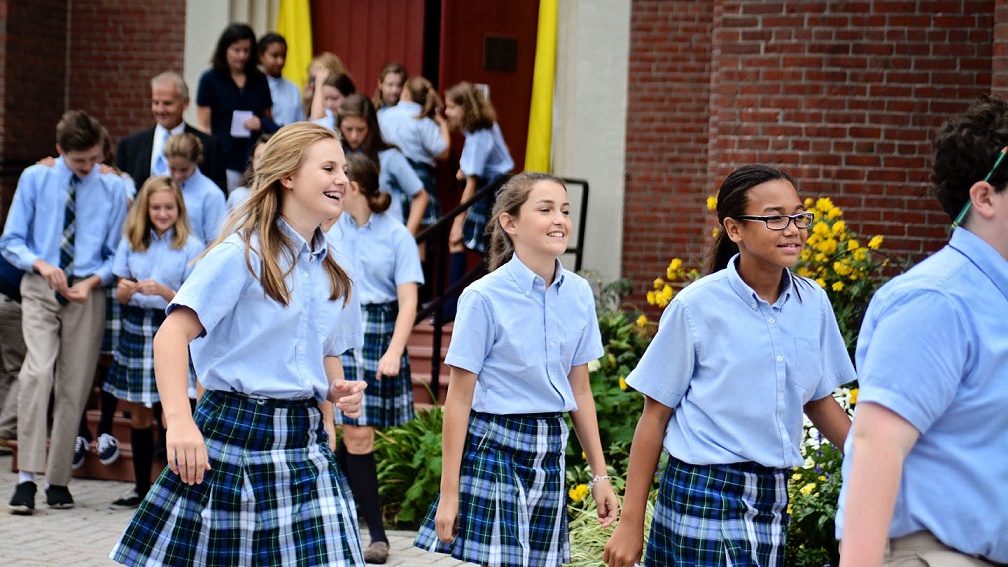

The Protestant Family Ethic Report, a new educational research survey conducted by AEI’s Institute for Family Studies, finds that education in private Protestant and Catholic schools results in greater family outcomes later in life. The data shows correlations between Protestant and Catholic schools and positive family outcomes such as a higher intact marriage rate, lower divorce rate, and lower rate of children born out of wedlock.
An AEI panel of guests and experts met on Sept. 16 to discuss the results and implications for Christian education in the United States. Dr. Patrick J. Wolf, Distinguished Professor of Education Policy and chair of Education Reform at the University of Arkansas, introduced the understood variables of the research.
- All schools have a “moral ecology” which infuses values into their school culture.
- Parents value the moral formation of their children in schools and want schools to shape behaviors and character of their children.
- Private schools typically define mission as “educating the whole child” and have more freedom than public schools to address moral issues related to family life.
- Most religious schools stress value of marriage or celibate single life.
Wendy Wang from the Institute for Family Studies and Albert Cheng from the University of Arkansas shared details and statistics of the report. The data is based on the cohort of millennials in the Understanding America Study #20 and #37 as well as the National Longitudinal Survey of Youth, 1997. Each data point in the Protestant Family Ethic Report contrasts students at public schools, Protestant schools, Catholic schools, and secular private schools (omitting homeschool students due to lack of data available).
Wang shared that the study did control for students’ backgrounds as it is commonly known that families with a more financially stable status are more likely to send their children to private religious schools. Cheng added that the survey also considered results from the Understanding America Study, which used a similar sample pool as NLSY97.
Key findings:
- Protestant school attendees are more than twice as likely as public school attendees to be in an intact marriage; 50% less likely to have a child out of wedlock
- Protestant school attendees who have ever married are ~60% less likely than public school attendees to have ever divorced
- Secular private school attendees who have ever married are ~60% less likely than public school attendees to have ever divorced
- Catholic school attendees are about 30% less likely to have had a child out of wedlock than those who attended public schools
Even after controlling for finances, family structure, and race, the trends held the same with private Protestant and Catholic schools reporting vastly different outcomes from public and secular private schools. The data suggests that Protestant and Catholic schools have highly positive outcomes on financial stability later in life, even for students who grew up in financially difficult circumstances.
Wolf concluded the presentation reminding that the study outlines correlations but cannot determine causality due to many unquantifiable factors (personal character, family values, ethics, etc.).
“Religious schooling, particularly Protestant schooling, is associated with or predictive of marriage outcomes,” Wolf said. “The schools themselves aren’t necessarily causing those outcomes, but we do have good theoretical and qualitative reasons to think that these value-rich environments for educating young people do contribute to these higher rates of desirable marriage outcomes for adults.”
Wolf also outlined public policy initiatives which he believes ought to result from these findings:
- Public schools can do more to promote the idea of positive marriage outcomes; stress value of marriage as associated with positive life outcomes.
- Policy makers should give parents more educational choices so that parents can continue to consider values and character of schools when making school choices.
Following this presentation, Wolf moderated a Q&A session with Wang, Cheng, and two guests: Lindsey Burke from the Heritage Foundation and Andrew Walker from Southern Baptist Theological Seminary. Burke pointed out that families already know that the values of a school will affect family formation later in life and called on policy makers to catch up.
“Parents understand this; it’s policymakers and education analysts who have been behind the curve on this point,” Burke said, referencing an over-emphasis on test scores and math competencies. She also referenced research which shows that parents consider the safety and values of schools first and test scores last when choosing an education institution for their children.
Burke also referenced a Heritage study across the country which found that although public schools avoid discussing marriage and family outcomes in terms of the success sequence, 72% of parents and 60% of school board members agree that this topic needs to be addressed in the public sector. She supports the educational savings account model (as has been tested in Arizona) to reallocate funds so that more families can have the financial stability to choose a private school.
Walker offered 5 axioms related to the findings of this report:
- Protestant family ethic, as expressed in this study, vindicates the emphasis on Christian worldview formation at the heart of many Protestant institutions and calls for redoubled effort in the face of mounting cultural changes.
- This study reinforces the positive role of religiously informed ethics education in fostering the social capital necessary for a stable political order.
- The Protestant Family Ethic report reinforces the need to make the type of education that stresses character and family formation as accessible as possible.
- Following the themes from the work of Alexis de Tocqueville, the Protestant Family Ethic report again demonstrates that religion is inseparable from free and virtuous society.
- The Family Ethic Report should serve as a helpful reference for further thinking about the common good in uniquely Protestant ways.
“[This report serves as] a mirror for Protestant educational institutions that their values have a quantifiable impact on individuals and larger communities,” Walker said.



Comment by Search4Truth on September 30, 2020 at 1:19 pm
The values described above are exactly the reason that the left is so opposed to private education. The family has been under attack for decades. Once this bastion of ideals is crushed, there will be little left to support any semblance of family.