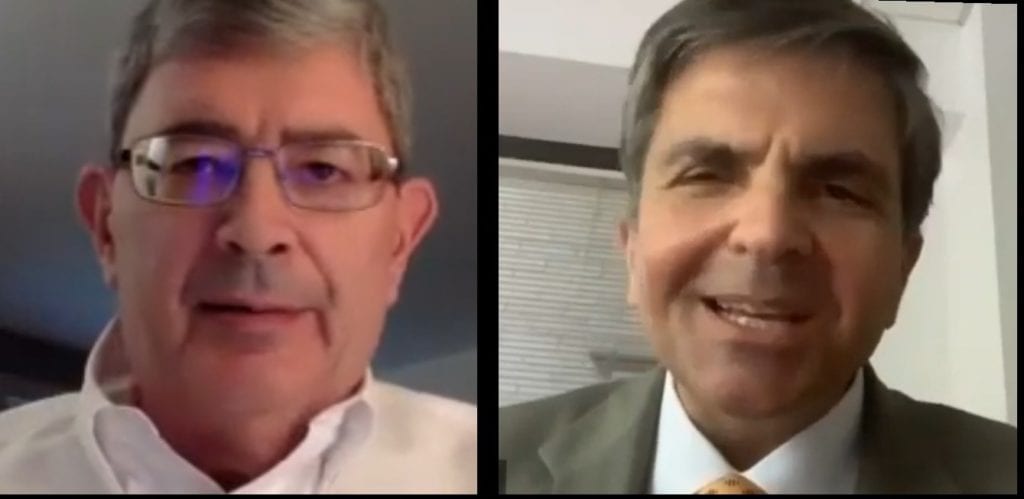
Here’s my chat with renowned Catholic thinker George Weigel on his new book The Next Pope: The Office of Peter and a Church in Mission, about the future of Catholicism’s global mission, including the political and cultural. Weigel is one of the last surviving of IRD’s founding fathers, which included Richard Neuhaus, Michael Novak and Carl Henry, among other distinguished Christian thought leaders. He’s perhaps best known as biographer of Pope John Paul II.
Among other questions, I ask Weigel about why non-Catholics should care about Catholicism’s future, about the Catholic Church’s teachings on human rights and democracy, how Christians should view recent months of social upheaval, and about the temptation to think apocalyptically.
As always, Weigel is fascinating.
Here’s audio, with video and transcript below. Enjoy!
Tooley: Hello this is Mark Tooley, President of the Institute on Religion and Democracy, with the great pleasure today of conversing with George Weigel. I’d like to refer to him as one of our last remaining founding fathers of the IRD. He, of course, was a very young man at IRD’s founding but he’s better known as one of America’s most distinguished Catholic commentators, theologians, historians, biographer of Pope John Paul II, and has a new book out this summer called The Next Pope, about which I’m going to talk to him. George, thank you so much for joining this conversation.
Weigel: Great to be with you Mark. It’s always good to be with the people of IRD. It was really one of the major turning points in my life to be part of the founding of the Institute on Religion and Democracy, and the friendships that grew out of that over years meant a great deal to me, still do mean a great deal to me. And I’m confident that you are carrying on the work that was so nobly begun in the late 1970s.
Tooley: Well we’re so grateful to the work you all did- yourself, Michael Novak, Richard Neuhaus, Carl Henry, and the other great notables who are no longer with us.
Weigel: Well let’s not forget Peter Berger, he was part of that gang too. It was quite a gathering and I have to say, Carl Henry was my first encounter with first-rate, theologically-serious Evangelical Protestantism, and that as you know, has been a large part of my own ecumenical work ever since so it’s great that you’re still working on these issues and good to be with you today.
Tooley: Your newest book, The Next Pope… tell us what it’s all about.
Weigel: Well, let me begin by telling you what it’s not all about- this is not an attempt to game out the next papal conclusion. There is no discussion of internal church politics in this book. There is no discussion of candidates for the papacy in this book. This book is an agenda really for the entire Catholic Church in the mid-21st century. It’s an agenda focused through the prism of this unique office called the papacy and what I think the next pope drawing on the experience of his three predecessors, each of whom I have known personally, ought to do to lead the Catholic Church and indeed lead all Christians into a period of evangelical and missionary fervor. So it’s an agenda book, not a horse race, gambling, betting form or whatever book. It’s quite short. The book is only 141 pages. It explores what the next pope might do in terms of advancing the evangelical mission of the church, what the next pope might do to reform the episcopate in the Catholic Church, and to continue the reform of the priesthood to work with laypeople. A particular interest to IRD I think will be what I suggest the next pope might do in terms of the Vatican’s role in world affairs, and I have some things to say about the reform of the Vatican itself, perhaps above all. And I think this will be of particular interest to IRD people as well- I suggest that the fundamental requisite for a pope for any of the future is that he recognized a basic truth about Christianity at this moment in Western cultural history, and that truth is that Christian communities which maintain a solid sense of their doctrinal identity and their moral boundaries can not only survive, but can flourish even under these challenging cultural circumstances in which we find ourselves. Christian communities that, on the other hand, fudge their doctrine, fudge their boundaries so that it’s virtually impossible to tell whether you’re in or whether you’re out; Christian communities that have lost touch with the great tradition of Christianity as C.S. Lewis would call it, wither and die. If you don’t understand that, you’re not going to be much of any sort of a Christian leader, and that includes being the bishop of Rome.
Tooley: Now for listeners who are not themselves a Catholic, if you’re a Protestant or an Evangelical or not even a Christian, why should you care about the next pope in the Catholic Church and its role in the world?
Weigel: Well in the first place because the Catholic Church is the first, is the biggest Christian community in the world, and what 1.3 billion Catholics do has an effect on everyone in the broader Christian community. When Catholicism flourishes, as it has done for example under the leadership of John Paul II, everyone else I think is strengthened in their own commitment to missionary discipleship. Secondly, I think everyone else in the Christian community should care because whether we like it or not, the papacy is the most visible representation or symbol of Christian faith in the world today. Now you can’t reduce the Catholic Church to the papacy as much as the media often try to do that, but the unique position of the pope within the Catholic Church, within this largest Christian body, naturally makes the papacy a focus of public attention for all Christians. So, it’s very important that the man who holds that office be someone who can speak in a sense not for the entire Christian community, but out of the entire Christian community, and in an even more important sense to the entire Christian community so that’s very important. Finally, the Vatican when it puts its mind to it, if I could put it that way, can play a very important and influential role in world affairs. As you know, I’ve written extensively about the role of Pope Saint John Paul II in the collapse of European communism. I think he was the pivotal figure in that drama of the 1980s. He certainly was not the only leader of the Christian resistance to communism or the democratic resistance to communism, but he was crucial to the process of auto liberation in Central and Eastern Europe. So although the pope only controls 108 acres in the center of Rome, the pope can have a lot of, throw weight, in world affairs if he deploys the moral authority of the papacy in as effective a way as John Paul II did, and that’s good for everybody. That’s good for everybody. It was very good for Protestants and Orthodox Christians behind the Iron Curtain that John Paul II was the great liberator that he was in fact.
Tooley: As the hub of vitality for the Catholic Church and of Christianity continues to shift to the Global South, most especially Africa, will the Catholic Church and wider Christianity have a diminishing role in shaping Western societies or is that not necessarily the case?
Weigel: I don’t think it’s necessarily the case, although we’re in tough shape. All Christian communities in Western Europe right now, the deterioration of the churches throughout Western Europe, is really quite astonishing. And many of them have simply become as they are in Germany, hollow shells, hollow institutional shells, the institutions being supported by a lot of tax money through the German church tax, but they’re essentially non-governmental organizations doing what they think to be good works. They’re not preaching the gospel, they’re not inviting others into the fellowship of the saints, they’re not even witnessing in a distinctively Christian way in the public square, so that’s a real challenge for the Christian future. Here in the United States, I think it is still possible to imagine a great awakening, a third or fourth great awakening, of Christian conviction that has a positive effect on all of society. But I must say, I think you were hinting at this, some of the most impressive Christian leaders I have met in recent years are bishops of the Catholic Church from Sub-Saharan Africa, many of whom are first-generation Christians. They’re the first person baptized in in their family, they are full of the joy of the gospel, they are full of conviction about building decent, humane societies, they’re not having a whole lot of luck at it at the present moment because they’re dealing with all sorts of problems, most recently this pandemic which has had a horrible effect throughout Africa, but the vitality of the churches in Sub-Saharan Africa is reminding all of us really of what it was like to live in the time of the acts of the apostles. And that ought to give us some inspiration for our own evangelical work and public witness in our own countries, however decadent we have become.
Tooley: Of course, you and your role with IRD, as well as elsewhere, were very much part of the battles in the 1980s contending for democracy and human rights against various forms of liberation theology. And of course, Pope John Paul II was central to the triumph of democracy and human rights against the old Soviet bloc. We seem to be in another moment in the world today and even in America, where there’s growing despondency and more and more questions about the viability of democracy and what we understand to be human rights or “liberalism.” How should the, what does the Catholic Church bring to the table in terms of a greater understanding and appreciation for democracy and human rights?
Weigel: Today what the Catholic Church brings to the table is its social doctrine, which is developed over the last 125 some years. It’s a social doctrine that I think is particularly relevant to this moment because it refuses to deal with people as categories. Catholic social doctrine begins with the individual human person, the dignity and value of every individual human person. We call this the principle of Christian personalism. We don’t deal with people as gender groups or racial groups or ethnic groups or ideological groups or whatever, and when you start dealing with people as categories, you’re either going to dismantle the democracy you have or you’re not going to be able to build the one that you seek. We have to think about individual human persons living for the common good not simply their own aggrandizement, that’s the second principle of Catholic society, and living in solidarity with each other. So that’s one thing the church brings to us, the church does not canonize democracy. I think the Catholic Church has the same view of the democratic project as Winston Churchill- it’s the worst form of government imaginable, except for all the rest. And some of our friends today who imagine that the answer to the world’s problems lies in new forms of authoritarianism are really making a very bad mistake, the same mistake that was being made in the 1920s and 30s in Europe with some very grim results. On the other hand, what all of us who believe in the gospel have to bring to the democratic project is an understanding that democracy is not a machine that can run by itself. It takes a certain kind of people, living certain virtues, to make the machinery of democracy and the free economy work so that the net result is genuine human flourishing and social solidarity. You can’t just think of democracy in the market as instruments. It takes a special kind of mechanic to run that machinery so that it runs well and what we’ve seen over the last six months in the United States is that we do not have a sufficient critical mass of people living those virtues necessary to sustain the democratic project over time. And absent that critical mass of virtuous citizens, we are getting what we see on the streets of many major cities today, and this is not a good prescription for the democratic future, for the future of the America.
Tooley: Now, Evangelical Protestants often tend to think apocalyptically; I’d like to believe that Catholics are less prone to that temptation. As we look at our current cultural moment in America, especially the unrest of the last several months, how can we as Christians look at America with some sense of hope and Christian confidence?
Weigel: I think we have to recognize, Mark, that we really are at an inflection point here. There’s a crossroads facing the United States in the next several years. Down one path, one path leads us to genuine renewal, to a deeper expression of liberty and justice for all. And another path leads us to anarchy, chaos, ideological indoctrination, the kind of frankly Maoist oppression, of individuals and entire groups of individuals that we’ve seen in recent months, but we’ve still got a choice in this. We’ve still got an opportunity to build from not a perfect history, a history full of sin, but a history also full of noble striving. And if we forget that noble striving, if we forget the accomplishments that have made this, for example if I may say the most racially egalitarian society on the planet, and the most racially egalitarian society in human history, if we let anarchists and nihilists steal that history and rewrite it according to their own ideological template then we really are going to lose the American experiment. Now in terms of apocalyptic, I think it’s frankly a form of cheap grace to think that the Lord Jesus is going to come and save us from the mess that we’ve created for ourselves. This is our responsibility, I mean I pray every day several times, as I know you do, thy kingdom come and I mean it. I mean I’m happy to welcome him whenever, but that can’t be an escape hatch between now and the second coming of the Lord and the coming of the kingdom in its fullness. This is an arena of responsibility, in which all of us are being called to live out the full public meaning of our baptism by being civil, tolerant, decent, humane, just citizens and by calling our brothers and sisters in this American democratic experiment to live those same virtues.
Tooley: George Weigel, author of The Next Pope, thank you so much for a very insightful conversation.
Weigel: Thanks Mark, good to be with you.
The IRD · George Weigel’s “The Next Pope”



Comment by Brother Thom on September 12, 2020 at 7:11 am
I really enjoyed this post, and may as well enjoy the book. I wasn’t sure where the post was going until Weigle said the church can “maintain a solid sense of their doctrinal identity and their moral boundaries can survive.” This is the difference between traditionalists and progressives in the United Methodist Church. Traditionalists see a future based on scripture as it is written, and Progressives want a future where scripture is served up a la carte right beside a trash can where they can dump scriptures that don’t fit their progressive narrative.
We split from the UMC over a lack of stewardship at our former local charge. Our new ministry has flourished under Traditional principals. One interesting facet of our very traditional ministry is our gay outreach which happened by God’s design, not something we were leaning into. Several of my posts on gays, God, and the church caught the attention of a number of young gay men who contacted me to challenge what I had written. Basically they all wanted to use Adam Hamilton’s theory that Leviticus was not intended for today and should be disregarded. There is no question that Leviticus was directed at the Hebrews, but I would remind folks that Jews are still here today, and so are we. Again we see the a la carte tactic Hamilton has pushed on Progressives.
What I learned from these young men is that their Progressive UMC’s (and some other denominations) had taught them that Traditionalists hate them, and we were condemning them to hell. That’s absolutely wrong and given the high suicide rate among young gay’s I can only imagine how it affects them. The facts are that:
1) Traditionalist love gays as we would any of our neighbors
2) Only God can condemn anyone to hell, no man on earth gets a vote
3) We can’t disregard scripture we don’t like
4) Hamilton is right on one thing, the word homosexual does not appear in the Bible
5) The act of man lying with a man as with a woman does exist in the Bible
6) The Bible describes the sexual side of homosexuality as a sin
7) The Bible contains no hierarchical list of sins listing homosexuality above adultery
8) We are all sinners, and that includes heterosexuals too
9) Nowhere in the Bible is it written you should hate your sin so much that you should cut the rest of your life should short because of it … remember Jesus!
10) Don’t confuse the traditional belief in the scriptures with discounting you as a child of God. Our beliefs and your self worth can coexist.
I apologize for departing from the topic a bit, but I did want to hit on what divides the United Methodist Church as it relates to Weigel’s comment mentioned above.
Comment by Ken on September 12, 2020 at 1:21 pm
Thank you Brother Thom. I also left the UMC as you did & for basically the same reasons. The left leaning upper leadership of the church are selling those in the gay community & honestly all sinners, myself included short by withholding The Gospel from them & instead making excuses for what God has called sin, condoning sin & in some cases encouraging sin to continue. The church leadership doesn’t want to confront sin because it might make parishioners uncomfortable & send them heading toward the doors. Before leaving I wrote a letter to the pastor telling her if I was unfaithful to wife to use an example I would expect the church to confront me on it If they knew for the sake of directing me to true repentance & repairing the damage caused by my sin. This kind of thing is totally alien in the UMC nowadays because the leadership, especially at the top puts feelings before the Good News of The Gospel. This is why the UMC is dying a slow death. I joined a Bible teaching church where The Gospel is taught every week & all are welcome. The Gospel is not sugar coated, but fingers aren’t pointed either. God’s Word when taught instead of feel good sermons speaks for itself.
Comment by George on September 12, 2020 at 3:59 pm
Brother Thom, well said.
Comment by Brother Thom on September 14, 2020 at 2:24 pm
Ken,
There are many issues affecting the UMC, and homosexuality is just one of them. Bishops have created empires and business entities that literally take up the majority of their time. They have an overinflated sense of themselves. Take a look at the buildings much work from, they are grandiose and opulent. They have large staffs to help them organize and run the business side of the church. They have drivers and cars because they are simply too busy to drive themselves. Who pays for this, the families living paycheck to paycheck and giving all they can in tythes. Bishops and their staff along with far too many district superintendents eat up millions in apportionments.
I have visited with dozens of UMC’s over the past several years, and the number one complaint from leaders in those congregations was meddling district superintendents.
I’ll stop there, but before I do there one other issue that plagues the UMC and that is deceit. I’ll give you an example. The UMC boasts that they have approximately 12 million members worldwide. That’s a very deceptive claim. They arrive at this number by the very fact that they created an archaic process to take members off the rolls. It’s a laborsome process that requires three years for each former member. So what happens is churches just don’t do it. They don’t remove names from the rolls. Many of the 12 million UMC boasts are dead and others have left the church for various reasons for decades and have never been removed. My research on this topic puts the actual active members at between 7 and 8 million at best.