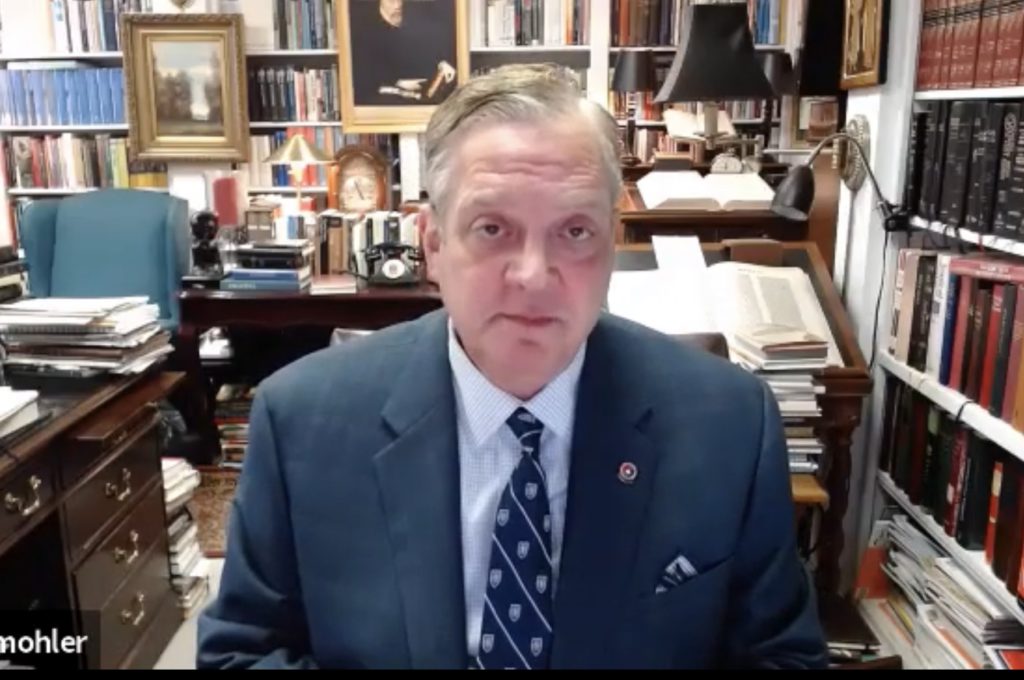
Here’s my video interview with longtime Southern Baptist Theological Seminary President Albert Mohler. His school, in Louisville, Kentucky, is one of America’s and the world’s largest seminaries. Mohler himself is one of Evangelicalism’s most prominent public voices. In our conversation, in which Mohler speaks from his legendary personal library, he discusses the seminary’s response to Coronavirus, his recent announcement of his presidential electoral choice in 2020, and his new book The Gathering Storm: Secularism, Culture, and the Church. Enjoy!



Comment by Jo Anne Lyon on May 1, 2020 at 9:03 pm
Thanks for this interview. Brought more clarity.
Comment by Jean Primm Purcell on May 2, 2020 at 10:16 am
Refreshing conversation. Point of interest – the term “conservative Christian.” I get why it’s used “in inside talk” yet it rakes across my sensitivities as one very concerned about “the church.” My biggest encouragement comes from stories in Africa about steadfast faith of Anglican leaders, for example. I had a memorable conversation with the leader of a Christian community large in India (Mar Thoma) staying with our Indian friends overnight. Never have I experienced such an attentive listener. I was in awe of the spirit of such a revered, intelligent, humble person. Good seemed to emanate from him
I know the Christians in India, a certain region there, pray faithfully & sing from house to house in the mornings. That is the Christian life there, including much hospitality towards travelers, etc. I long to share that more where I , USA. Here, in DC area, near Baltimore, too, program-devotion is hurting the Christian way of giving tI’m to each other, truly sharing. In that regard, the Korean pastor & his wife who lead that community in our Anglican church, are most dear to me. A bishop, also, now retired, showed that same spirit, no pretense but calmly real. I’m frustrated about church life in this era.
“
Comment by Gary Bebop on May 3, 2020 at 3:14 pm
Great interview, addressing real concerns about the present march of strident and pugnacious secularism, and the need to vote strategically in 2020. Give us more!
Comment by Sam on May 4, 2020 at 4:16 am
Mohler is a national treasure.
Comment by Bill on May 8, 2020 at 6:02 pm
Mark, Great interview. Now I understand that brother Mohler is a strong Christian.
Comment by Charlie Winkelman on May 8, 2020 at 8:46 pm
Great interview, Mark. I appreciate your ministry for those trying to be faithful in the “sideline” denominations. I also appreciate the Southern Baptist commitment to God’s Word in the face of the anti-Christian secularism of much of modern American culture. As a small church PCUSA yet evangelical pastor in north-central PA about to retire & hoping to “finish well” for Jesus, you & IRD have been a great encouragement. Thanks!
Comment by Ted R. Weiland on May 11, 2020 at 5:05 pm
For more regarding the late 1700 founders’ religious persuasions, see Dr. Albert Mohler’s interview with Dr. Gregg Frazer at http://www.albertmohler.com/2012/09/10/what-did-americas-founders-really-believe-a-conversation-with-historian-gregg-frazer/.
Dr. Frazer proves from the key founders’ own writings that they were neither Deists in the purest sense of the word, nor were they Christians in the Biblical sense of the word. Instead, they were Theistic Rationalists.
Dr. Mohler is President of the Southern Baptist Theological Seminary. Dr. Frazer is Professor of History of the Master’s College in California.
Comment by Sue on May 13, 2020 at 10:12 am
So glad I listened to this interview. “Hope” is the operative word for the Christian.
Comment by Rebecca on June 4, 2020 at 5:33 pm
I am going to listen to the interview again. But, due to one of the comments above, I’ll add a site where they have the primary source documents used by the American founders. Yes, we were founded as a Christian nation: https://www.constitution.org/primarysources/primarysources.html And, the school textbooks after the Revolution were very religious, clear into the 1900s.