The following guest post is from Bishop Timothy Whitaker. Bishop Whitaker was elected to the United Methodist episcopacy in 2001, and led the Florida Annual Conference. He retired in 2012.
The first half of the second article of the Nicene Creed is considered to be the most important expression of orthodox Christology: We believe in one Lord, Jesus Christ, the only Son of God, eternally begotten of the Father, God from God, Light from Light, true God from true God, begotten, not made, of one Being with the Father; through him all things were made. For us and for our salvation he came down from heaven; was incarnate of the Holy Spirit from the Virgin Mary, and became truly human.
While the first half of the second article is undoubtedly the most significant expression of the church’s confession of the truth of the incarnation to communicate that salvation through Jesus Christ is from God, the final statement in the second article is also an extremely important statement about the identity of the Lord Jesus Christ, the only Son of God. This final statement is eschatological (“the last things”) whereas the first half of the second article is mostly protological (“the first things”). The final statement is, He will come again in glory to judge the living and the dead, and his kingdom will have no end.
The statement itself literally comes from the annunciation of the angel Gabriel to the Virgin Mary in the infancy narrative of St. Luke. Luke 1:33 contains the divine promise to Mary and the world, He will reign over the house of Jacob forever, and of his kingdom there will be no end (NRSV).
Behind this citation of Luke 1:33 is a story of the church attempting to get right its conception of Christology and Trinitarian theology and also rejecting the theology of one of the stalwarts of the Council of Nicaea.
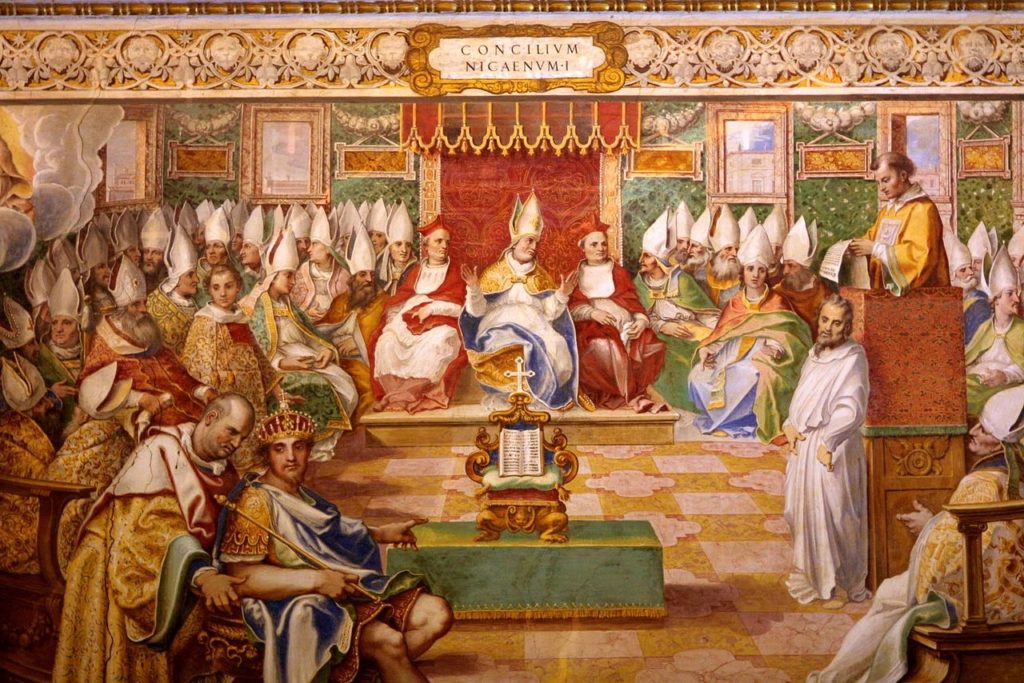
The Council of Nicaea rejected as heresy the theology of Arius, the Alexandrian presbyter, that the Son was a creature of God the Father. If Arius were right, then the church was committing idolatry in worshiping Jesus Christ. When the Eastern creeds began to include the teaching, and his kingdom will have no end, they were rejecting the Sabellian heresy of another and more recent teacher, Marcellus of Ancyra.
Marcellus had been a member of the Council of Nicaea who strongly supported the inclusion of the hoomousion and who was a friend of the great champion of Nicene orthodoxy, Athanasius of Alexandria. According to Marcellus, the Word of God did not become the Son until the incarnation and therefore the name of “Son,” like the names of “Christ” and “image,” were properly applicable to him during the incarnate state of the Word. Sonship in the deity would disappear when the purposes for which the Word became incarnate had been finally accomplished. Jesus Christ the incarnate Son was indeed promoted, as it were, to divine status, but Marcellus thought the Son would ultimately be absorbed into God’s Being as the divine energy of God, the Word (Logos) of God.
Marcellus denied that the kingdom of the Lord Jesus Christ, the only Son of God, would have no end. The idea that Christ’s kingdom would be everlasting makes no sense if there were no further role for the incarnation of the Word as the “Son” or the “Christ” when the purposes of the incarnation are consummated. The story of Marcellus is just another illustration of the perennial fact that the scriptures are subject to plausible interpretations that do not fit the doctrine of the church when interpreters are guided by presuppositions that differ from those of the church. There is no end to speculation and theologizing, but the scriptures belong to the church, and the church itself is guided by the Holy Spirit, including tradition which is the product of the illumination of the mind of the church by the Spirit.
The church in the fourth century was repelled by Marcellus’ teaching, and that is why the Nicene Creed includes the clause, and his kingdom will have no end. The reason the church so strongly viewed Marcellus’ teaching as dangerous is because the idea that there will be an end to Christ’s kingdom is tkingantamount to the idea that there will be an end to the Person of the Lord Jesus Christ, the only Son of God–which, indeed, is what Marcellus thought. What was at stake in the theology of Marcellus was nothing less than the ontological status of the identity of Jesus Christ as the only Son of God. Since Marcellus had supported the first half of the second article of the Nicene Creed, as it was expressed in the Creed of Nicaea, as a member of the Council of Nicaea, his rejection of the everlasting kingdom of Christ proved that endorsing the first half of the second article did not guarantee orthodox Christology and Trinitarian theology. Thus the clause, and his kingdom will have no end, had to be included in the creed to rule out any misunderstanding of the first half of the second article.
This confession at the end of the second article of the Nicene Creed is as important as the protological section in the first part of the second article. To claim that the Son’s kingdom will have an end is to claim, in effect, that the Son himself will have an end and that God is not triune. The confession, and his kingdom will have no end, underscores that the only Son of God, who is the same as the Lord Jesus Christ, has his own hypostasis eternally distinct from that of God the Father, and that God is not a solitary Monad who manifests himself in transient modes of being, but God is the superabundant, ineffable, eternal communion of three Persons of the same Being. Thus the kingdom of God is the kingdom of the Father and of the Son and of the Holy Spirit, for the Father always has with him the Son and the Spirit.
The explication of the Nicene Creed by the World Council of Churches, Confessing the One Faith, observes that “from the beginning of his earthly mission, Jesus proclaimed the kingdom of his Father (Mark 1:15),” and so “his own kingdom can never be anything other than to prepare and bring about the kingdom of the Father.” Indeed, his kingdom is precisely “to persuade and lead everyone and everything into submission to the Father, just as the Son submits himself to the Father.” Consequently, because Christ’s kingdom is all about seeking the rule of the Father, his kingdom “will have no end” (Luke 1:33). The import of confessing the kingdom of Christ is that “it implies criticism of systems and ideologies” and the “unmasking of the false claims” of all the kingdoms of this world. The church bears witness to the true kingdom and provides the earthly kingdoms “with a perspective of their ultimate destiny and with a criterion of what will be expected of them by the coming Judge. World history should be moulded with that judgement in mind–that is, in the light of the kingdom of the Pantocrator [the Almighty], the Ruler of all creation.”
The church of Jesus Christ lives between the first and future comings of its Lord. This eschatological tension entails having to walk a fine line between being in the world, which involves a responsibility to be in solidarity with the world and its well-being, and not being of the world, which involves learning the skills of maintaining the integrity of the church’s distinctiveness as God’s messianic people. Thus the church prays for the nation in which it exists and seeks to be a constructive contributor to society. At the same time, the church never endorses without reserve or even objection all of the values and ways of the state and society of which it is a part. This difficult, but never uninteresting, task of living as the church in the world will continue until the end of history because the church confesses of Jesus Christ: and his kingdom will have no end—his kingdom, not any of the kingdoms, nations, tribes, or agendas of this world.



Comment by Steve on February 21, 2020 at 9:12 pm
Thank God for Bishop Whitaker! His God-given theological insight is a blessing and benefit for the whole Church. O, for more of his type in the episcopacy,
Comment by One Trick Pony on February 22, 2020 at 4:52 pm
Cause not to mourn the passing of the UMC: https://tinyurl.com/tobpbgq WSJ article entitled “Thank God, American Churches Are Dying” Ericka Andersen, Feb. 20, 2020
“As thousands of churches close across the U.S., many fret about the inevitable decline of faith in American life. Congregational demise is troubling, but underreported data suggest that fear of a secularizing America may be overwrought. A religious renewal could be on the horizon.”
The times they are a changing.
Comment by Roger on February 22, 2020 at 5:19 pm
The Nicene Creed, should have explained the word “begotten”. It means by the Power of his Resurrection, he was begotten. See Acts 13: 32 – 33 and Romans 1: 3 – 4. His Kingdom will have no end because Jesus will not return to corruption (Acts 13: 34). Then in 1 Corinthians 15: 28 , when everything is subdued under Jesus’ feet, Jesus himself will subject to Him that put all things under him, that God can be all in all. (Alpha & Omega); One = Trinity, Godhead, or Elohim. Therefore, sometimes our Creeds don’t follow scripture.
Comment by Timothy W Whitaker on February 25, 2020 at 11:24 am
The Nicene Creed is structured according to the scriptures of 1 Corinthians 8:6 (“one God,” “one Lord”), which confesses that the one Lord Jesus Christ shares the divine identity of the one God and is the basis of the first two articles of the creed; John 15:26, which confesses that the Holy Spirit proceeds from the Father and is the basis of the third article of the creed; and also 1 Corinthians 15:3-4, a very early apostolic formula that is the basis of the confession about Christ’s death and resurrection for our salvation in the second article of the creed. The common apostolic formula cited by Paul in Romans 1:3-4 does not teach an adoptionist Christology, but it confesses that Jesus is the Messiah in two states–the Messiah who is the descendant of David in the humble state of his earthly life, and the Messiah who is “in power” in the glory of his risen life. It is true that there are some texts, e.g. Acts 13:33, which in isolation can be understood as saying that Jesus became the Son by his resurrection (rather than that he was revealed to be the Son by his resurrection), but these texts have to seen in the context of other Christological texts such as Philippians 2:6-11, John 1:1-8, and Hebrews 1:1-4 (also notice how Psalm 2:7 is quoted in Hebrews 1:5 in the context of Hebrews 1:2, meaning that “today” signifies the eternal day). The Nicene fathers like Athanasius were biblical theologians who primarily engaged in exegesis of texts by considering the sense of the whole of the scriptures, and studying the fathers helps us today to see how the Nicene Creed is grounded in the witness of the scriptures. The term “begotten,” derived from the “monogenes” in the Johannine literature, signifies the relation of the Son to the Father by analogy to human birth, and it confesses that the Sonship of Jesus Christ precedes the incarnation.