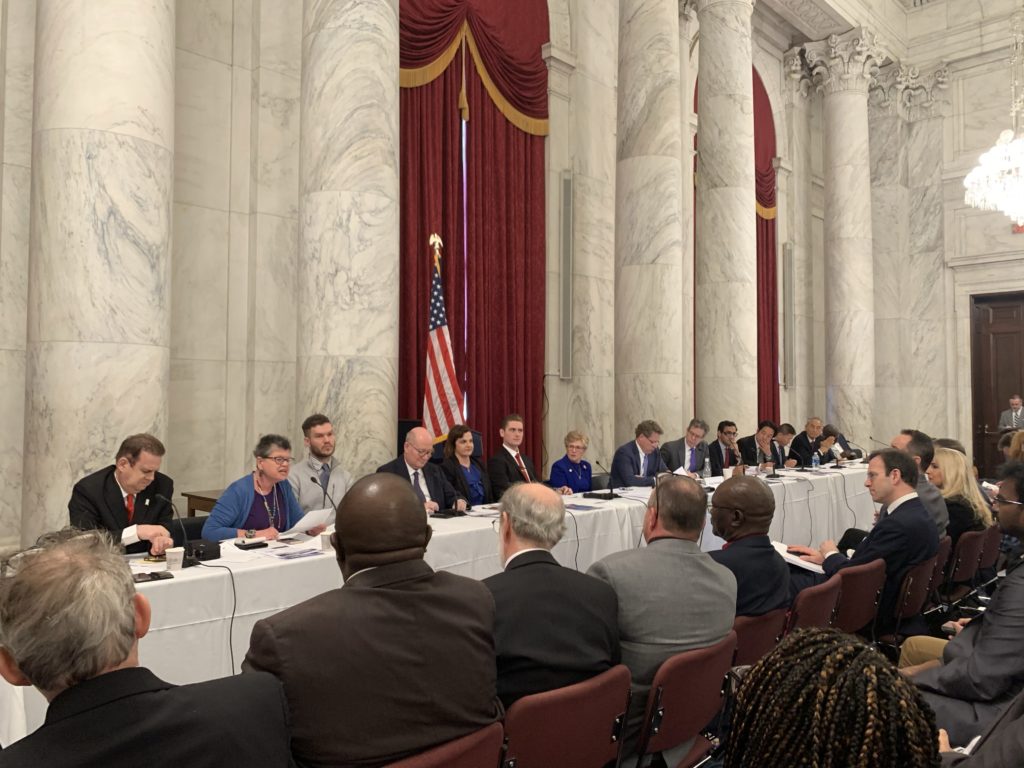
Tuesday, February 4, an unusually large crowd gathered in the Kennedy Caucus Room of the Russell Senate Office Building for a meeting of the International Religious Freedom Roundtable. The Roundtable is hosted by the Ambassador-at-Large for International Religious Freedom Sam Brownback. It is a regular occurrence – almost weekly. But this past week’s meeting was different because it was held during the week of the National Prayer Breakfast. Many of the some 200 people at the meeting were in town for that annual occasion.
At this meeting we were honored by the attendance of special guests from partner countries. And I was one of a number of people making statements about religious freedom issues. My statement is below, but here first, some background for my comments about both Sudan and South Sudan:
There have been some promising changes in Sudan. After months of protests by Sudanese citizens, (and years of persecution and warfare against Sudan’s “marginalized” people groups) Omar al Bashir, the genocidal Islamist leader of Sudan was removed from office, arrested, and imprisoned. A new transitional government including civilian and military councils is in place.
But some of the new leaders of Sudan are the same as Bashir. And so far, the United States appears to have failed to champion and support in any significant way both the new leadership that is different from the Islamist jihadists (such as Prime Minister Abadalla Hamdok), and the opposition force leaders that have always been different from the Islamist jihadists – in particular, Commander Abdelaziz Adam Alhilu, the leader of the Sudan People’s Liberation Army, North.
Alhilu, from the Nuba Mountains, is insisting on the new Sudanese government being a secular state, with no religion (read: “Islam, Sharia”) in lawmaking. This, he says, is the root cause of Sudan’s problems – Sharia and the superiority complex of Sudanese Arab Islamists over people from black, African ethnicities.
He says that if this demand is not met, the SPLA-North will call for self-determination in the area of Sudan under its control. And that area is quite a large area – since Alhilu’s army has been victorious in every ground battle in which they have engaged.
If the State Department has any sense, it will support this pro-freedom, pro-secular democracy position for Sudan’s constitution and governance. If it has any sense, it will not provide American “advisors” with the attitude of someone like Noah Feldman, who insisted that the Iraqis should include Sharia in their constitution. We see how well that worked out.
When it comes to South Sudan, the United States government, like the United Nations and pretty much the world community, has consistently portrayed the situation in that nation as a civil war between two equal sides. South Sudan President Salva Kiir and rebel leader Riek Machar have been portrayed almost as if they were two rival warlords, when one is actually the legitimate, fairly-elected president of the nation and the other is the former vice president who has attempted several coups and worked with the Islamist regime in Khartoum to wage armed, brutal rebellion by targeting civilians.
Now, miraculously enough, there was another peace agreement between the South Sudan government and the rebels. Currently negotiations have been taking place for a government reshuffle, incorporating all the rebel players into positions. The deadline for the completion of the government reshuffle is quickly approaching. Rather than threaten President Kiir with punishment if the deadline is not met, the United States should be supporting the sovereignty of the nation and Kiir’s leadership as he works to realign the government. That would give him confidence and would be a signal to those attempting to overthrow him that they do not have the backing of the United States.
Conversely, if we don’t support the legitimate leader, the former rebel forces that caused this disaster in the first place will take that as a green light NOT to cooperate, NOT to form a new government, but to resist.
ON SUDAN AND SOUTH SUDAN
Statement by Faith J. H. McDonnell, Institute on Religion and Democracy
Thank you, Ambassador Brownback and Greg.
I would like to introduce the Rt. Reverend Andudu Adam Alnail, the Bishop of Kadugli and Nuba Mountains, Episcopal Church of Sudan, and the Reverend Jim Tomkins from the Anglican Church in North America.
I am sad and disappointed today. I hoped to introduce Commander Abdelaziz Adam Alhilu, the leader of the Sudan People’s Liberation Army-North, a hero who has defended his people against genocidal forces in Khartoum for decades, and a man who truly believes in secular democracy and religious freedom for all. He was invited to the National Prayer Breakfast, and the Nuba Community bought his ticket, but he was denied a visa.
Many of us are devastated. One Nuba American friend, an Arabic translator for the U.S. military fighting against al Qaeda and ISIS in Iraq since 2009, called me yesterday and asked if the United States government would continue business as usual with the Sudan government. And what Abdelaziz wanted to stress, and what Bishop Andudu, representing the Church in Sudan, want to stress is that they will not accept Sharia. They did not fight and die for 30 years to have a new government also impose Sharia!
We are asking you, Ambassador Brownback, and the U.S. government to stand for ALL the people of Sudan, and to impress upon the Sudanese leadership that Sudan is for all Sudanese, even for the 75% of the population that has been called “marginalized” for years.
Then there’s South Sudan. South Sudan is at a turning point. A new government reshuffling is to take place. The sovereign nation of South Sudan, and the freely and fairly elected President of South Sudan, Salva Kiir, have done everything they can to enable this to happen, and have allowed people back in the government that have been responsible for countless deaths and displacements – because the U.S. and the world community told them to do it. Now we need to stand with them and signal to President Kiir that we support him as he works to realign the government. Because if we don’t, the former rebel forces that caused this disaster in the first place will take that as a green light NOT to cooperate, NOT to form a new government, but to resist.
In addition, some younger Diaspora South Sudanese now think that they can take over the country! They have even been talking to the Africa group of the National Prayer Breakfast about how the US should not support either President Kiir or Riek Machar, but let the YOUTH lead the country: Youth that have not been invested in the actual founding of the nation. Youth that have been supporting rebellion, but now since they do not see a reward in that direction, want the nation handed over to them. I ask you to remember what happened when youth ruled in the novel Lord of the Flies!
Again, I ask that the US government would signal support for upholding the sovereignty of South Sudan and not playing into the hands of the Gulf States and others that want to see South Sudan fall. Thank you, and God bless you all.
No comments yet


Leave a Reply