
By now, it is common knowledge that Evangelical Christians played a major part in electing Donald Trump. Exit polling showed that this demographic – white Evangelicals in particular – voted heavily for the Republican president-elect. However, another even larger group known as “notional” Christian also contributed to this outcome by throwing their support behind Trump at the last minute.
“While the media have made a big deal about the prolific level of evangelical support won by Trump, the real story may be elsewhere,” the Barna Group reported on December 1. “Barna’s research indicates that perhaps the most significant faith group in relation to the Trump triumph was notional Christians.”
The Barna Group surveyed voters after election 2016, finding that notional Christians made up 43 percent of voters. Between September and Election Day, support for Trump within this demographic shifted by 14 points in his favor. Trump was running 12 points behind his Democratic opponent Hillary Clinton among notional Christians in September, but ended up winning this group by 2 points in the actual election. This swing was the largest percentage change in favor of Trump of any religious group reported by the Barna Group.
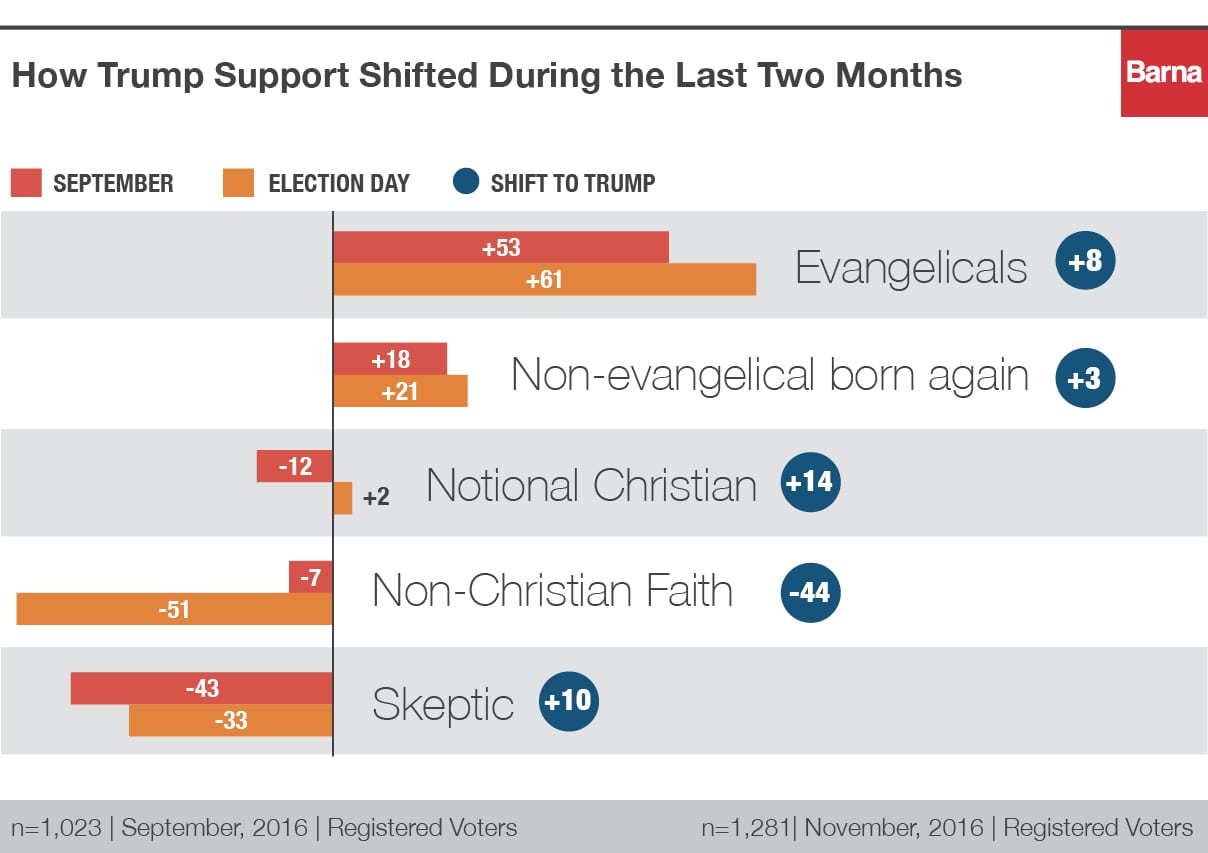
Trump’s victory among notional Christians was also significant due to the relative size of the demographic within the American electorate. Notional Christians made up nearly half of voters when defined by the Barna Group as follows:
Notional Christians are people who consider themselves to be Christian but they have not made “a personal commitment to Jesus Christ that is still important in their life today” or believe that when they die they will go to Heaven because they have confessed their sins and accepted Jesus Christ as their Savior.
The Barna Group specified “nine specific theological criteria” in order to qualify as an Evangelical instead of whether voters merely self-identified as one. Consequently, Evangelicals represented only 7 percent of voters according to the Barna Group, although this group overwhelmingly voted for Trump instead of Clinton (79 percent versus 18 percent).
Non-evangelical born-again Christians – who dedicated their lives to Christ but failed to subscribe to all the theological tenants of Evangelicalism – made up 24 percent of voters. They favored Trump by a margin 21 points over Clinton (56 percent to 35 percent) on Election Day.
George Barna, founder of the Barna Group and special analyst for election 2016, also noted the Clinton’s overwhelming victory among religious “skeptics,” an increasingly significant demographic in America.
“There has been no discussion about the fact that the skeptic vote really kept Hillary Clinton in the race,” Barna said. “The 33-point margin she retained with that one-fifth slice of the voting population was her primary faith base. The size of the skeptic population continues to grow while the born again community continues to shrink.”
No comments yet




Leave a Reply