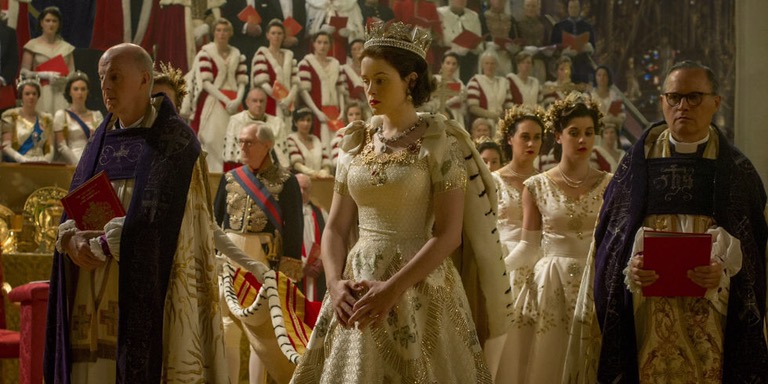
There’s a wonderful scene in the new Netflix miniseries The Crown about the British Royal family in which young Queen Elizabeth asks her aged grandmother Queen Mary about her ultimate responsibility. Mary responds:
The calling comes from the Highest Source, from God Himself. Monarchy is God’s sacred mission to grace and dignify the earth, to give ordinary people an ideal to strive towards, an example of nobility and beauty to raise them from their wretched lives. Monarchy is a calling from God. That’s why you’re crowned in an abbey, not a government building, why you’re anointed, not appointed. It’s an archbishop who puts the crown on your head, not a minister or public servant, which means you’re answerable to God in your duty, not the public.
Elizabeth demurs, explaining that her husband Prince Philip disagrees, believing in “separation of church and state,” and that the clergy are responsible to God, but monarchs serve the public.
Mary dismisses Philip’s views, noting that his Greek and Danish royal ancestors were merely “carpetbaggers and parvenus,” who couldn’t possibly compare to their own grand 1000 year lineage. “It’s the Church of England, dear, not the Church of Denmark or Greece,” Mary concludes to her granddaughter with finality, her point needing no further elaboration.
On the surface, Queen Mary’s views, expressed in 1952, seem medieval. Britain had centuries before established parliamentary supremacy over the crown. The “divine right of kings” had last been fully claimed by King Charles I, provoking a civil war and his own beheading.
And yet this spiritual view of monarchy does not claim coercive political power. Mary tells her granddaughter she must not intervene politically, even as she struggles with an elderly Winston Churchill who refuses to retire. Instead the monarch’s hardest task is to remain impartial and act as symbolic ruler for all people. The crown is an icon of the state’s ultimate vocation ordained by God.
A modern democratic regime is elected by the people, and if responsible and honest, will pursue the best interests of the people. At the same time, all legitimate government serves under divine authority, in accordance with divine law, enacting justice and peace. Modernity interprets government as mainly the instrument of popular will, unhindered by transcendent authority. Christian pacifists deride war and capital punishment, along with all force, as merely public vengeance.
But states that are just and true are not debasedly enacting public whims. They instead, to the extent humanly possible, and realizing the limits of their authority, prudently and impartially exercise righteousness for the public good in service to God and His glory. Governments need not be theocratic to be just, of course, and preferably are not, nor do the personalities of government have to be pious. Yet all rightful governments, knowingly or not, serve at God’s pleasure.
Old Queen Mary, as a lay theologian, seems to understand the state’s divine vocation in her counsel to young Queen Elizabeth, who listens and heeds, for the good of her people and the world.
No comments yet




Leave a Reply