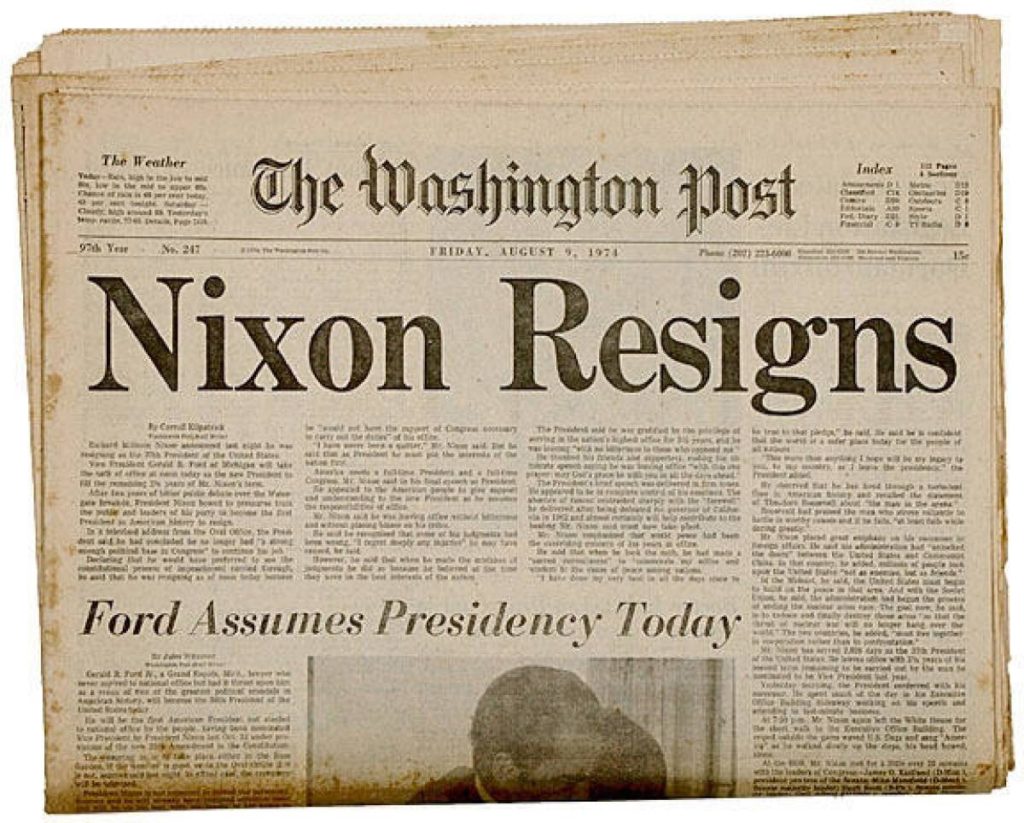
Although only age 9, I very well recall the day of Richard Nixon’s resignation from the presidency on a very hot Washington Summer day 42 years ago as of August 9. Everybody the day before, at least in DC, was abuzz about it, including the children with whom I spent the day at Summer camp. “Nixon’s resigning!” was the echo on the bus ride back to Virginia from a Washington playground. Even the very young and uninformed could not help but know of the unfolding national crisis surrounding the Watergate scandal that dominated television, newspaper headlines, and lots of conversation. My fourth grade teacher in Arlington, Virginia had given our class a full and fairly impartial briefing about Watergate. We had all listened quietly and carefully.
On the evening of August 8 with my mother I watched Nixon’s anticipated resignation speech, which I just re-watched for the first time after 42 years in its entirety. At the time critics were angered by its lack of detailed admissions about wrongdoing and its professions of nobly placing country before personal interest by resigning rather than contesting impeachment. He regretted “deeply any injuries that may have been done in the course of the events that led to this decision.” And he “would say only that if some of my judgments were wrong, and some were wrong, they were made in what I believed at the time to be the best interest of the nation.”
Nixon shared that his whole family, and his own lifelong instincts, counseled him to fight on. But the lack of support in Congress made such combat untenable and inadvisable for the national interest. He urged support for incoming President Gerald Ford. Nixon understandably reviewed his considerable accomplishments: the opening to China, renewed friendship with Arab peoples [especially Egypt, which had just broke with the Soviets], new relations and nuclear arms limitations with the Soviet Union, which he hoped would eventually lead to “destroying these terrible weapons so that they cannot destroy civilization and so that the threat of nuclear war will no longer hang over the world and the people.”
Only briefly citing having “ended America’s longest war,” i.e. Vietnam, Nixon had less about which to boast, as he knew even then that Indochina was on the verge of collapse to communism. Noting that “peace among nations” had always been and would remain his passion, he pointed to ongoing global aspirations:
Around the world, in Asia, in Africa, in Latin America, in the Middle East, there are millions of people who live in terrible poverty, even starvation. We must keep as our goal turning away from production for war and expanding production for peace so that people everywhere on this earth can at last look forward in their children’s time, if not in our own time, to having the necessities for a decent life.
And Nixon extolled his own country’s continued abundance amid challenges:
Here in America, we are fortunate that most of our people have not only the blessings of liberty but also the means to live full and good and, by the world’s standards, even abundant lives. We must press on, however, toward a goal of not only more and better jobs but of full opportunity for every American and of what we are striving so hard right now to achieve, prosperity without inflation.
Nixon was “confident that the world is a safer place today, not only for the people of America but for the people of all nations, and that all of our children have a better chance than before of living in peace rather than dying in war.” Even as he resigned in disgrace, he hoped his pursuit of peacemaking would be his legacy to the country.
I vividly remember the unprecedented giant, terse banner headline on The Washington Post sitting on the front stoop next day: “Nixon Resigns.” That morning of August 9 with my grandmother I watched his emotive farewell to the White House staff, in which he quoted Teddy Roosevelt again, as he had the night before, and delivered a rambling, poignant, seemingly impromptu review of his own family’s sufferings, including his mother who was a “saint,” and his simple, poor father, a lemon farmer and grocer, who was a “great man,” because he “did his job.”
There were several unforgettable Nixonesque quotes:
The greatness comes and you are really tested, when you take some knocks, some disappointments, when sadness comes, because only if you have been in the deepest valley can you ever know how magnificent it is to be on the highest mountain.
And:
Always give your best, never get discouraged, never be petty; always remember, others may hate you, but those who hate you don’t win unless you hate them, and then you destroy yourself.
Some have seen in this last quote an admission that Nixon, who had succumbed to rancor and with perhaps paranoia to his own many enemies, realized he had “destroyed” his own administration through his own avoidable obsessions. In his speech the night before, he had insisted he bore no “bitterness toward those who have opposed me, because all of us, in the final analysis, have been concerned with the good of the country, however our judgments might differ.”
And yet countless Watergate tapes indicate his bitterness was in fact quite ample. His claims of good will were likely aspirational, the rhetorical fruit of his boyhood Quaker conscience that neither war nor political combat had ever fully suppressed. Nixon, striving always to be tough, had often dissembled and plotted, but rarely with ease.
Nixon told his White House staff, some of whom wept, before he boarded his presidential helicopter for the last time:
I can only say to each and every one of you, we come from many faiths, we pray perhaps to different gods — but really the same God in a sense — but I want to say for each and every one of you, not only will we always remember you, not only will we always be grateful to you but always you will be in our hearts and you will be in our prayers.
And Nixon had concluded his resignation speech with this prayer: “May God’s grace be with you in all the days ahead.”
An unaired video of Nixon’s preparations for this resignation speech show a smiling man trying to be jocular and calm with the assisting staff at what was the most agonizing moment of his life. His strained banter is both awkward and endearing.
Even in my boyhood I sensed the angry national differences, including in my own family, over Nixon, whose quarter century political career had always been among the most divisive. But the passage of decades has cooled many of the most heated opinions about the man. There is now a calmer reflection about his faults, failures and genuine achievements, which we should remember as we address today’s rancorous public debates over current political personalities.
Whatever Nixon’s many private demons, given poisonous vent in the Watergate tapes and machinations, his resignation speech showcased his nobler longings for world peace and national virtue. Like most of us, he was used by God to achieve some good, for which he hopefully will be honored, even as his political and moral failures will also be forever recorded, and hopefully placed under God’s grace.




Comment by Steve on August 9, 2016 at 11:19 pm
I’ll beg to differ on how much he thought South Vietnam was on the verge of collapse. There is a school of thought that it took Nixon’s resignation to renew North Vietnam’s hope in an early military victory of the south. That they believed Nixon had guaranteed renewal of military support if the south were attacked. After Nixon left office, that support evaporated and the north felt free to renew the conflict and achieve their goal of reuniting Vietnam under the Communist rulers in Hanoi.