(Published in full on the Faith & Chelsen: Tackling Tough Topics in Church and Culture blog on Patheos Evangelical Channel)
The other day I saw the video footage that has recently been published by The Truth Division of Bernie Sanders extolling bread lines. Sanders, with more hair, talks about Nicaragua and how, “as poor as Nicaragua is,” one of the “nice” things that he saw was that as a result of “direct government policy in terms of the distribution of food, people are not hungry by-and-large.” (That “by-and-large” can cover a multitude of sins!)
Sanders continues that whereas American journalists lament the poverty of countries where people “are lining up for food,” he believes bread lines are a good thing! In other countries, he says, only the rich get food and the poor starve to death. You’ve heard of “rice-bowl Christians” — the Leftist concept that no one would ever consider embracing Christianity other than for a handout? Considering Senator Sanders’ disapproval of charities, in his utopia there would definitely be no rice-bowlChristians, but plenty of rice-bowl — brown, macrobiotic rice, I’m sure — Socialists.
Leaving economics, free market capitalism, theology, and other such virtues aside, the Sanders’ quote was a nostalgic moment for me. I was transported back to a church mission trip to Moscow in January 1991. In those heady days ofPerestroika and Glasnost, life was not as restrictive as it had been, but it was still the Soviet Union. Our team was there to work with a former prisoner of faith and personal hero of mine, Alexander Ogorodnikov. Ogorodnikov, who had spent nine years in the Gulag, was starting the first charity soup kitchen in the Soviet Union, amazingly, with the Supreme Soviet’s blessing.
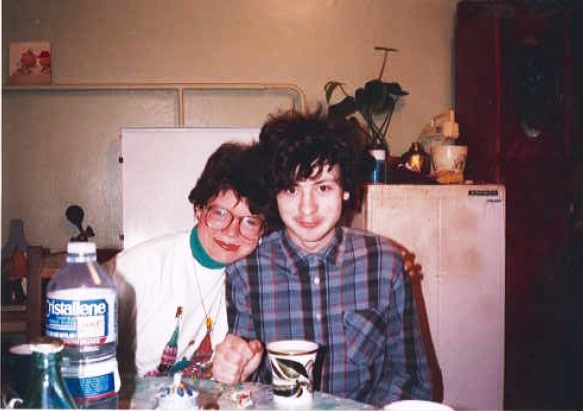
The four men on our mission team stayed at the flat of one of Ogorodnikov’s colleagues in the Christian Democratic Union of Russia (CDUR). Another colleague knew a place where my teammate Andrea and I could stay. It was the flat of a family that had gone to visit relatives in Romania and left their fifteen year old son, Sasha, at home. Through Sasha, who spoke English fluently, Andrea and I learned about the day-to-day life of a citizen in the Soviet Union.
We had seen many lines in Moscow wherever we went. Long lines, and the automatic response “it is very difficult” to every proposal we made were now familiar occurrences. But our first up-close experience with people in line for food was on the evening we took Sasha to Pizza Hut. In 1991 Pizza Hut was still a novelty in Moscow. Men, women, and children were in a queue that stretched around the block when we arrived. But Sasha led us to the other side of the building where there was no line at all.
“Why don’t some of those people come to this side?” I asked. It was very cold to be standing outside.
“They don’t have American dollars,” Sasha explained. “That’s the ruble side; this is the US dollar side.”
Sasha was excited. He had never been in the US dollar section of Pizza Hut before and assured us that it was much nicer than the section for the rubles possessors. One would be tempted to think: Those ugly Americans, lording it over the Russians, getting preferential treatment! But the US dollar section of Pizza Hut was full of Soviet citizens (Party members?), all flush with American currency. Soviet equality.
(Continued here)
No comments yet




Leave a Reply