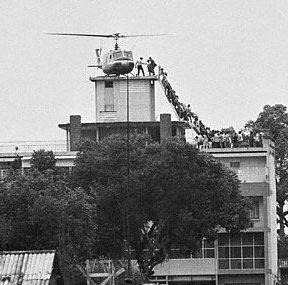
Yesterday The Washington Post had a fascinating obituary on Saigon’s last CIA station chief. Presiding over the CIA’s largest overseas presence, he was tasked to help preserve non-Communist South Vietnam after the U.S. military withdrawal. Of course, North Vietnam violated the 1973 peace accord, and the Nixon Administration, followed by Ford, was too enmired in Watergate to forcibly respond. Congress refused additional aid, and the result was disaster, after the expenditure of 50,000 American lives.
On April 29, 1975, the U.S. covertly alerted all U.S. persons to evacuate Saigon. They and thousands of panicking South Vietnamese were ferried to U.S. warships, many by helicopter from the embassy roof. The ambassador left with the U.S. flag under his arm. The CIA station chief, a Hungarian American and legendary operative whose experience dated to WWII, wired his last cable at 4:40am as Saigon fell to North Vietnam on May 1, as the Post recounted:
“This will be final message from Saigon station,” he wrote in a clipped, telegraphic style. “It has been a long fight and we have lost. . . . Those who fail to learn from history are forced to repeat it. Let us hope that we will not have another Vietnam experience and that we have learned our lesson. Saigon signing off.”
I was only 10 years old but I remember that day very well, with the giant newspaper headline “Saigon Falls” and television footage of desperate Vietnamese crowds pleading at the U.S. embassy gates for escape. Thousands would later be executed by their new Communist masters. Weeks before, Cambodia had also fallen to the monstrous Khmer Rouge, who would murder nearly 2 million, with similar scenes of anguish at the U.S. Embassy there, as well as in Laos, where Communists also conquered. Calamity and horror.
A John LeCarre novel recalls those days with the CIA chief in Hong Kong sardonically toasting his British counterpart: From one declining power to another!
Vietnam became a Soviet client state, and everywhere America, and democratic government, was seemingly in retreat. The world, already beset by global recession exacerbated by the 1973 oil embargo, faced a bleak future of permanent Cold War rivalry, undergird by the threat of nuclear war, with the Soviet Union gaining the edge. Threats of nuclear or environmental apocalypse (then it was global cooling, global famine, and a depleting ozone layer) were common fare. Even Hollywood churned out disaster movies.
Fourteen years later Communism fell in Eastern Europe, and in 1991 the Soviet Union, once so formidable, dissolved. America had at this point completed a decade of dramatic economic growth and was at the start of an unforeseen information and technological revolution. Suddenly it was no longer a declining power but the only superpower, a hyperpower without rivals, unprecedented since Rome, presiding over an increasingly democratic world of dramatic economic growth for nearly all. Even Communist Vietnam, shorn of its Soviet patron, eventually liberalized its economy while still clinging to one party dictatorship.
What a difference 15 years can make! And the shift was foreseen by very few, even the optimists.
Today, as 40 years ago, our culture is beset by declinism and pessimists. America is receding, economically, geopolitically, culturally and spiritually. Supposedly we are now post-Christian. Supposedly the future belongs to recreational marijuana, polyamory, socialized medicine, addictions to Internet porn, and unemployable middle aged men living in their parents’ basement waiting for government checks.
But history takes surprising turns none can predict. In the same Washington Post with the Saigon CIA chief obit was a report on the rise of a Tea Party type movement in France but centered on social not economic issues. It helped fuel this week’s electoral defeat in local elections of the ruling Socialists, who imposed same sex marriage and sexual orientation curricula in the schools, igniting mass protests in a country supposedly sexually permissive. France is largely secular, with only 5 percent church attendance. But it now has its own organized Religious and Cultural Right, which includes Catholics, Muslims and other traditionalists. Who would have guessed.
The supposed demise of American religion, reported breathlessly by secularists and by despairing religionists, ignores the burgeoning vitality of new inner city churches and the unchanged numbers for overall church attendance. The hegemony of liberal Protestant religion in the 1950s and 1960s helped generate the unexpected subsequent Evangelical revival in the 1970s and 1980s. What reaction will there be to today’s supposedly enshrined secular trends?
Only God knows. History and Providence don’t move in a predictable straight line. Our nation’s future is always in doubt, depending on the character of our people and divine grace. But the future of Christianity is always secure. Despite ourselves, we are promised The Church will prevail, a promise history has always confirmed.




Comment by Bryan Anderson on April 4, 2014 at 12:44 pm
Masterful and eloquent analysis! Even sermonic. Well done good and faithful servant.