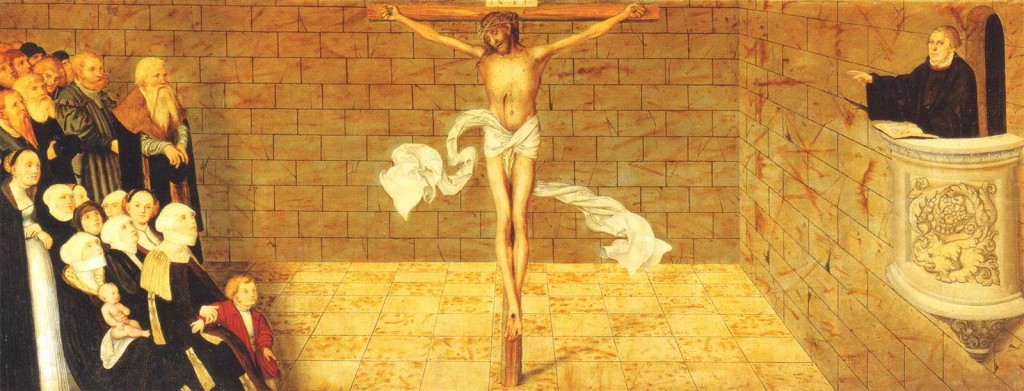
With the Restless and Reformed Movement getting some belated headlines from the New York Times, other Christian traditions are wondering once again how a strain of Calvinism (generally poo-pooed in the elite imagination) could gain traction among evangelicals looking for deeper theological roots. One group of particular interest has been the Lutherans. With a traditionally strong presence in the American Midwest and a prominent fruit of the Protestant Reformation, Lutheranism presents a perfect test case regarding religion in the United States.
James R. Rogers over at First Things offers just such an analysis, and I believe it’s one of the best diagnoses so far. Ethnicity and a poorly catechized laity seem to be obstacles, but even these should not get in the way of Lutheranism’s spirit and claims if someone is really an honest, well-read, and bright seeker. Other currents are afoot.
Among other factors, Lutheranism lacks an Institutes (a concise systematic theology by its founding figurehead), and its writings are harder to understand for a searching evangelical. The Augsburg Confession and Luther’s Shorter Catechism are composed differently than the Westminster Confession of Faith and the Westminster Catechism. The Westminster documents were written in response not only against Roman Catholicism, but also against the 39 Articles and spirit of Anglicanism, and thus the Westminster theologians included more rationale in their formulations. Seekers like to see the reasoning behind documents. It’s not like Lutheranism is hard to understand. It’s just that “reading into Calvinism” is easier for American evangelicals.
Also, the Lutheran views of the sacraments, grace, the church, and salvation really grate against the American spirit. To quote Rogers,
The crucial shift is that, for the Lutherans, justification derives from Christ’s faithfulness—his trustworthiness—rather than from an act of mental will…The rationalism and nominalism inherent in Zwinglian sacramental theology is the very air that American Evangelicalism inhales. The shift from an Evangelical church to a Lutheran church is therefore not simply one of amending a few abstract theological affirmations, it represents a cultural shift for the person as well as a shift in how one conceives of and expresses one’s piety and spirituality, both individually and as part of an ecclesiastical community.
Indeed, for American evangelicals, Zwinglian approaches to the ordinances are king, and even American Calvinism (perhaps because of Scottish Realism) has tended to exile or heavily reinterpret Calvin’s own views of the sacraments. If you think that is a specious claim, take note of the prominence of Reformed Baptists across the nation.
The author jumps around a big point (he kind of gets there) regarding America and Calvinism. Essentially, American intellectual thought is a giant development, struggle with, analysis of, and response to Calvinism, particularly the Puritan and Scottish strains. As Kevin DeYoung said recently, “American theology is still an extended debate about the meaning and truth of Calvinism.” It should not be missed that most Americans still think along religious lines.
Read the full article here.




Comment by Justin Clarke on May 30, 2017 at 10:11 am
As a former Evangelical turned Lutheran I can say that there are lots of Evangelicals are going to Lutheranism. Rogers is correct in that many of the thing lists are hindrances to the evangelical. Lutheran theology especially surrounding the sacraments are counter-intuitive to evangelicals. The thing is confessional Lutheranism, by and large, is not big on tooting its own horn. We don’t go to the Evangelical conferences, this often leads to people assuming we are not there, or that we are not growing. It has never been part of American Evangelicalism is and has no desire to be. We don’t see ourselves as Protestant or Evangelical we see ourselves as Lutheran.
People like Jonathan Fisk, Bryan Wolfmueller and the show Issues Ect have been major entry points for evangelical who converted to Lutheranism.
I was a seminary student at a Reformed institution when I left to join the Lutheran Church (LCMS), once you enter you realize how many evangelical refugees there are in the Lutheran church.
Comment by Richard CHAPMAN on June 20, 2018 at 3:09 am
I was raised in the lcms. Educated k thru 8 in our private school. We left the lcms over the seminex issue and later rejoined loosing a few to the wels folks who need a space of thier own God love them. I know more from my k thru 8 studies than many evangelical pastors can conceive. Further study at a Catholic university has brought ne here. No matter how hard I study I can find no better answers than the confessions. The evangelical mis use of solar scriptura to mean whatever you experience is good so long as you claim it came from scripture.ask them where scripture came from and you will get the best selling bookstore version. Bottom line The is people want to feel good and an alter call and an extra bath does that, gives them a sence I got this yet I know Daddy is backing me up. Even got a plan. NOTHEING IS HARDER THAN PURE SURRENDER AND THAT IS WHAT JESUS COMMANDS US AND CALLS US TO DO. So if you go to heaven God did that for You in its entirety, if you dont it’s your fault . That some get that complicated. It’s called faith. All this talk of judgment that is works rightiouness in a costume. Faith in The. Christ’s saving work and its efficacy makes you guiltless and without fault fully acquitted thru Christ. Many chapters by far better than myself have explained. Good news is God does all the work period. Come on over you will learn to love the 100 percent biblical liturgy.