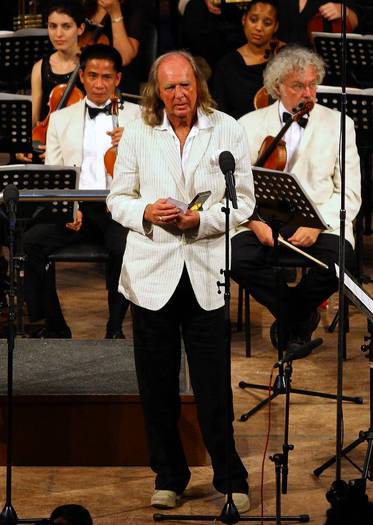
“I think there are an awful lot of artists around who are very good at leading us into hell. I would rather someone would show me the way to paradise.”
-Sir John Tavener (1944-2013)
These may not be the late English knight’s most famous words, but they capture, perhaps better than any others, the nature of what the musician strove to accomplish with his work, and what he labored to offer throughout his life. Few men in the last half century have filled the world with such sublime, ethereal music, nor composed in a style so imbued with a profound awareness of God’s presence. On Tuesday, November 12, the world-renowned choralist died peacefully at his home in Child Okeford, Dorset at the age of 69.
The Guardian reports that Tavener’s death came in the wake of “long suffering from health problems related to his having suffered a stroke in his 30s, as well as two heart attacks and a brain tumour”, while the Los Angeles Times notes that he “had been suffering from Marfan syndrome, a genetic disorder that contributed to his towering height — he stood 6 feet 6 inches tall — and weakened heart.” The LA Times‘ David Colker and David Ng observe in their obituary that
Tavener, knighted in 2000, suffered numerous medical setbacks in recent years, but it didn’t dampen his humor. Earlier this year he told a reporter from London’s Guardian newspaper that doctors couldn’t pinpoint a cause of some of the pain he was enduring. “All they ever say is, ‘You’re lucky to be here at all!'” Tavener said, “which is charming.”
He observed even those difficulties through a spiritual lens. “Suffering is a kind of ecstasy, in a way,” he said. “Having pain all the time makes me terribly, terribly grateful for every moment I’ve got.”
Such insightful words find their inspiration in the Gospels, Psalms, and numerous Church Fathers, though Tavener disdained to be considered a Christian mystic. He left no great written meditations or tracts on his experience of the divine love, but a deep spiritual awareness of God breathes through his compositions. Tavener is survived by his wife Maryanna and three children, and an extraordinary musical legacy which has seen his work lauded across, and above, Christian denominational boundaries.
It is especially fitting that Tavener’s music should transcend the confines of a particular denomination, given that his own life mirrors such transcendence. He was born to devout Christian parents in north London, assisted his father who worked an organist at a Presbyterian church, many of his choral works became well-known from their popular performances in Anglican and Roman Catholic cathedrals, and yet the man himself belonged neither to a Reformed church, nor the Churches of England or Rome. One particular aspect of Tavener’s life that remains largely unknown is that of his actual religious affiliation. He was, perhaps surprisingly to some, a convert to Eastern Orthodox Christianity.
As The Washington Post‘s Robert Barr notes in his obituary,
Sir John’s later, better-known works flowed from his conversion to Orthodox Christianity and his collaboration with Mother Thekla, a Russian emigre and Orthodox nun to whom he turned for support after his mother died in 1985.
Thekla’s short “The Life of St. Mary of Egypt” inspired his 1992 opera, “Mary of Egypt,” and she provided many of the librettos for other works.
The fruits of their collaboration included “The Protecting Veil” in 1987, “Song for Athene” (1993), “The Apocalypse” (1993), “Fall and Resurrection” (1999) and “We Shall See Him as He Is” (1993) [cf. 1 John 3:2].
Sir John dedicated his book “The Music of Silence: A Composer’s Testament” (2000) to Mother Thekla. She “helped me put my music and my life together,” he said.
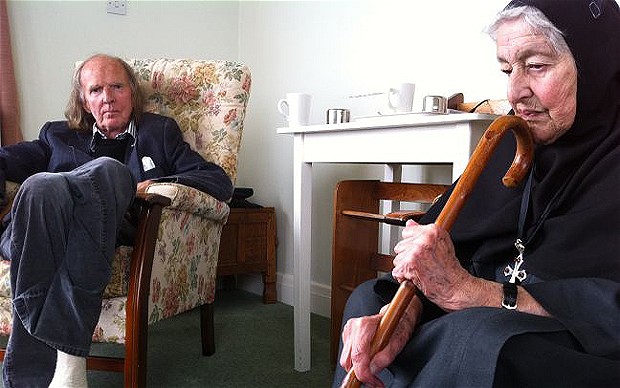
According to Mother Thekla’s own August 7, 2011 obituary in The Telegraph, not only was the brilliant nun Tavener’s spiritual mother, but also a constant source of creative feedback and intellectual inspiration for many of his compositions:
A beautiful, Russian-born Cambridge graduate who co-founded the monastery near Whitby and latterly lived there in seclusion as the abbess, she furnished the words for some of Tavener’s most important religious works, and was the spiritual driving force behind one of his most popular pieces, The Protecting Veil (1987).
In 1993 she supplied the words for Tavener’s Song For Athene, originally written to commemorate Athene Hariades, a young half-Greek actress he knew who had died in a cycling accident. Tavener attended Athene’s funeral, and came away with the music fully-formed in his mind. “I rang Mother Thekla that same day,” he remembered, “and I said: ‘I want words’.”
The next day’s post brought, from Thekla, the quote from Shakespeare’s Hamlet: “May flights of angels sing thee to thy rest”, together with verses from the Orthodox funeral service .
Mother Thekla was also Tavener’s librettist on his opera Mary Of Egypt (1992) and choral works including The Apocalypse (1993) and Fall And Resurrection (1999), which was dedicated to his friend the Prince of Wales.
Tavener’s conversion marked a profound turning point not only in the composer’s spiritual life, but also in the style and range of his work. As Colker and Ng report,
Tavener first came to fame with his raucous 1968 cantata “The Whale” that was so admired by John Lennon it was released on the Beatles’ Apple record label. But Tavener’s best known compositions are meditative, spiritual pieces rooted in the Eastern Orthodox form of Christianity he embraced in his 30s.
Among those works are the 1993 “Song for Athene” that was played during the funeral for Princess Diana in 1997, and a quiet 1982 setting of William Blake’s “The Lamb” often performed at Christmastime. His music was also used in films such as Terrence Malick’s 2011 “The Tree of Life” and Alfonso Cuarón’s 2006 “Children of Men.”
And even though his compositions became far more gentle than in his early years, it didn’t keep him from experimenting with the form and challenging audiences. His 2003 “The Veil of the Temple,” for example, is a choir piece of epic proportions — it takes seven hours to perform.
According to The Guardian’s brief obituary of Tavener in its Music section, “Tavener was best known for his religious music, and joined the Russian Orthodox Church in 1977. His Orthodox faith and the rituals of the church exerted a huge influence on his work.” Yet, as Colker and Ng note, Tavener did not confine his intellectual interests or musical inspiration to Christianity alone:
“. . . [H]e could stir controversy. His 2004 “The Beautiful Names,” based on the 99 names of Allah in the Koran, was commissioned by Tavener fan Prince Charles. But when it was performed by the BBC Symphony and Chorus at Westminster Cathedral, it drew protesters from Christian groups angry it was being done in such a prominent Christian landmark.”
While Tavener maintained a lifelong interest in other faiths, and never ceased learning all that he could about them, there is no evidence that he ever abjured his Christian faith or ceased to consider himself an Orthodox Christian. As the Guardian admits, in his 2010 interview with the BBC, he affirmed that he remained “essentially Orthodox” in his spiritual beliefs.

It is only fitting that I share with you two of Tavener’s most beloved and hauntingly beautiful choral pieces. First, his heart-rending elegy “Song for Athene”, touchingly re-arraigned as the “Song of the Angel” in time for Princess Diana’s 1997 funeral. Composed at the BBC’s request, the elegy combines verses from Shakespeare’s Hamlet (Acts II and V) and litanies from the Eastern Orthodox funerary liturgy. Here is a particularly magnificent arrangement sung by the Anglican Winchester Cathedral Choir. I include the lyrics in all their majesty, composed by none other than Mother Thekla, Tavener’s spiritual mother, dear friend and creative muse:
Alleluia, alleluia (Refrain).
May flights of angels sing thee to thy rest. (R)
Remember me, O Lord, when you come into your Kingdom. (R)
Give rest, O Lord, to your handmaid who has fallen asleep. (R)
The choirs of saints have found the well-spring of life and door of paradise. (R)
Life: a shadow and a dream. (R)
Weeping at the grave creates the song: Alleluia.
Come enjoy rewards and crowns I have prepared for you. Alleluia, alleluia, alleluia.
Lastly, I share with you the unabridged glory of Tavener’s Funeral Canticle (Ikos) in all its majesty, sung here by the Choir of St John’s College, Cambridge under the superb direction of Christopher Robinson.
As you read the haunting prose and listen to the sublime music — which begins by evoking the soul’s confusion at its departure from the body, continues in its uncertainty as to its ultimate destination, only to conclude with the transcendent hope of theosis — I leave you to ponder this quote from the late choralist: “If one is going to create this eternal, celestial music, one has got to listen, to be silent, to hear the angel of inspiration dictate.”




Comment by Michael Vakil Kenton on November 14, 2013 at 5:20 am
Sir John you knew from your direct experience that religion was so beyond the form. No doubt you are still playing music on another level.
Vakil, Sacred Music Radio
Comment by Ryan Hunter on November 18, 2013 at 9:26 am
Thanks for your comment, Vakil. I have no doubt that Sir John is singing in a different kind of choir now than one he ever conducted in his earthly life.
Comment by AleksOD on December 8, 2015 at 8:39 am
Thank you, Ryan. I never knew of him before. What an amazing man! What a fantastic music!
Comment by Ms Biljana Tesic on May 21, 2020 at 7:22 pm
Superbly written. I love John Tavener s music. Wonder if you can advise me where to obtain a copy of lyrics for EPISTLE OF LOVE by Sir John Tavener. Look forward to hearing from you soon.