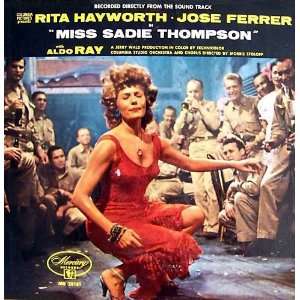
Over the weekend I watched the 1953 movie Miss Sadie Thompson, with Rita Hayworth escaping her fallen past and Jose Ferrer as the self-righteous churchman who won’t let her.
The film is a window into an earlier era when Mainline Protestants were still pillars of American culture. Ferrer is an influential layman who heads a powerful Protestant missions board based in Boston (!). His character and its zeitgeist no longer exist and shouldn’t be forgotten.
The fun-loving Hayworth character quickly stirs up a U.S. Marine base on a remote Pacific island when her ship in transit to New Caledonia drops her off for a brief visit. Her visit coincides with a delegation of well-dressed missions visitors, including Ferrer, his equally stern wife, and a more relaxed physician with his wife. Ferrer recalls his missionary father had evangelized the island’s natives, and he is appalled when a native church service is interrupted by raucous singing by Hayworth and her Marine admirers at the nearby saloon, which should be closed on the Sabbath.
Ferrer and his wife are even more indignant when they realize that Hayworth is staying with them at the island’s only hotel. And he eventually recognizes her as the employee of a Hawaii brothel that he had led the police to close. His physician colleague implores him to resist a campaign against Hayworth, but Ferrer successfully demands the island’s U.S. governor expel Hayworth back to San Francisco, where she faces additional legal difficulties. Ferrer, who has powerful allies in Washington, D.C. and is renowned for his political influence, insists he cannot compromise with evil.
Hayworth pleads for Ferrer to relent from his demands that she return home to face justice for her crimes, which included guns and unsavory underworld characters. A softer Ferrer eventually reads to her the 23rd Psalm, which spiritually convicts her and persuades her that she in fact must atone by facing the consequences of her past.
In a tragic twist, before Hayworth penitently leaves for San Francisco, Ferrer, in a moment of dark passion, sexually assaults her. The next morning his body is found in the surf, Ferrer having committed suicide over his own moral collapse. Hayworth stoically now rejects her previous spiritual awakening. But the kindly physician counsels that she not reject what is good only because Ferrer failed to abide his own professed standards.
Apparently the original story had Ferrer as an ordained minister, but censors insisted such misdeeds by a clergy were unacceptable, so he is instead a lay missions executive. It’s impossible today to imagine powerful Mainline Protestant missions officials sternly extolling righteousness to island natives, U.S. Marines or anybody else, much less compelling political action by government officials. A contemporary version might entail an activist Protestant missions executive, clad in shorts and a t-shirt, cajoling island natives into demonstrations against U.S. Navy vessels, to the indifference of U.S. diplomats.
And it’s hard picturing a missions official from almost any religious tradition of today demanding a stern morality from anyone. Therapeutic self-affirmation seems likelier.
Harder still to imagine today imposing, exacting authority figures exemplified, at least as a depraved caricature, by Ferrer, and more admirably portrayed in other movies of the era. Spencer Tracey as the priest in Boys Town would be one example. Such people actually once existed. I remember them from my childhood as teachers, school principals, clergy, business owners, neighbors. Generations starting with the Baby Boomers were uncomfortable in this role and, although deploying countless other virtues and talents, don’t aspire to stern imposing authority figures.
The slide into cultural informality and discomfort with authority may be one more consequence of Mainline Protestantism’s implosion. And moral drama as portrayed in Miss Sadie Thompson is hard when there is no defined morality.




Comment by Earl Foote on November 6, 2013 at 10:57 pm
This story has been shown several times. It is based on a W. Somerset Maugham short story called “Rain.” Under the name of “Miss Sadie Thompson,” a movie w/Gloria Swanson was released in 1928; another, called “Rain,” was released in 1931 (I think) with Joan Crawford. The leading man is shown as a self-righteous prig who leads Sadie to repentance but then rapes her and kills himself. I frankly don’t at all see anything admirable about the man; I doubt that Jesus would approve–remember the bit about “casting the first stone”? Sorry Mark, but this is not a good example of old-fashioned morality.
Comment by FAMiniter on November 8, 2013 at 9:36 pm
I agree with Mr. Foote. But then, when was there a good example of old-fashioned morality? Not particularly in Hawthorne’s The Scarlet Letter. Certainly not in Sinclair Lewis’s Elmer Gantry. Nor in George Eliot’s Middlemarch.
Rather, I would look for a more humble example, that of the Bishop Myriel, the Bishop of Digne, in Victor Hugo’s Les Miserables, who teaches, not by preaching stern words, but simply by giving and trusting. Save us from the Jonathan Edwardses of this world. The humility of Pope Francis is much more to my liking.
Comment by John S on November 18, 2013 at 8:36 am
A better question might be; what is old fashioned morality? It will be hard to find a movie extolling its virtues as Hollywood makes more money by sensationalizing against such. If you find it the exemplar is more likely a side character, like the physician in this movie, rather than those who are supposed to be the paragons of virtue, like Ferrer in this one. The irony is Christianity is flawed character grouped around and attempting to emulate a perfect one.