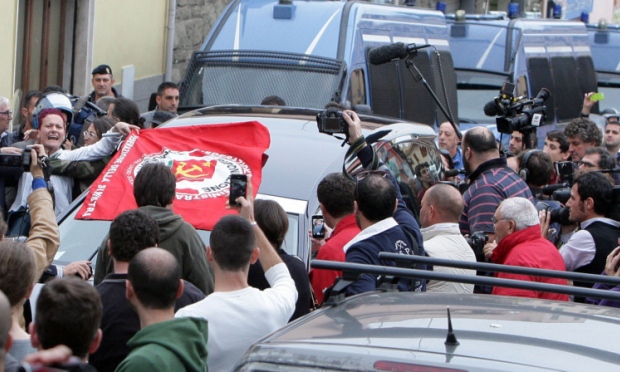
Earlier this month, former Nazi SS officer Erich Priebke died at the age of 100 while still under house arrest at the home of his lawyer in Rome, Italy. Priebke is most famous for carrying out the 1944 massacre of 335 Italians on Hitler’s orders, including around 80 Jews and a Catholic priest. Almost immediately, a debate began brewing about what was to be done with his body. Although his will dictated that he wished to be buried beside his wife in Argentina, the Argentinean government refused. His hometown in Germany indicated they weren’t interested. Meanwhile in Rome, Mayor Ignacio Marino banned any sort of burial or funeral service, saying, “Any demonstration of honor — civil or religious — would be an intolerable affront to the memory of those who fell in the fight for freedom of Nazism and fascism.”
It might seem disturbing that a secular official seemingly banned a man from receiving any religious funeral. However, the Catholic Church appeared to oblige him. Last Monday, the Pope’s Vicar General for Rome Cardinal Agostino Vallini instructed all Roman priests not to give Priebke a church funeral. After a funeral held by the schismatic Society of St. Pius X was disrupted by anti-fascist protesters, the new plan is for Priebke to be buried in a secret location.
Denying a funeral mass might seem harsh to some, but a cursory reading of canon law makes it clear that the denial was warranted. Canon 1184 §1 notes that an ecclesiastical funeral and funeral Mass must be denied to any “manifest sinners” who can’t be granted a funeral “without public scandal of the faithful.” “Manifest” sin is typically understood to mean sin that is clear and obvious to the community, presumably including the murder of hundreds of innocents. It is not made explicit whether or not the sinner needs to be unrepentant, but Priebke stubbornly refused to admit personal guilt for his actions until the end. In his last public statement, he reiterated that he was only following orders and denied the systemic gassing of undesirables by the Nazi regime as a Jewish myth.
The Catholic Encyclopedia (written as early as 1907) notes that in modern times, the practice of the Church has been to interpret prohibitions on burials as mildly as possible. But if ever there were a clear-cut case for the denial of a burial, this is it. However, it’s worth noting that if statements from the press are to be believed, Priebke seemingly attended Mass right up until the end. The terms of Priebke’s house arrest allowed him to attend church, and The Guardian reports that local Jews would be enraged to run into him on his walk to church through the park. Media reports don’t indicate what church he attended, but it’s a fair bet that since he requested a Catholic funeral, he likely attended a Catholic church. All of which leads to an important question: was an unrepentant Nazi war criminal receiving the Eucharist?
The language banning certain individuals from church funerals and the language banning individuals from receiving communion are very similar. Canon 105 bans those “obstinately persevering in manifest grave sin” from being admitted into Holy Communion. It seems that by any fair standard that those who are denied a Catholic funeral must also be denied communion while they live. But if statements from Priebke’s few supporters are to be believed (which is questionable, admittedly), he “has received the sacraments of the Confession and the Eucharist… as he die[d] reconciling with God and with the Church…” At the very least, there appears to have never been a citywide declaration from the Vatican banning Priebke from communion like their was denying him a burial.
If an unrepentant Nazi had indeed received communion, the reluctance of some in the Catholic Church to deny the Eucharist has reached parody levels. Likewise, decisions to deny Catholic funerals today are so rare that it typically generates media coverage. The Catholic Church ends up sending an unfortunate message; those who persist in manifest sins are welcome to partake to sacraments and be considered part of the Church community, except when public opinion demands that they not.
Compare the Priebke case with two other recent cases: In 2012, a Danish priest declined to bury a woman for being in an open lesbian relationship for over 30 years. After liberal Denmark predictably reacted with horror and outrage, the priest quickly apologized and backpedaled. In 2009, many Catholics openly criticized Archbishop of Boston Sean O’Malley for speaking at and presiding over the funeral of Massachusetts Senator Ted Kennedy, who for over four decades was the foremost pro-abortion voice in the Senate. Asked about the controversy, Cardinal Prefect of the Apostolic Signatura Raymond Burke went as far as to openly criticize Archbishop O’Malley’s decision to allow Senator Kennedy to have a Catholic funeral.
No doubt Priebke’s sin was worse than the Danish woman’s and Senator Kennedy’s. But under canon law the severity of the sin isn’t relevant, only that the sin is “manifest” and would cause scandal to the community of the faithful. The only justification for disallowing Priebke’s funeral but not the others appears to be the popular backlash the Church would face from secular forces. But when the Roman government requested the Vatican deny an allegedly practicing Catholic a burial, the Diocese of Rome was happy to oblige.
It isn’t necessary to bring in highly politicized issues like abortion to note that questionable Catholic burials are far too common. In one Chicago Catholic cemetery, it’s only a short walk from the Bishop’s Mausoleum to the grave of Al Capone. John Gotti and Lucky Luciano are buried in the same Catholic graveyard as some of New York’s greatest Catholic politicians and officials. Even in Rome, the body of notorious mob leader Enrico de Pedis was interred in the Vatican-run Sant’Apollinare Basilica alongside respected Italian Catholics, until the body was exhumed by police in 2012 in connection with the kidnapping of a 15-year-old girl.
Proclaiming who deserves a Catholic funeral and who doesn’t isn’t possible from afar. Outside observers are often incapable of knowing who died reconciled with the Church and rejecting a life of sin. But the fact that these refusals are so rare likely indicates that too many priests are massaging or simply ignoring the rules about who can and can’t receive an ecclesiastic funeral. This widespread failure mirrors the reluctance of priests and bishops to refuse communion to certain sinners, despite unequivocal statements from Church leadership that they must. The unfortunate message being sent is that unapologetically partaking in public sin and being a Catholic aren’t mutually exclusive… except when politicians demand that they be.
No comments yet
Leave a Reply