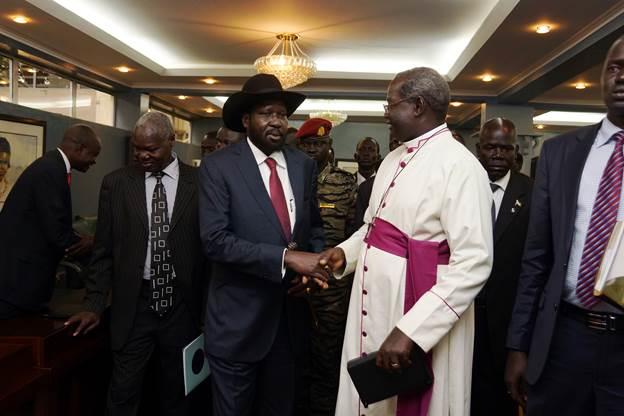
President Salva Kiir Mayardit, asked for a blessing for the new government from the Most Rev. Daniel Deng Bul, Archbishop, Episcopal Church of Sudan. (Photo credit: Larco Lomayat)
THE BACKGROUND: DISMISSALS
South Sudan President Salva Kiir Mayardit sent the world into a tizzy in late July 2013 when he dissolved his entire government. Kiir dismissed the Vice President, Riek Machar, the members of his cabinet, deputy ministers, and military officers. He also dismissed the Secretary General of the Sudan People’s Liberation Movement (SPLM), Pa’gan Amum.
On July 24, a U.S. State Department press release in response to President Kiir’s actions declaring that the United States was “deeply concerned” by “the risk to stability” caused by Kiir’s actions. “Deeply concerned” is the same phrase that the State Department uses in reaction to wholesale slaughter by the Khartoum regime, so you can see how seriously they were taking this upheaval!
The State Department press release continued by saying that “The United States calls on all parties to maintain calm and prevent violence, and on the Government of South Sudan to quickly and transparently form a new cabinet.” State encouraged South Sudan to do this “in a manner that reflects the diversity of the South Sudanese people, and that respects its Transitional Constitution and the democratic ideals the new country has espoused.” Finally, the State Department declared that during this “time of grave challenges, it is critical that South Sudan stay true to the vision it laid out for itself two years ago at its independence” and that this vision “can only be realized through sustained commitment to democracy and good governance, justice and accountability, and respect for rule of law and the human rights of all of South Sudan’s people.”
Sudan activist group, Enough Project, put out a short brief on Kiir’s sacking of the government ministers the same day that it took place. “Seven Things You Need to Know About South Sudan’s Government Crisis,” does answer some of the questions regarding the drastic measures taken by Kiir. For instance, it explains that Kiir’s actions were legal, “as South Sudan’s transitional constitution, which was adopted in 2011, gives President Kiir broad authority to dismiss senior government officials.” The brief also assured that things were remaining calm, but tense, on the ground in Juba and said, “Until the reshuffle is complete, it is going to be difficult to know how the power players affected by Kiir’s decision will react. Most were completely unaware of Kiir’s decision until they saw the announcement on TV.”
On July 25, South Sudan Government spokesperson Larco Lomayat provided an update on the security situation in Juba and all over South Sudan saying that everything was proceeding as normal and no curfew was in place. “Just continue with your normal life as usual, do not restrict your movements even after work,” Lomoyat said. A few days later, new ministerial appointments and reshuffling began to be announced. The first was the appointment of Dr. Barnaba Marial Benjamin as the new Minister of Foreign Affairs and International Cooperation. Others followed, and on August 7, Kiir’s newly appointed ministers were sworn into office.
SWEARING-IN OF THE NEW GOVERNMENT: WARNINGS AND BLESSINGS
Reporting on the swearing-in, Lomayat revealed that Kiir issued a number of warnings to the ministers before they took their oaths. Kiir warned that each minister or deputy must work a full day, from 8AM to 5PM, taking no more than one hour for lunch. Lomayat said Kiir told the new ministers that some of the old ministers used to go home for lunch and never came back. Kiir said that things had changed. If a minister leaves for lunch and doesn’t report back to work after lunch time, “let him or her remain home and never come to the office again,” he declared.
Kiir also warned of ministers who traveled too much at the government’s expense, and those who took a ten percent commission for every contract. He told those who might contemplate such actions to “watch out” as he would not “tolerate these kinds of evil practices.” He would expect progress reports every three months, he said, because he expects them to serve the people of South Sudan.
Finally, Lomayat reported that the new cabinet and other officials received a blessing from the Most Rev. Daniel Deng Bul, the Archbishop of the Episcopal Church of the Province of Sudan (including Sudan and South Sudan), and by the Rt. Rev. Enoch Tombe, Bishop of the Diocese of Rejaf in the Episcopal Church of Sudan, and Bishop Paride Taban, the retired Roman Catholic bishop of Torit Diocese, and the co-founder of the New Sudan Council of Churches. This was the first time such a blessing had been given before the oath-taking of new government ministers, and it would seem to be a good way to get the new government off on the right foot.
As for why there had to be a new government, there really are no clear answers. There is a lot of speculation — ranging from U.S. officials accusing Kiir of having “no clear reason” for dismissing his government, to those who suspect that some of the former government officials may have been working with the Islamist regime in Khartoum to undermine not just Kiir’s presidency, but the sovereignty of South Sudan itself, to all manner of variations on those themes. The birth of South Sudan was a miracle, and it must not be forgotten that this young nation was created out of the devastation of decades of war. Pray for its protection from those that would seek to destroy this fledgling nation.



Comment by Slater Armstrong on August 10, 2013 at 11:17 am
Thank you for this article Faith! It offers more than possible explanations, it offers hope, encouragement, challenge, and incentive to pray for this young nation born out of slavery and destruction! They deserve a better chance, so let us join this call to raise standards, vigilance and accountability with resolve to hold ourselves to the same.
Comment by Faith McDonnell on August 10, 2013 at 12:12 pm
Thanks, Slater. I agree.
Comment by Linda Rhyne on August 10, 2013 at 11:35 am
Sounds like the former ministers were taking advantage of their positions. The president had every right to clean house. Will pray for South Sudan!
Comment by Faith McDonnell on August 10, 2013 at 12:10 pm
Thanks so much for your prayers for South Sudan, Linda. I believe God has good things in store for that nation.