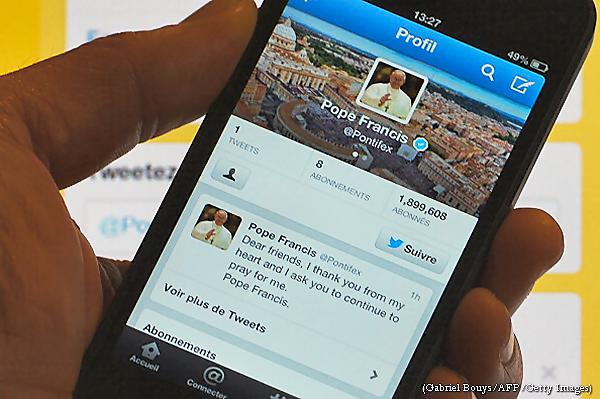
Indulgent Tweet? Pope Francis’ declaration extending indulgences to both physical and social media pilgrims at World Youth Day was wildly misrepresented. (Photo credit: Gabriel Bouys/AFP)
By Alexander Griswold (@HashtagGriswold)
There are few topics there are as frequently misrepresented, misunderstood, and misreported by national news outlets as religion. In a 2012 poll, a majority of both the general public (57 percent) and reporters (52 percent) stated that the media does a poor job reporting on religious matters. The same poll found that 2/3rds of the public believe that media coverage of religion is scandal-driven. A separate poll found that only 19 percent of Americans thought that the media is “friendly” towards religion.
Why do journalists fail at accurately reporting on religious matters? The answer is simple; most journalists simply don’t care. A 2007 Pew study found that only 8 percent of journalists at national news outlets attend weekly mass or religious services, compared to 39 percent of Americans. Many media figures note in particular the dearth of religious conservatives in the national media. Just last month, a panelist on CNN’s Reliable Sources noted that in TV newsrooms, “there are very few people of faith and very few evangelical Christians… [I]f you did a survey of any newsroom in Washington, the number of people of deep faith who oppose gay marriage would be minuscule.”
Patheos’ GetReligion channel highlighted the problem beautifully by pointing out a recent New York Times op-ed that said the following about Bill Gates’ mother: “Her concluding message was reminiscent of the Voltaire (or Spiderman) mantra that great power implies great responsibility: ‘From those to whom much is given, much is expected.’” Even less religious Christians would recognize that Mary Gates was quoting a Bible verse, while more religious Christians would recognize it as a paraphrase of Luke 12:48. But the entire New York Times’ editorial staff only thought of Voltaire and Spider-Man’s Uncle Ben.
(Unfortunately, the Times misspelling of Spider-Man as ‘Spiderman’ is an even more common and rampant problem. If there were room, I would include my 40,000-word dissertation on the topic, “Spider-Man/Spiderman: Does Whatever a Hyphen Can”)
But every so often, the national media shifts from apathetic and sloppy on religious issues to hostile. Take the recent coverage of World Youth Day. Today, over 2.5 million Catholics will flock to Rio de Janeiro to see Pope Francis speak on his first international trip as pope. There’s a sort of poetry in the first South American pope’s return to the continent to speak to the future of Catholicism. How could this be anything but good press for the Catholic Church?
Enter the news media. Late last week, a common story was reported and reposted in hundreds of news sources. The gist of story was that ahead of World Youth Day, Pope Francis had declared that anyone who followed him on Twitter would receive indulgences that would lessen their time spent in purgatory. Among the headlines:
-
“Follow pope online, get to heaven sooner – Facebook likes don’t count” –Los Angeles Times
-
“Pope now offering indulgences in exchange for Twitter followers” –Slate
-
“Pope’s Twitter followers get to Heaven faster? OMG!” –U-T San Diego
-
“Pope Indulges Twitter followers with promise of heaven” –CBS
-
“How to save your soul- in 140 characters or less” –USA Today
It’s a story that hits all the right buttons for journalists. There’s the social media angle that reporters go gaga for. The story also makes the Vatican look like conniving conmen who sell their religion to the ignorant masses by promising to get them into heaven for cheap. It makes it appear that the Catholic Church is trying desperately to relate to young tech-savvy people. And of course, the story is bizarre and ridiculous, and as all the sensible young urban professionals working for the national media know, so is religion.
Over 180 media outlets covered the story on the first day, but remarkably few did any sort of digging that might contradict their initial assumptions. Those that did reported the actual truth. This month, the Vatican released a document offering plenary indulgences to those who made a pilgrimage to World Youth Day. However, they were mindful of those who due to financial limitations or health restrictions would be unable to make such a trip. In an effort to include all, they determined that those who participated “with due devotion, via the new means of social communication” would be considered pilgrims. It also isn’t as simple as following anybody on Twitter; the faithful must follow the events as they occur live.
Offering plenary indulgences to pilgrims is a longstanding Catholic tradition that comes with several strings attached. For one thing, recipients of indulgences must also have their sins absolved by a priest. For another, it requires true spiritual devotion. The pilgrim, whether in person or thousands of miles away, must be truly contrite and repentant of their sins. You don’t have to believe in indulgences (this Protestant doesn’t) to see that the concept isn’t as illogical or unethical as the media presents it.
“Following World Youth Day on social media (or television, or radio) in a state of repentance after being absolved of your sins will get you a plenary indulgence” doesn’t have quite the same ring as “The Pope wants a bigger Twitter presence, so he’s handing out free trips to Heaven.” So instead, the media went with a highly sensationalized and misleading take on the story, and if that made the world’s most prominent religious leader look like a cad, so be it.
Journalists need to seriously examine their ability to report religious news fairly and accurately. After all, they’re doing themselves no favor by tuning out an issue that most Americans care strongly about. If individual national news outlets refuse to reevaluate their often hostile coverage of religious matters, Americans can always take the matter into their own hands: by turning off the TV, cancelling the paper, closing out of the webpage, and finding an outlet that does care.
No comments yet



Leave a Reply