by Christian M. Stempert

photo: This is what we think poverty looks like (credit: Google Images)
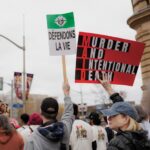
Earlier this week, the Catholic social justice group ‘Nuns on the Bus’ paid a visit to Rep. Paul Ryan’s home office in Janesville, Wisconsin. The Catholic sisters pulled into town on the second day of their 15-day cross-country bus trip to promote the ‘Faithful Budget Campaign,’ which calls for a budget that “protects the common good, values every individual and lifts the burden on the poor.”
Part of the “Priorities for a Faithful Budget” document, which was submitted to Congress in March, calls for the federal “government’s continued partnership to combat poverty.” And this sounds good. Poverty isn’t something that we want to have in our community, nation, or even the world. But what exactly is “poverty?”
When most of us think of poverty, we think of absolute impoverishment. We picture a skin-and-bones woman clutching her malnourished baby to her breast in a place like India, where more than 40% of the population live on less than $1.25 a day, or in sub-Saharan Africa, where more than 60% of the population lives like that. That is what the World Bank has defined as “absolute” or “extreme poverty.”
But what about here at home, in the United States? According to data released by the U.S. Census Bureau in September of 2011, the poverty rate here is more than 15%. Does that mean that more than 15% of Americans are having a hard time feeding, clothing, and housing their families? Not necessarily.
A friend of mine recently wrote a piece for an undergraduate publication called The Ideas Forum that helps to shed light on poverty in America. She writes: “Though I had never felt poor growing up, the official indexed report from Health and Human Services placed my family in the category of being ‘extremely impoverished’—the lowest possible standard of living for a child in the United States…Being one of ten kids living off of one working parent in 2003, I was off the charts in devastating, hopeless poverty.” Nearly ten years later, she has six more siblings, and according to the government, her family is in even worse shape than ever. “Yet,” she says, “I still don’t feel very poor.”
That’s because poverty in American is measured on a relative scale. As a result of the widespread productivity and prosperity in our nation’s history, Americans enjoy much higher standard of living than almost anywhere else in the world. This leads to a somewhat skewed vision of what poverty means in our country.
According to a 2007 paper by Robert Rector of The Heritage Foundation, nearly three-quarters of households classified as poor by the federal government own a car; 31 percent own two or more cars. Sixty-two percent of poor households have cable or satellite TV service; over half of them own two or more color televisions. Eighty percent of poor households have air conditioning.
In summary, the report says: “Overall, the typical American defined as poor by the government has a car, air conditioning, a refrigerator, a stove, a clothes washer and dryer, and a microwave. He has two color televisions, cable or satellite TV reception, a VCR or DVD player, and a stereo. He is able to obtain medical care. His home is in good repair and not overcrowded…While this individual’s life is not opulent, it is equally far from the popular images of dire poverty.”
That is a picture of what “poverty” means to the American government. It is not a measure of how well families can provide for themselves. Rather, it is a relative standard, comparing the amount of income that individuals and families have.
While this may be the situation of the average “impoverished” American, I am not pointing this out to detract from those who truly are in need. There are people here in the United States who are in desperate need of help, who struggle to feed and clothe their children on a regular basis. We do have a moral responsibility to help them, as the proponents of Faithful Budget Campaign recognize. But because of the difficult financial situation our nation is in right now, we do need to distinguish between the people who really need our help and those who don’t.
Passing a budget without any cuts to social programs is impractical. We need to deal with our debt and deficit problems and not keep putting it off. I have no doubt that many Christians, including the ‘Nuns on the Bus’ deal with those who are truly desperate, and are fighting to help them. But our current government standard of poverty is not set up to help the extreme minority who really are in need.
According to The Heritage Foundation, 11 percent of the households classified as “impoverished” by the U.S. government “sometimes” or “often” don’t have enough money to meet their basic living needs. Not 11 percent of American households, 11 percent of those in “poverty.” But instead of focusing on the 11 percent who are truly in need, the current system caters to the 89 percent of the “poor” who will keep voting for anyone who continues to subsidize their living.
In this debate, we all want the same thing: to fulfill the moral duty that Jesus laid on us in Matthew 25 when he said to care for those less fortunate than ourselves –“the least of these.” But in order to do that, we need to reassess what it means to be “impoverished” so we can focus on the people who truly in need of our help.



Comment by Christian M. Stempert on June 21, 2012 at 4:41 pm
Reblogged this on Christian, Libertarian.
Comment by Sam Hamilton on July 2, 2012 at 3:26 pm
“Overall, the typical American defined as poor by the government has a car, air conditioning, a refrigerator, a stove, a clothes washer and dryer, and a microwave. He has two color televisions, cable or satellite TV reception, a VCR or DVD player, and a stereo.”
This doesn’t tell me anything about someone’s ability to feed or clothe their children,pay their medical bills, etc. If someone is renting an apartment most of that stuff comes with it. Color televisions are not that expensive and neither are DVD players or stereos. They are not marks of luxury, and, in fact, can be picked up at the local Goodwill very cheaply or they could have been given/donated. In the end, the mere possession of these things says nothing about a person’s income level.
The problem with Rector’s studies as well as federal definitions of poverty, is that they don’t actually look at individual people’s lives. They don’t tell us how poor people actually live. And they don’t tell us much about how much money we should be spending on federal anti-poverty programs.