Mikhail Bell
July 25, 2011
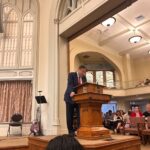
Coptic Solidarity speakers openly spoke about the challenges ahead. |
Egypt after President Hosni Mubarak’s abdication has left Coptic Christians in a quandary. Mubarak relied on notoriously undemocratic means to maintain power. But across 30 years he also restrained radical elements from further marginalizing Egypt’s largest religious minority. Experts and practitioners from Lebanon, Iran, Egypt, Syria, and Sudan articulated these conflicting sentiments at the second annual Coptic Solidarity Conference in Washington, DC earlier this month. Coptic Solidarity was founded to empower the Copts in Egypt toward “full and inalienable citizenship rights and inequality,” according to their mission statement.
While speakers did not harken for President Mubarak to return, they were reticent about how to preserve religious freedom in his absence. “It is very important that we are all united,” Dr. Walid Phares, a Lebanese-American counterterrorism expert, emphasized.
Phares gained acclaim during the Arab Spring revolts because his book The Coming Revolution: Struggle for Freedom in the Middle East accurately predicted Mubarak’s ouster.
A recent Boston Globe articles indicates that Egypt could hold national elections as early as November, causing worry among Coptic Christians. Many analysts believe the party with the most public support is also the most radical: the Muslim Brotherhood.
Michael Ledeen, a foreign policy specialist, offered unflinching criticism of an Egypt ruled by the Islamist group. “If the Muslim Brotherhood gets Egypt, they will be failures,” he asserted.
Several Members of Congress sounded alarms over the Muslim Brotherhood. Representative Sue Myrick (R-NC) warned against expecting good faith diplomatic relations with an Egypt under the Islamist group. “Our government is playing checkers and they [the Muslim Brotherhood] are playing chess,” Myrick chided.
Instead, Myrick encouraged dialogue with groups whose vision for a new Egypt is more inclusive. Such groups may be harder to find but the unique political situation requites ingenuity. “You’ve got to move beyond those who yells the loudest,” the congresswoman concluded.
Representative Frank Wolf (R-VA), a noted religious freedom and anti-trafficking advocate, spoke strongly in favor of a more tolerant Egypt. “This is a real danger,” he warned of an Islamist victory.
Still other officials saw protecting freedom to worship as a universal calling. “My district is 51% Hispanic but that is not a reason” to remain silent, Representative Albio Sires (D-NJ) said in defense of religious liberty in Egypt and elsewhere globally.
Barriers to Entry
In June, National Review reporter Andrew C. McCarthy described a shift in U.S. foreign policy, with the U.S. State Department outreaching to the Muslim Brotherhood, perplexing democracy advocates. The Brotherhood is the largest organized group in Egypt. And its motto remains: “Allah is our objective, the Prophet is our leader, the Koran is our law, Jihad is our way, and dying in the way of Allah is our highest hope.” In the past, the Brotherhood has openly backed the implementation of sharia by way of an Islamic caliphate.
“At the end of the day, sharia is about compliance,” Dr. Phares reminded his D.C. audience.
Coptic Coalition
First, participants agreed broad coalitions provide religious minorities with leverage to garner greater international attention from potential allies. Transnational cooperation can raise awareness while simultaneously connecting Coptic Christians to advocacy networks of other persecuted groups.
Some scholars believe the lack of support from Americans is due to unfamiliarity with the Middle East and North Africa. “We need to educate the American public,” Phares implored. Moments earlier he recounted an unsettling incident with a college student. When asked, “What is the Middle East?” the student opined that it was the “opposite of the Middle West.”
Second, speakers called for an international lobbying organization similar to the United Nations Human Rights Council that would prioritize the persecution of religious minorities. To this end, Eblan Farris of the World Council for the Cedars Revolution conveyed an unshakeable resolve. “[We must go] wherever the fight takes us,” he urged.
Elevating religious persecution to an international level on par with other human rights is not for the faint of heart.
“We have a lot of work ahead of us,” Congressman Sires admitted. If Coptic Christians can count on such a broad coalition of support in the future, there is no telling how they can change Egypt for the good of all.
No comments yet



Leave a Reply