At their May 2010 meeting in Columbus, Ohio, the United Methodist Council of Bishops officially announced the defeat of church constitutional amendments they had supported creating a new U.S. only regional conference. And an amendment virtually mandating an open church membership policy was also defeated.
“In rejecting the amendments related to the worldwide nature of the United Methodist Church, we believe members of annual conferences around the world are sending a strong message that this specific vehicle for change was flawed,” admitted Kansas Area Bishop Scott Jones, speaking on behalf of the Committee to Study the Worldwide Nature of the United Methodist Church, which drafted the proposals.
Constitutional amendments in United Methodism must receive a two thirds vote at the General Conference and then ratification from two thirds of voters at local annual conferences around the world. The global church amendments, which critics called “global segregation,” gained only about 38 percent of 49,000 annual conference voters around the world. Critics warned that a new U.S. only regional conference that excluded Africans and other internationals could ultimate facilitate liberalizing the church’s stance on homosexuality.
Reading the statement of his committee, Bishop Jones identified the reservations that may have contributed to the failed attempts to segregate the UMC into regional bodies. “It was unclear how the changes, if approved, would have been implemented,” he said. “To some, the proposals were theologically suspect. To others the process seemed overly complicated.”
The release of the voting results and the subsequent conversations were among the more momentous, and at times tense, moments of last week’s meeting in Columbus. Of thirty-two amendments proposed, just five received the needed two-thirds vote needed to pass. The original amendment number and full text of the successful amendments are as follows:
Amendment 8: The proposed amendment would add “gender” to those categories of persons protected in the list of duties of General Conference.
Amendment 9: The proposed amendment would ensure a minimum basis of support for the election of bishops at jurisdictional conferences.
Amendment 17: The proposed amendment would make supporting constitutional changes to allow reinstatement of legislation adopted by the 2004 General Conference and subsequently declared unconstitutional by the Judicial Council to allow lay persons on the committee on investigation to vote on matters of ordination, character, and conference relations of clergy.
Amendment 19: The proposed amendment would allow additional clergy members to participate in the election of clergy delegates to general, jurisdictional, or central conferences.
Amendment 22: The proposed amendment allows formally recognizes that the Baltimore-Washington Conference has been appointing pastors, superintending the congregations and integrating the congregations of Bermuda into the life of the Baltimore-Washington Conference. The General Board of Global Ministries and the Baltimore-Washington Conference recognize these churches as United Methodist congregations.
Of the twenty-seven rejected amendments, twenty-three concerned the segregation of United Methodism into separate, regional conferences. Their defeat was a decisive rejection of the attempts to alter the church’s structure.
According to global church amendment supporters, segregating the church’s structure by region would empower growing United Methodist churches in Africa. But the African churches voted nearly 95 percent against these amendments. In contrast, there was widespread support for the failed amendments in the very small European conferences and predictably liberal U.S. Western Jurisdiction.
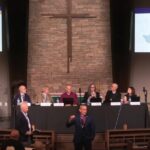
After guiding the Council through the voting results, Council President Bishop Gregory Palmer of Springfield, Illinois opened the floor to discussion. Some liberal bishops complained of unwanted interference by evangelical caucus groups in the amendment voting process. Virginia Bishop Charlene Kammerer said. “I believe the fabric of our experience might reflect other places, at least in the U.S. church where this happened. I honestly believe that these constitutional amendments and the process around them became tainted along the way…What happened in our setting along the way was that there were people from outside of our conference, representing caucus groups, who appeared at annual conference, who found a way to speak unauthorized at some of our conference events. And I discovered after the conference that there were ballots distributed of how one should vote…I feel like the process was tainted for the whole church.” Speaking after Kammerer, New Jersey Bishop Sudarshana Devadhar concurred, saying that he witnessed the same behavior in his episcopal area.
After nearly twenty minutes of open debate, Bishop Devadhar moved to enter executive session. The motion passed and, for the next hour and a half, the bishops’ conversation was behind closed doors. Later in the week, the conversation resumed in open session, likely revealing some of the tenor of the previous private session. Some bishops indicated the vote reflected the laity’s lack of trust in the bishops and, consequently, think the Council should tread lightly, deferring to the church’s’ decisions. Bishop Jones, speaking from the floor in a subsequent session, said, “A crucial factor in interpreting the votes is what I perceive, and he evidently perceived, to be a lack of trust between the grassroots and the leadership of the church.”
In an interview following the plenary session, Jones diagnosed the failure of the amendments: “My personal view is that the strongest argument was a lack of certainty of how the amendments would be implemented. And that was clearly one of the factors involved. I find widespread commitment to the unity of the worldwide church, and also widespread commitment to the ability for each region to create variations. Getting clarity about exactly what all of that means is one of our tasks.”
Other bishops indicated that while they are required to follow official decisions, bishops are bound by their consciences. Albany Area Bishop Susan Hassinger’s asked the bishops, “What is the nature of episcopal leadership at this time, in light of the decisions of the votes on the constitutional amendments? Is our leadership role to bring into effect the constitutional amendments? Are there places in which we need to stand – take a stand – or speak out?”
Addressing the defeated “inclusivity” amendment about church membership, Hassinger answered her own questions: “As a follower of Jesus in the Wesleyan tradition, I cannot support the vote, which was only 2,000 – less than 2,000 – difference. And so I want to commit to you, my brothers and sisters, that I will continue preaching and teaching the good news; that there is wideness in God’s mercy and [it is] not narrowed by any specific issue – there’s a wideness in God’s mercy; that a faithful church will proclaim that God’s grace and mercy are available to all; and that a faithful church will seek to make ministry available to all.”
The open church membership amendment, which was defeated by about 52 to 48 percent, with two thirds needed for passage, essentially originated with the 2005 controversy over Virginia pastor Ed Johnson, who declined to grant immediate church membership to an openly active homosexual. Bishop Kammerer removed Johnson from his pulpit but was overruled by the United Methodist Judicial Council, which ruled that local pastors have discretion over church membership. The Council of Bishops condemned the Judicial Council’s action. The amendment potentially would have overridden the Judicial Council and mandated automatic church membership for all applicants.
Speaking to that amendment’s failure, retired Bishop Melvin Talbert echoed Bishop Hassinger’s defiant sentiments. After acknowledging the binding authority of the decisions, he said, “I don’t believe we as bishops can bind our conscience. And when we in good faith feel that the General Conference has erred in one direction or another…I think we have the episcopal responsibility to speak to our own church. And like my sister, I cannot stop preaching about the inclusiveness of our church for all people – no matter who they are, from whence they came…I will not intentionally violate what the Book of Discipline says, but I don’t have to agree with it.”
Nearly all the bishops seemed to agree that the church must determine what the results reveal about the challenges facing United Methodism. In a one-on-one interview, Bishop Jones identified two tasks before his committee. First, it must “delineate those things that ought to belong to the General Conference because they are essential to the worldwide unity of the church.” And second, it must determine “whether our general agencies are U.S. agencies or global agencies.” When asked what the next steps are, Jones’ answer reflects the uncertainty shared by large portions of the church: “We do not know…We are continuing our discernment about the basic principles that are to be followed.”
No comments yet


Leave a Reply