United Methodist Bishop Minerva Carcaño of the Desert Southwest Conference continued her advocation for liberalized U.S. immigration policies while also talking about her grandmother’s deep influence on her, during a speech to the annual United Methodist School of Congregational Development.
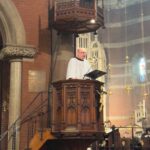
“I am pretty fed up with the time we spend in the church and particularly at preachers meetings talking about self-care,” Bishop Minerva Carcaño told those attending the United Methodist School of Congregational Development. “Self-care is pretty common sense. In this narcissistic society in which we live I don’t need to tell you about self-care.” (Photo courtesy UMNS) |
Approximately 300 pastors, bishops, and district superintendents attended the 2008 School of Congregational Development. The School is the General Board of Discipleship’s annual training event for new church pastors, and was held in Orlando, Florida from July 31- August 5, 2008.
“Hundreds of people, men women, children, babies in arm, cross the border into Arizona . . . in an effort to come to this country for jobs to feed and clothe their family; they come desperate for life,”said Carcaño, who has been a staunch advocate of loosened immigration regulations. “. . . Many of them are detained by the border patrol or by what is now known as Homeland Security.”
Most who have heard Carcano know the influence that her grandmother, Sofia, had on the young Minerva Carcaño. Speaking of her grandmother, the bishop told her audience that “She was enormous, just enormous, in faith. She had very specific spiritual disciplines.”
Carcaño cautioned the clergy in attendance that “while spiritual disciplines . . . are necessary, if you are to become leaders, there needs to be much more than spiritual disciplines.” In fact, she admonished, “When serving each other is ignored, my brothers and sisters, our Christian living, and even more so our Christian leadership, becomes a sham. Because the Christian life, more than being about a set of disciplines, is about relationship”.
“Our spiritual life should be a reflection of the life of Christ; a life lived out through concrete deeds,” said Carcaño. “. . . We are to wash each other’s feet; we are to serve one another, thus bearing witness to Jesus’ love. This is the heart of Christian living; this is the essence of the spiritual life of a Christian leader.”
Giving her audience an example of the kind of deeds that are “the essence of the spiritual life of a Christian leader,” Carcaño mentioned a woman who washes the feet of illegal immigrants when the Department of Homeland Security returns them, often sick or injured, to the Mexican side of the Arizona-Mexico border. The woman told Bishop Carcaño that “the foot-washing is what she does to fill her spirit. And from the foot-washing that does fill her spirit she turns and she fights for justice, advocating for immigration reform, for compassionate treatment of the immigrants.”
Carcaño rejoiced, “Hers is a servant leadership whose blessing is the future of seeing the world transformed.” She added, “It is because of her, not because of the COB [the United Methodist Council of Bishops], or the legislative body of this country, or the presidential candidate—it is because of her that I believe that immigration reform will yet come in this country.”
This year at General Conference, Carcaño helped lead rallies protesting, in part, the current restrictions on immigration. Last summer, she spoke to United Methodist youth about the importance of her work to liberalize U.S. immigration policy, stating, “Today my church is working to change the laws. We U.S. citizens are not the only ones He cares about; He cares about all his children, even the undocumented [illegal] immigrants!”
Noting his joy regardless of circumstances, Carcaño remarked, “[The apostle] Paul was a tough old bird and I have come to not only appreciate him but to admire him greatly,” because “Even in the foul smelling confines of a prison he could sing—he could sense the presence of Jesus.” She admitted, “I didn’t like Paul when I first met him; [because] he was the guy whose words my father used to tell me that I could not be a spiritual leader [ordained clergy].”
The bishop confessed jokingly, “I am pretty fed up with the time we spend in the church and particularly at preachers meetings talking about self-care. Self-care is pretty common sense. In this narcissistic society in which we live I don’t need to tell you about self-care.”
Conversely, she observed, “What I need to tell you and what I need to consistently say to myself is, ‘Don’t believe in modern-day U.S. narcissism that says that you and I are the most important, most precious, most special creatures on earth.’ It ain’t true!”
No comments yet


Leave a Reply