LOUISVILLE—If knowledge is power, then observers at national meetings must be powerful indeed, because one hears a lot.
For instance, when the Presbyterian Church (U.S.A.) Advisory Committee on Social Witness Policy (ACSWP) met at the end of January in Louisville, the committee members were briefed on what is happening in various denominational offices. The committee also received a heads up on the coming General Assembly in June in San Jose, California, from no less than the Stated Clerk of the General Assembly, Clifton Kirkpatrick.
To share the power of knowledge, then, here are some of the useful tidbits Kirkpatrick related:
The Confession of Belhar
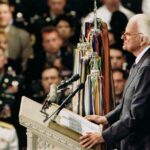
According to PCUSA Stated Clerk Clifton Kirkpatrick, “our whole calling as Presbyterians is to be ecumenical.” (Photo courtesy PCUSA) |
The Confession of Belhar, a statement of faith adopted in 1986 by the Dutch Reformed Mission Church in South Africa, has been touted for some time as a prime next addition to the PC(USA) Book of Confessions. Now, Kirkpatrick hopes that “we can move forward” on that process, which is being recommended by the Advocacy Committee for Racial Ethnic Concerns (ACREC). “What we are hungry for is to deal deeply and theologically with what it means to be community,” Kirkpatrick proclaimed, and Belhar “addresses critical issues. Its focus is a part of what we need in the church and the world today.”
It was obvious that the Stated Clerk plans to join ACREC in pushing the Confession of Belhar at the assembly. The next step toward getting it adopted, he explained, would be to have a committee do a two-year study and suggest in 2010 that it become a confession. Then it would need the approval of presbyteries and the 2012 General Assembly, as well, for it to be added to our Book of Confessions.
The confession arises out of the infection of apartheid coming to a head in South Africa. Interestingly, Vernon Broyles, an influential social-witness volunteer on Kirkpatrick’s staff, noted that he was there in Belhar in 1986, when the confession was first adopted.
The confession centers on reconciliation and unity, even saying that “anything which threatens this unity may have no place in the church and must be resisted.” It elevates the dispossessed, saying that “God, in a world full of injustice and enmity, is in a special way the God of the destitute, the poor, and the wronged.” The signers are serious, pledging to fight against apartheid “even though the authorities and human laws might forbid [it] and punishment and suffering be the consequence.”
The Confession of Belhar is obviously a principled statement written for a time and place, for a set of brutal political conditions of enmity and separation. It addresses a political issue—apartheid. Belhar is written, however, in the form of a confession of faith. Confessions classically deal with matters of belief and doctrines, such as Christology, salvation, and the church.
Aprincipal function of the Book of Confessions is to expound the “essentials of the Reformed faith,” to which all PCUSA officers pledge themselves. Therefore, incorporating the Confession of Belhar would enshrine various social and political convictions as “essentials of the Reformed faith,” on a par with the Trinity, justification by faith, and the authority of Scripture.Some will call it necessary. In fact, Kirkpatrick spoke of “global systems exacerbating the gap between the rich and the poor” and urged as “necessary” the study of the Confession of Accra with Belhar.
The Confession of Accra
The Confession of Accra, a stinging rebuke of the United States in particular and global trade and the free market in general, was adopted by the World Alliance of Reformed Churches (WARC) in Accra, Ghana, in 2004. At the heart of the Confession of Accra is this statement: “The root causes of massive threats to life are above all the product of an unjust economic system defended and protected by political and military might.”
What is this “unjust economic system”? Everyday capitalism. According to the straw man Accra describes, it “is an ideology that claims to be without alternative, demanding an endless flow of sacrifices from the poor and creation. It makes the false promise that it can save the world through the creation of wealth and prosperity, claiming sovereignty over life and demanding total allegiance which amounts to idolatry.”
And who is the tyrant protecting such an unjust system? The United States and its “empire.” “[T]he current world (dis)order is rooted in an extremely complex and immoral economic system [the free market] defended by empire,” the confession rages. “In using the term ‘empire’ we mean the coming together of economic, cultural, political and military power that constitutes a system of domination led by powerful nations to protect and defend their own interests.” The U.S. is later singled out by name.
The Confession of Accra is an example of church leaders shooting themselves in the collective foot. Those who feel poor and put-upon have used this odd, quasi-theological vehicle to bash capitalism, the one economic system that has done the most to lift their lives from poverty and give them opportunity. They use the platform of a supposed confession of faith to accuse the United States and allies of determinedly building a thuggish empire of crude self-interest.
Kirkpatrick, who is also president of WARC, swears by this document and is already pushing it before General Assembly, apparently oblivious to the natural extent of his own supposed American complicity. He would shoot himself in both of his American feet and then reload to fire away some more.
Upon examining the document, however, Presbyterians as a whole will likely find the Confession of Accra inaccurate and uncharitable in its analysis, and therefore deeply troubling and problematic. This so-called confession isn’t about our faith. Instead, it attempts to give confessional status to a particular set of economic views (anti-capitalist), just as the Confession of Belhar seeks to do the same for a particular set of political views. Neither politics nor economics deserves confessional status. While all of life falls under the sovereignty of God, not all subjects or viewpoints ought to become Presbyterian confessions.
Advocacy and Advisory Committees
General Assembly commissioners often feel dominated by staff and inside-the-loop voices, and yet Kirkpatrick was queried about how the advocacy and advisory committees felt slighted at times in 2006 by General Assembly committee leaders. Kirkpatrick reminded the committee members that they “have voice on the [plenary] floor and in committees.” This is a tremendous advantage, given to only the few and the favored.
Kirkpatrick also reminded these advocacy and advisory committee members of their “unique opportunity to speak directly” to committees on any subject they choose by writing “advice and counsel” memoranda that committee members receive with other official committee papers. “Committee moderators have judgments to make,” Kirkpatrick counseled. “Make clear your roles with the leadership…. Provide resources based on policy.”
Unlike observers or overture advocates even, these advocacy and advisory committee members often interject themselves deeply into committee business, to whatever extent the chair will tolerate. Perhaps that will happen all the more boldly in June.
General Assembly Size
“There will be close to 200 additional commissioners this year,” Kirkpatrick reminded the crowd. “This will create a new dynamic.” Indeed, committees will be even more cumbersome; plenary will have scores more vying for the few opportunities to speak. Whatever sense of just being a cipher in a crowd that commissioners might have felt before will now be exacerbated.
Confirming an idea his associate had first mentioned last fall, Kirkpatrick noted that “we’re proposing two more committees.” Thus, committees will not only be larger, but there will be more of them, probably 16. He made it clear that “all committees will handle business,” perhaps hoping to fend off criticism of the previously announced plan to have two committees experiment on mock business only, by using alternative forms of decision making. How much true business these extra committees now will handle was left unclear.
However, Kirkpatrick said that one of the new committees will focus on youth and one on the now-ubiquitous subject of “discernment processes.” These committees will be “more generative in their business,” Kirkpatrick explained. “They’ll be thinking.” Thinking or not, by the Standing Rules, General Assembly committees are accorded no right to generate their own business.
Preaching
Father Elias Chacour, the Melkite Greek Catholic Archbishop of Galilee, will preach on Wednesday at General Assembly. If true to form, he will likely deliver a mostly reasonable but subtly troublesome message that is strongly pro-Palestinian and quirkily anti-Israel. His address will probably focus more on politics than faith, at an event (worship) when political messages are not particularly appropriate, and at a time (as plenary sessions begin) when a partisan voice on a heated subject is hardly fair. Still, Chacour is a crowd pleaser and is certainly not the most egregious possible choice.
Innovations
When asked, “Will there be an effort to introduce discernment processes?” Kirkpatrick gave a direct answer: yes. He elaborated by saying that as stated clerk, he planned to “use Robert’s [Rules of Order] more richly,” which sounds a little scary. Kirkpatrick also commented that “one of the things for moderators is ‘How do you use Robert’s but also look for a third way?’” Again, the implications for possible manipulation and petty tyranny by a moderator cut loose from parliamentary procedure are a little unsettling. What’s more, General Assembly made clear through a pointed amendment to the recommendations of the Peace, Unity, and Purity Task Force that “alternative forms of discernment” are allowed to be used only “preliminary to decision-making,” not “as a complement to parliamentary procedure.”
Another innovation commissioners will probably experience is “speak-ins.” For many assemblies, commissioners and advisory delegates have had the opportunity to comment briefly to the whole assembly on non-business topics at a “speak-out” time. This populist act of saying something at a speak-out has become almost a rite of passage for some.
The speak-ins, however, would involve the General Assembly leadership piping in video segments of somewhat-random Presbyterians from across the country. Maybe an elder from Iowa or a seminary teacher from California will suddenly be twenty feet tall on a video screen, telling General Assembly what he or she thinks.
A speak-in could be fresh and interesting. It could get tedious or be too cute or too trite. But, most worrisome, is that such a manufactured element could introduce yet one more subtle or not-so-subtle opportunity for leaders to manipulate the assembly. Who gets given the screen time to speak? Who chooses what gets shown versus what ends up on the cutting-room floor? Somebody has to engineer the experience through decisions made, and that person’s or group’s decisions may not serve fairness or neutrality in the plenary sessions. The speak-outs are spontaneous and off business topics. A speak-in, however, would be, by nature, highly vulnerable to manipulation.
A Garbled Attribution
Kirkpatrick also answered questions in general about his division, the Office of the General Assembly. Apparently there was some concern among the advocacy and advisory committee members about pay inequity between employees of the General Assembly Council and those with the Office of the General Assembly. Kirkpatrick talked of “trying to temper the higher salaries.”
But then, in one of those remarks that one imagines he would like to retrieve, Kirkpatrick quoted a classic Communist slogan popularized by Karl Marx: “From each, according to his ability; to each, according to his need.” He used it as an ideal for how to operate.Unfortunately, Kirkpatrick then attributed the quotation to the New Testament!
There have been grumblings that our Presbyterian leadership doesn’t know its Marx from its Mark, or maybe its Freud from its Philippians. And Kirkpatrick does have a tendency to pile flowery phrase upon phrase when he speaks. But this was not one of his better moments! He capped the segment by saying, “I have a deep conviction that God is not through with the Presbyterian Church yet” and “our whole calling as Presbyterians is to be ecumenical.”
That last part is becoming more and more evident in Kirkpatrick’s priorities. However, I still would prefer having as our whole calling “to glorify God, and to enjoy him forever,” as the Shorter Catechism teaches us.
No comments yet


Leave a Reply