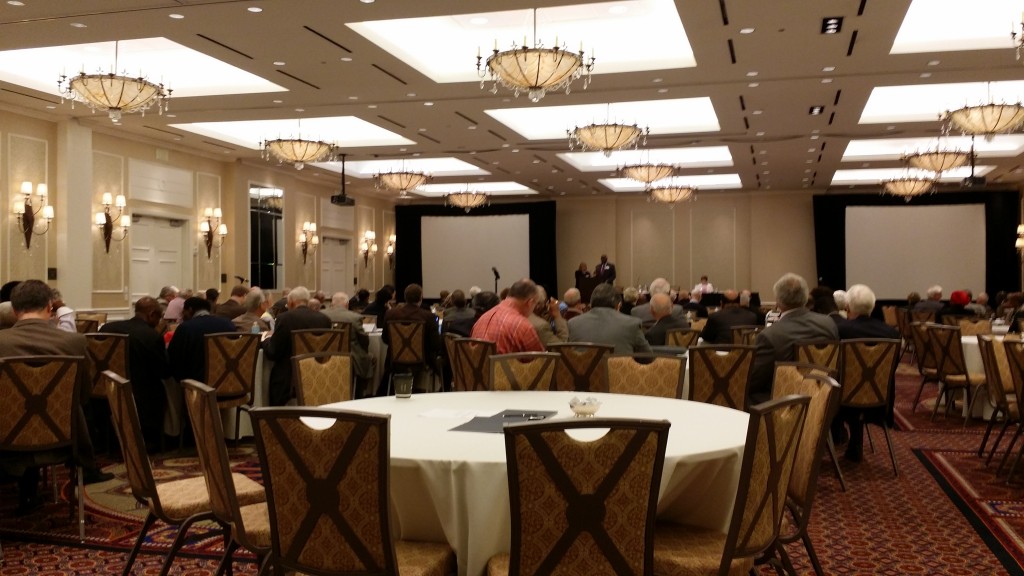
Today, during the first full day of the annual meeting of the Council of Bishops of the United Methodist Church, the Rev. Dr. Kevin Watson was invited to address the assembled bishops from around the world. His speech focused on urging reclamation of the early Methodist practice of “Christian conferencing” as “the one thing United Methodists could do today most likely to bring deep renewal” of our denomination, with the Holy Spirit’s blessing. Watson is Assistant Professor of Wesleyan and Methodist Studies and the UMC’s Candler School of Theology.
He noted that rhetoric in modern United Methodism about “holy conferencing” (a phrase never used by John Wesley) has been misused to mean merely conversing politely in the midst of disagreement. Such modern holy-conferencing rhetoric, “at its worst,” can be used to silence deep convictions, avoid difficult conclusions, and treat the way we converse as more important than the content of our conversation, as if there are no right answers to the questions facing our church.
But Watson explained how early Methodists did their “Christian conferencing” primarily in classes and bands. Both kinds of groups fostered deep bonds of Christian affection between members.
Classes were geographically-based, coed, required-attendance small groups of 7-10 people that were transformation-based rather than information-based. Meetings centered on members asking each other “how is it with your soul?” – or more optimistically, “how does your soul prosper?” Class members bore each other’s burdens, spoke the truth in love, and experienced Christian fellowship at a deeper level than they knew was even possible.
A band was a group of about five people of the same sex and marital status who had already experienced Christian conversion and who were eager for that personal perfection in love and avoidance of all intentional sin which Wesley, with “audacious optimism,” taught was a blessing Christians could enjoy in this life. Band meetings involved members questioning each other about and confessing their sins. This was not for the purpose of humiliating and shaming but rather for constructively helping each other grow in holiness. While few United Methodist congregations today have bands, Watson noted that in all of our congregations’ ministry contexts, there are people (including pastors) facing the sort of torture from their own secret sins that bands met head-on.
Watson noted that American Methodism was growing faster than the U.S. population at the time in which classes were central to our organization. He observed that “momentum is building to reclaim this part of our heritage.” But he also challenged our bishops by noting how some non-denominational evangelical churches having taken up such highly accountable small groups abandoned by modern United Methodists: “We can’t let them be more Wesleyan than us!”
All bishops were provided with a copy of Watson’s 2013 handbook, The Class Meeting: Reclaiming a Forgotten (and Essential) Small Group Experience.




Comment by Orter T. on November 4, 2014 at 11:50 am
Amen!!!
Comment by John S. on November 12, 2014 at 7:32 am
From the way I’ve seen it used I thought “Holy Conferencing” is about getting the backwards laity on the path to political and social enlightenment. But for the UMC to reclaim the early days of Methodism it would have to stand for more than the latest fad or GC vote, perhaps something as simple as the Christianity embraced by the Fathers.