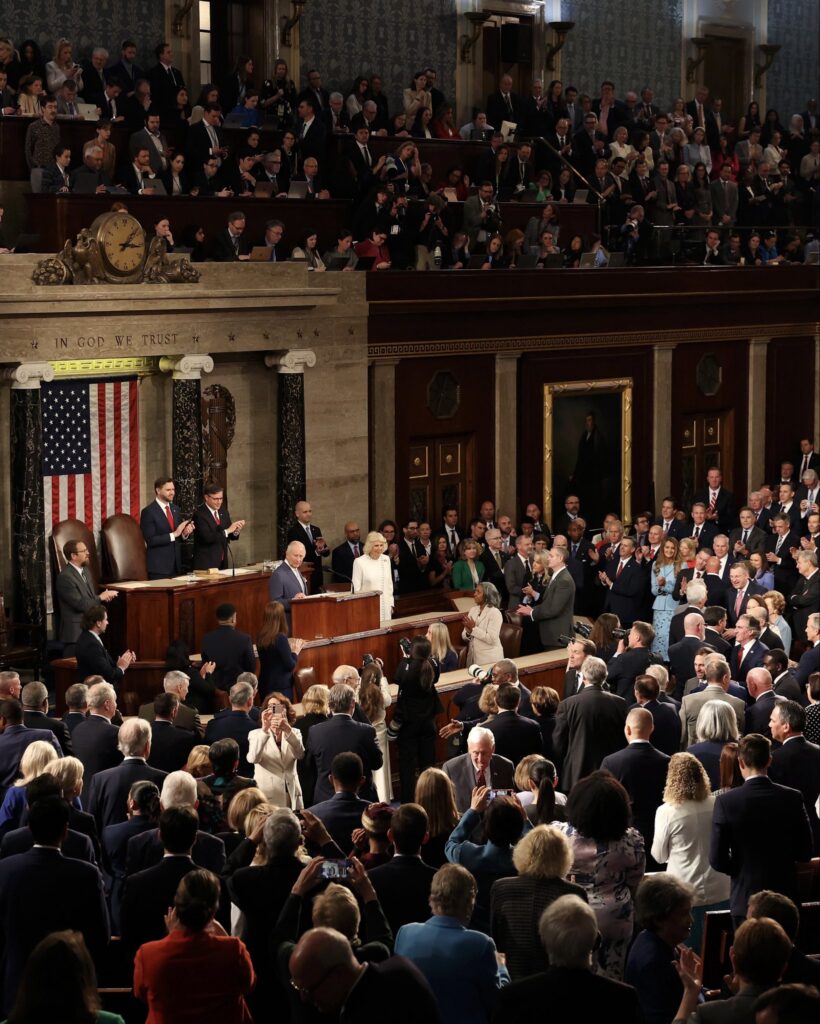

In his speech to the U.S. Congress, King Charles III wonderfully reviewed the spirit of liberty that shaped Anglo-America, informed by Christianity:
The Founding Fathers were bold and imaginative rebels with a cause. Two hundred and fifty years ago, or, as we say in the United Kingdom “just the other day,” they declared independence. By balancing contending forces and drawing strength in diversity, they united 13 disparate colonies to forge a nation on the revolutionary idea of “life, liberty and the pursuit of happiness.” They carried with them, and carried forward, the great inheritance of the British Enlightenment—as well as the ideals which had an even deeper history in English common law and Magna Carta. These roots run deep, and they are still vital.
Magna Carta has appeared in at least 160 U.S. Supreme Court cases since 1789, the King noted, “not least as the foundation of the principle that executive power is subject to checks and balances.”
The King recalled the Glorious Revolution of 1688 as precursor to America’s own Revolution:
Our Declaration of Rights of 1689 was not only the foundation of our constitutional monarchy, but also provided the source of so many of the principles reiterated, often verbatim, in the American Bill of Rights of 1791. It is here in these very halls that this spirit of liberty and the promise of America’s founders is present in every session and every vote cast.
(Read the rest here.)




Comment by Os Guinness on May 22, 2026 at 5:08 pm
The story of American freedom is far richer and deeper than King Charles and his speech writers probably know. Tocqueville wrote rightly of America’s double founding, and the first and Puritan founding owed everything to the 17th century rediscovery of the Hebrew Republic and ‘the founding of God’s nation.’ Exploring these rich biblical roots should revitalize Evangelical preaching to day, underscore the importance of the Reformation, and wean contemporary Evangelicals off the toxicity of the false political reliances to day. Much more could be said here.
Comment by Qohelet on May 23, 2026 at 5:31 am
I think what happened to not just America but the west in general was that the center right that used to exist didn’t recognize the danger of the rising far right and since they both were generally opposed to the left, the center right pretended they were allies.
The most obvious example is Brexit, where people that knew better like David Cameron thought they could control Nigel Farage by giving him a vote and instead ended up committing one of the dumbest foreign policy blunders in their nation’s history.
This of course is the IRDs problem. It was founded to combat liberation theology and moved onto gay Methodists, but now it has to deal with Trump calling himself Jesus and Hegseth debating the Pope on whether bombing children is a just war.
If there had been any recognition earlier that right wing Christians have far more in common with leftwing Christians than Christian nationalists, we’d all be a lot better off.
Comment by David on May 23, 2026 at 7:32 am
Well, the Glorious Revolution of 1688 undid the declaration of religious freedom issued by James II. What followed was a strongly anti-Catholic policy. The first place in the US to have freedom of conscience guaranteed in writing was a Dutch colony in 1645.
Comment by Gary Bebop on May 23, 2026 at 1:07 pm
Great to see a comment by Os Guinness at this site. He’s long been a salient and effective commentator on Christianity and culture. As a young seminarian I attended a lecture he gave at Reed College (then a bastion of Marxist persuasion). I was immediately drawn to Guinness’ cutlass sharp slashes of logic and illustration. “The truth will out.”
Comment by Thomas on May 23, 2026 at 7:37 pm
David, in fact William III of Orange tried to give religious tolerance to Roman Catholics, like existed in the United Provinces, but it was rejected by Parliament.
Comment by Different Steve on May 27, 2026 at 6:02 pm
The term “Christian nationalist” gets used in a few different ways, which is part of why it creates so much heat.
In academic and political discussion, it usually refers to the belief that the United States is fundamentally a Christian nation and that government should actively promote or privilege a particular vision of Christianity in public life. Researchers often distinguish that from ordinary religious belief or conservative Christianity. Someone can be devoutly Christian, socially conservative, or patriotic without fitting the stronger ideological definition.
Critics use the label because they see certain movements pushing:
closer ties between church authority and state power, preferential treatment for Christians, religious tests in practice if not law, or rhetoric suggesting “real Americans” must share a certain faith tradition.
Supporters or accused groups often argue the term is unfairly broadened and weaponized to discredit:
traditional Christians in politics,
religious conservatives, people advocating public morality influenced by faith, or anyone defending America’s historical Christian influences.
So whether it’s “merited” depends heavily on the case:
If someone explicitly argues the government should privilege Christianity as the nation’s defining identity, the label can be descriptively accurate.
If it’s applied merely because someone is Christian, conservative, pro-life, patriotic, or attends church, then it becomes more of a political smear than a precise description.
A lot of current arguments come from people using different definitions without realizing it. One side hears “dangerous theocratic movement,” while the other hears “Christians participating in democracy.” Those are not the same thing.
Comment by Different Steve on May 27, 2026 at 6:19 pm
Your argument depends on treating every populist or nationalist movement as “far right” by definition, which is exactly the kind of rhetoric that has hollowed out serious political discussion in the West.
Brexit was not some irrational mass delusion orchestrated by Nigel Farage. Millions of Britons voted for it because they were tired of democratic decisions being transferred to distant bureaucracies that ordinary voters could not meaningfully influence. You may disagree with Brexit, but dismissing it as one of the “dumbest foreign policy blunders” just signals contempt for the electorate.
Likewise, the idea that orthodox Christians have “far more in common” with progressive Christians than with Christian nationalists ignores the actual theological divide. Christians who affirm historic doctrines on sexuality, nationhood, authority, sin, or social order are not going to see themselves as naturally aligned with churches that openly reject those teachings simply because both groups dislike certain populist movements.
And the Trump/Hegseth examples are doing a lot of emotional work here. Trump saying ridiculous things does not somehow invalidate every concern conservatives have about cultural decline, border policy, bureaucratic overreach, or the aggressive secularization of public life. Nor does criticism of the Pope automatically amount to extremism. Christians have debated just war, state power, and papal judgment for centuries.
What actually happened over the last few decades is that establishment elites repeatedly labeled ordinary conservative concerns as ignorant, racist, fascist, or extremist until many voters stopped trusting those institutions entirely. That backlash did not emerge from nowhere.
Comment by Different Steve on May 27, 2026 at 6:26 pm
Qohelet Comment Section Drinking Game
Take one sip every time Qohelet says:
– “far right”
– “Christian nationalist”
– “the west”
– “people who knew better”
– “toxic”
– “we’d all be a lot better off”
– “generally opposed to the left”
– “this is the IRD’s problem”
Take two sips if:
– Brexit is blamed for literally everything
– Trump is compared to a religious figure
– all conservatives are quietly merged into one giant category
– disagreement with progressive Christianity is treated as extremism
– “democracy” somehow means elite consensus must never lose a referendum
Finish your drink if:
– ordinary voters are described as manipulated dupes while elites are portrayed as innocent victims
– every political conflict becomes “moderates vs extremists”
– someone invokes “just war” in a way that implies all historical Christian reasoning before 2015 was barbarism
– the entire theological divide between progressive and orthodox Christianity disappears in favor of generic anti-nationalism
Bonus round:
If someone responds with “this proves your point,” everyone hydrates immediately because the thread has become self-parody.