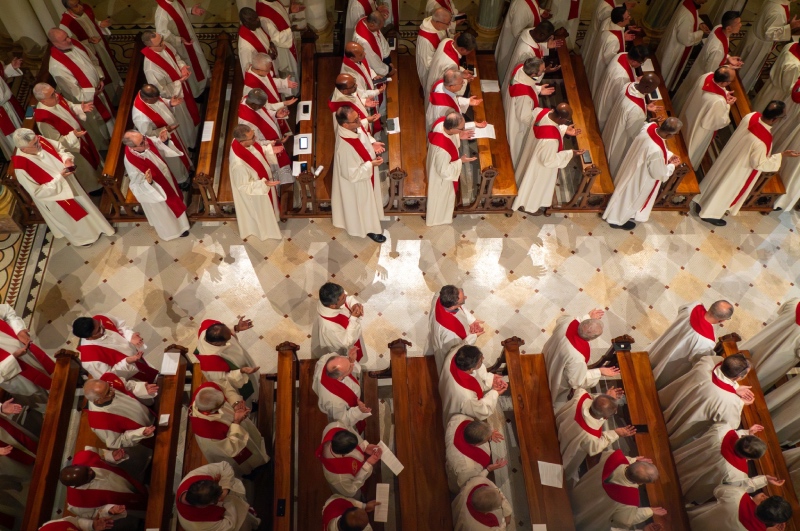
The Society of Jesus, the Catholic religious order founded by Ignatius of Loyola in 1534, has become synonymous with radical progressivism in the Church. Liberation theology, which has bedeviled Christians of all stripes since the 1960s, has counted Latin American Jesuits like Juan Luis Segundo and Jon Sobrino as major proponents. Malachi Martin, traditionalist gadfly and ex-Jesuit, accused the Society of being in a “state of war” against the Papacy.
The perceived liberal turn in the Society has diminished its standing in the minds of the faithful, a change reflected in the implosion of Jesuit vocations, reaching historic lows, while the Dominicans, the Jesuits’ historic rivals, have experienced impressive growth, in no small part due to their reputation as a bastion of orthodoxy.
Yet all hope for the Jesuits is not yet lost. The Society, nearly five hundred years old, has suffered far worse. From 1773 to 1815, the Society formally did not exist, being suppressed by the Papacy at the behest of Europe’s secularists, who feared the Society’s fidelity to the pontiff and potential for subversion. Banished from the Catholic world, the Jesuits returned from their exile to become some of the Church’s most valiant defenders. Jesuits took up the mantle of science, education, and the liberal arts to demonstrate the compatibility of the Christian religion with the fruits of men’s minds.
In the twentieth century, despite the revolutionary changes brought about by the Second Vatican Council, the Jesuits still produced faithful servants of the Lord.
Walter Ciszek, an American, spent over twenty years in the gulags, clandestinely preaching and providing the sacraments for the Catholic faithful in Stalin’s Russia. Aloysius Jin Luxian, who was purged during the Cultural Revolution’s anti-Catholic measures, rebuilt the Catholic Church in Communist China, working tirelessly to bring Chinese Catholics into communion with the Church worldwide. James Schall, a professor at Georgetown University, reinvigorated Catholic learning and greatly popularized the work of G.K. Chesterton.
The witness of these men, and so many others whose names history does not record, demonstrate that the sons of Ignatius have not been subsumed wholly by the chaos of the last fifty years.
Yet, the crisis in the Society is apparent. The poor reputation the Jesuits have garnered amongst contemporary Catholics is not unearned. Jesuit institutions, from high schools to chaplaincies, have become hotbeds of liberalism. The Jesuit tradition of being on the leading edge of the Church’s ministry to the world has led to a number of Jesuits, including those at high levels in the Society, openly denying the Church’s teaching on social issues, the Eucharist, and the existence of the Devil.
Yet this cancer in the Society, as Malachi Martin put it, is not only a Jesuit problem. The legacy of the Second Vatican Council opened the floodgates to all manner of progressive infiltration, leagues beyond what was called for by the Council. The influence of liberal laypeople in institutions and parishes furthered the doctrinal atrophy of the Jesuits and many other Catholic orders. Even the stalwarts of sound Catholic doctrine, the Dominicans, produced the founder of liberation theology, Gustavo Gutiérrez.
The challenges facing the Society are immense, but hope is far from lost. Although not nearly as public as the editors of prominent Jesuit publications or Vatican bureaucrats, the Society has a pious repository of good men doing profound work to forward the mission of the Gospel. Jesuit spiritual directors continue to guide their sheep to Christ, Jesuit scholars continue to engage the evangelize the intellect, and Jesuit priests continue to push the Church towards a cura personalis, a care for the person, especially among the most marginal.
The monumental changes in the Society have not shaken its members away from the mission Ignatius set out almost five hundred years ago, to do all things for the greater glory of God.
The consternation Jesuits face by many pious Catholics, especially in this country, is understandable, but misses the fundamental value of the Jesuit vocation. Calls to suppress the Society, refound it, or replace it with a more traditionalist alternative ignore the immense service to the Church that Jesuit have done and continue to do.
In the Society, there is an appetite to deepen devotion to Ignatius’ vision, to affirm Catholic teaching, and to re-evangelize Jesuit institutions who have gone astray. This reformism will be impossible to enact without support from the Catholic faithful. Regardless of what Vatican watchers and the internet apologetics industry reports, the Jesuits remain an asset to the Church, and the faithful would be remiss to give up too soon on God’s Marines.
More from IRD:
Catholic Publication calls for ‘LGBT Saints’
Massachusetts Bishop Orders School to Stop Calling itself ‘Catholic’ in Flag Controversy



Comment by Qohelet on November 3, 2025 at 4:45 pm
Liberation theology hasn’t “bedeviled Christians of all stripes” since the 1960s.
It accurately represents our faith, which (as Paul reminds us in Gal 3:28) claims that no race or nationality is superior to another in Christ.
Liberation theology has only bedeviled those who ignore Christ’s call to care about the downtrodden (Matt 25) and think the church ought to enforce worldly and unjust power structures.
Comment by Thomas on November 3, 2025 at 8:40 pm
Liberation theology is pure marxism, because it promotes classes struggles and aims to destroy organized religion. The Catholic social doctrine is the remedy for a society injustices.
Comment by Different Steve on November 3, 2025 at 9:35 pm
Ai generated:
Nothing is inherently wrong with liberation theology if you take it as an attempt to live out Christ’s concern for “the least of these.” But there are reasons why some Christians — especially more traditional or hierarchical ones — have said it “bedeviled” the church. Here’s a breakdown:
—
1. Liberation theology’s origins and intentions
Liberation theology arose in Latin America in the late 1960s, particularly through figures like Gustavo Gutiérrez, Leonardo Boff, and others.
Its main idea: the Gospel demands a “preferential option for the poor” — that Christians must side with the oppressed and challenge structures of injustice.
It reads Scripture “from below,” emphasizing how God acts in history to liberate people from social and economic oppression (like in Exodus or the Sermon on the Mount).
So far, that’s fully consistent with much of Christian teaching.
—
2. Where controversy came in
The trouble started with how some liberation theologians framed that liberation.
Many drew heavily on Marxist social analysis to describe class struggle and oppression. While they didn’t necessarily endorse Marxist atheism or revolution, they did borrow Marx’s critique of capitalism and power.
That set off alarm bells, especially in:
The Vatican, which saw Marxism as fundamentally incompatible with Christian belief.
More conservative Protestant churches, who viewed it as politically radical or even revolutionary.
Pope John Paul II and Cardinal Ratzinger (later Benedict XVI) both warned that using Marxist ideas risked turning the Gospel into a political ideology rather than a message of salvation.
—
3. The deeper tension
Liberation theology shifted emphasis:
From personal sin and salvation → to social sin and collective liberation.
From heavenly redemption → to earthly justice.
Critics said that focus distorted Christianity into a political program, reducing the faith to “social work with sacraments attached.”
Supporters countered that Jesus himself confronted oppressive systems and that ignoring material suffering is what distorts the Gospel.
—
4. Why people said it “bedeviled” the Church
The phrase “bedeviled” reflects that it caused deep divisions:
Some priests and bishops became activists, even revolutionaries.
Others condemned it as dangerous or heretical.
Governments in Latin America often saw it as subversive.
The Vatican tried to rein it in, but couldn’t ignore the truth that it arose from real poverty and injustice.
So “bedeviled” here means it challenged, divided, and unsettled the established Church — not that it was pure evil.
—
5. The modern perspective
Today, liberation theology has largely been rehabilitated. Pope Francis (who saw its rise firsthand in Argentina) speaks often in its spirit, though without its Marxist vocabulary. The “preferential option for the poor” is now part of official Catholic teaching.
Comment by David Gingrich on November 4, 2025 at 6:51 am
Liberation theology is literally Marxist.
Marxism in practice has benefited only the people at the very top. And it destroys prosperity, freedom of speech and freedom of religion.
Comment by Qohelet on November 4, 2025 at 7:16 pm
Comments like “liberation theology is literally Marxism” make me wonder what you think the Gospel is? Helping the poor not be so downtrodden is literally the core of the Christian faith.
Capitalism in practice also benefits the people at the very top.
Comment by Glenn Wheeler on November 4, 2025 at 11:42 pm
Qohelet,
Calvinism is the single biggest influence on American pop Christianity. Even those within Wesleyanism have been influenced by it more than they realize. In Calvinism, material prosperity is a sign that a person is among the elect, while being poor and downtrodden is a sign a person is among the damned.
The remnants of that, way in the background, is the main reason American pop Christianity has traditionally been, for all practical purposes, callous towards the poor.