What are the major expressions of Christian political witness today in America?
MAGA Christianity is not necessarily the largest but is perhaps the most politically influential now. It is devoted to Donald Trump, is nationalist, strongly opposes immigration, shuns U.S. foreign engagements, is (with exceptions) wary of supporting Ukraine, is mostly pro-Israel but has an anti-Israel element, affirms tariffs, and, as a populist movement, is suspicious of traditional conservative themes about free markets and limited government. Entrepreneurial charismatic voices are strong in MAGA Christianity, which often esteems strong leaders and bold declarations, amid signs and wonders. Its churches are often independent Pentecostal/charismatic (exuberant worship with belief in modern prophecies, healings and speaking in tongues), distinct from denominationally Pentecostal. A disproportionate number of MAGA personalities are not pastors of traditional churches but ministry leaders and social media influencers who have large online followers. Some MAGA Christian influencers have vague institutional affiliations and vague theology, being more specific about their political commitments. As perhaps the most online-based of major Christian influences, MAGA Christianity is susceptible to conspiracy theories and hyperbolic rhetoric. It also is probably somewhat more religiously diverse than the traditional Religious Right, including Hispanics and some blacks in charismatic churches.
The traditional Religious Right, dates to the 1970s, centers around conservative evangelicals who are mostly nondenominational, Baptist, or denominationally Pentecostal, often in megachurches but also including small town and rural churches. Its leaders are pastors of large churches, leaders of parachurch groups, or commentators on social media. Its traditional concerns focus on pro-life, domestic religious freedom, and opposing transgender advocacy. For most of its history it aligned with Reagan-era domestic and international policies, i.e. lower taxes, limited government, and free markets, with robust U.S. national security and defense policies. In recent years it has increasingly aligned with MAGA based on solidarity regarding transgender issues and pro-life advances, plus overall opposition to woke culture. This alignment has reduced the Religious Right’s propensity for traditional free market themes and to some extent a robust U.S. foreign policy. The Religious Right is more supportive of Ukraine than MAGA Christianity and still is interested in international religious freedom although perhaps less so than in previous years. Traditional religious conservatives remain pro-Israel even as Dispensationalism recedes. Amid collapsing denominational loyalties and post-COVID church attendance decline, Religious right adherents are less likely to be regularly physical church participants than in years past. And they are less likely to rely on traditional institutional religious media, instead heeding alternative secular online conservative media.
The old Religious Left has become almost irrelevant. It was mostly tied to Mainline Protestantism, whose decline it has followed and now surpassed. Responding to MAGA Christianity should have revived its spirits. Instead, it is muted, and when it speaks, widely ignored. Denominations have become increasingly unimportant even to their remaining adherents, who are typically unaware of political pronouncements from their own officials. The ecumenical groups and spinoff organizations related to Mainline Protestantism and previously providing the strongest voices for the Religious Left have died or are empty shells. Independent bloggers, substackers, YouTubers, and podcasters could have filled this void, replicating the role they play for the Religious Right and MAGA Christianity. But there is insufficient energy on the Religious Left to offer those independent voices with strong followings. Many Americans who once would have identified with the Religious Left have in recent decades become more secular and no longer expect traditional religious voices to speak to or for them.
The Evangelical Left was surging twenty years ago, partly in reaction to decisive Religious Right support for President George W. Bush. Evangelical leftists wanted to remain orthodox and evangelistic while rejecting American foreign and military policies, focusing on social justice and racial reconciliation instead of culture war flashpoints. But many evangelical leftists became sexual liberals and effectively became exvangelicals or liberal Protestants. Some left the faith altogether. It’s hard to identify strong remaining voices who are specifically evangelical while also touting politics of the left.
The closest exception to the above statement would be black Protestantism, which remains largely theologically orthodox and evangelistic, including social conservatism, while adhering to progressive political stances. But like Mainline Protestantism, the historic black denominations have also long declined, with younger blacks leaving the church or aligning with nondenominational churches or online sources. Some black Christians, especially if charismatic or Pentecostal, align with MAGA Christianity. Many black clergy of course remain politically outspoken, but their meaningful constituency has shrunk.
Roman Catholic social witness remains systematic and clear, relative to all other Christian traditions, relying on its traditions and the supervision of the U.S. Catholic bishops. It remains socially conservative on topics like abortion and transgenderism, of course, while opposing hardcore immigration restrictions and espousing centrist views on economic and foreign policies. It serves as ballast in contemporary American Christianity, tethering Christian politics to a certain permanence. But like the old Religious Right, its influence is diminished, as most Catholics look elsewhere, chiefly online, for their political counsel. Some Catholics see their bishops as unacceptably tepid and align with MAGA Christianity. Other Catholics may not go so far but, following the trajectory of overall American Christianity, are individualized and self-selecting in their views. The independent Catholic left, like the mostly Protestant old Religious Left, has diminished in numbers and energy. They push the envelope on topics like sexuality, but many of their previous adherents, as with the Evangelical Left and old Religious Left, have secularized and no longer identify with traditional religious labels.
Anti-MAGA Evangelicals who identify with old conservatism, as under the Bushes and Reagan, and who are often tied to evangelical colleges and seminaries, have prominent commentators whom MAGA Christians disdain as leftists. These commentators often get published and quoted in prominent secular publications but lack a wide popular base. The collapse of the old Religious Left and the Evangelical Left now leaves anti-MAGA Evangelicals as the supposed “left” end of American Christianity even though their policy stances are typically conventionally conservative. The decline of American institutional religion has left American Christianity without a vibrant and authentic left flank, with remaining political divides largely on the right.
Christian Realism is another brand of political witness that, in the Augustinian spirit of Reinhold Niebuhr, is mindful of human caprice and tries to avoid overly confident political dogmatics. Pursuing political righteousness is necessary but comes with its own dangers and tragedies, Christian Realists believe. No political tribe should ever be confused with the angels. And even saints can lack political wisdom. But Christian Realism is much more a sensibility than a specific political perspective. Active partisans of most perspectives are impatient with its warnings. But most Christians, upon reflection, would likely agree with its key insights, chief of which is that “pride goeth before a fall.”



Comment by Qohelet on October 20, 2025 at 5:52 am
So the most important Christian voices are either not Christians (MAGA Christianity) or willing to compromise their principles for political power (the traditional right,) but it’s the Christian left that’s irrelevant?
For all the talk of our demise, together mainline churches have about as many members as the Southern Baptists do, and we haven’t chosen Pilate over Jesus.
Comment by David on October 20, 2025 at 6:47 am
It is customary at this point to capital “black” when used to identify the ethnic group.
Comment by Salvatore Anthony Luiso on October 20, 2025 at 6:35 pm
Regarding the notion that MAGA Christianity “shuns U.S. foreign engagements”: I think it would be more accurate to say that it follows Trump’s lead with respect to foreign engagement. Generally speaking, if Trump is for it, they are either for it or at least not against it, and if Trump is against it, they are against it or at least not for it.
It seems to me that a substantial number of Catholics–including clergy–are MAGA or otherwise pro-Trump (like the traditional Religious Right).
I know that many Catholics are liberal with respect to social issues, including abortion and homosexuality.
The article does not mention Orthodox Christians. Maybe because there are too few of them in the United States?
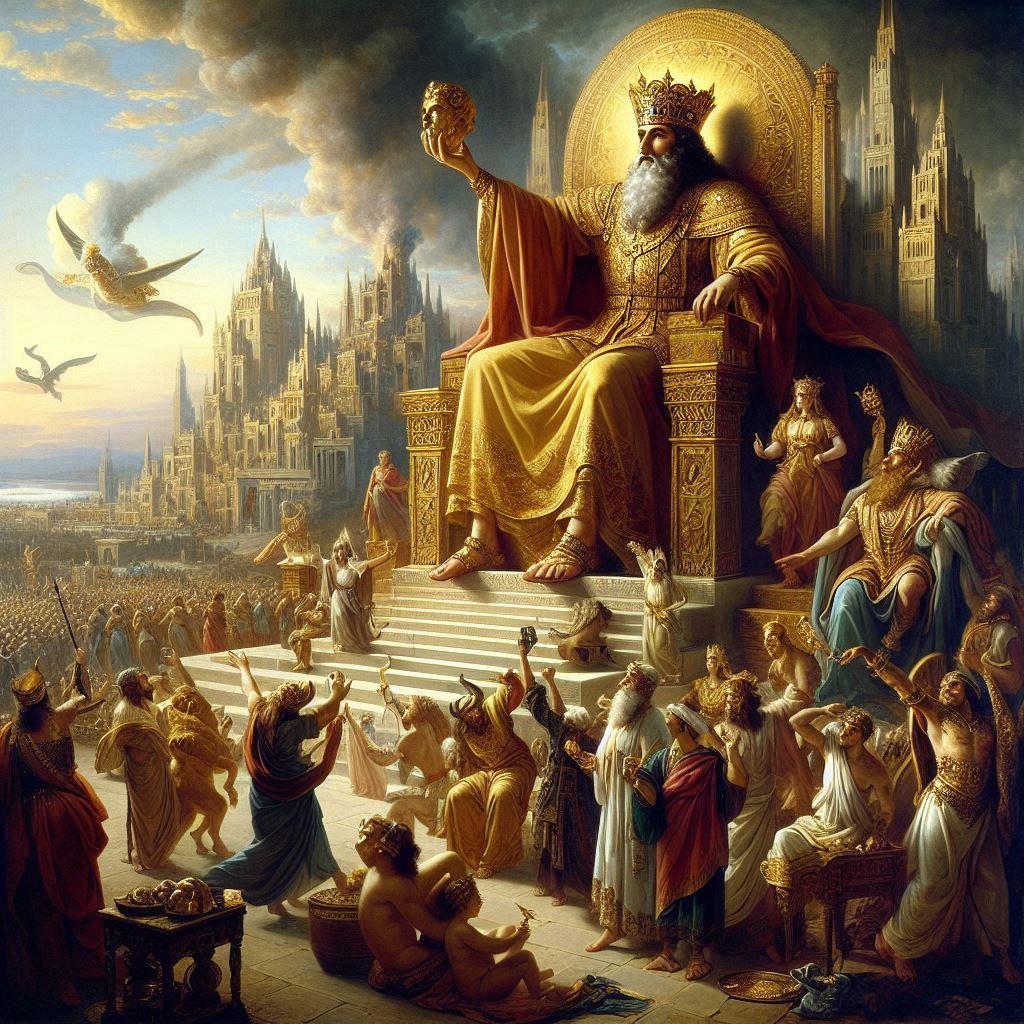
I’m curious as to the title of the picture which accompanies this article, and who painted it. I suggest that whenever this website publishes a picture, it publish a caption with it which identifies it.
Comment by Glenn Wheeler on October 20, 2025 at 7:08 pm
I agree that MAGA Christianity does not shun foreign engagements. Although Trump ran on shunning foreign engagements, so far all he has done is drastically increase foreign engagements. And the MAGA crowd follows like mindless sheep.
Comment by Lance Marshall on October 20, 2025 at 7:54 pm
Maybe that picture at the top is AI generated?
Comment by Norman C Lewis on October 21, 2025 at 9:01 am
Trump
Just uses MAGA Christains for his own use. He is as Christian as a fence post.