
How is it going these days for Christian faith, both in America and in the world? I am authoring a series (Part I here) to address this question by sharing personal experiences that grow out of my 69 years as a Methodist pastor.
Christian faith, especially mainline Protestantism, is being severely tested today, especially in North America and in Europe, a testing that I trace to the 1960s, 70s and 80s.
In 1967 I was appointed to Calvary Methodist Church in Elkhart, Indiana. The church grew rapidly in the 1950s and 60s among the working class in Elkhart but had over-built and faced severe financial pressure. The church had not paid apportionments (a no-no for Methodist churches of the time). Formerly a Methodist Protestant Church, it was regarded by many as a poor “country cousin” to the more successful Methodist Episcopal Church.
My predecessor, “Dwight,” was an extremely gifted graduate of Boston School of Theology. While fairly conservative in theology, Dwight was a social activist and had gained notoriety by passing himself off as homeless and living on the streets for several days in one of the larger cities, and then writing about his experiences, especially those with church people. This endeared him to a number of people in the church and community (but not all). He had attracted new church members who were much more politically and socially liberal than the older, established members. One of the new church families was that of Simon Peter M., a Methodist pastor under special appointment to head the Urban League of Elkhart. He had known Dwight in seminary. He also considered himself a friend of the Rev. Dr. Martin Luther King, Jr.
I had been in town only a few days when I was invited to a home to “get acquainted” with a select group of members. When I arrived, I was ushered into a living room where 17 members of the church were smoking (or holding, if they did not smoke) cigarettes. I was already known as being “evangelical” and the persons in that room were putting me to the test. With what group in the church would I identify? Across the evening we discussed many issues facing the church.
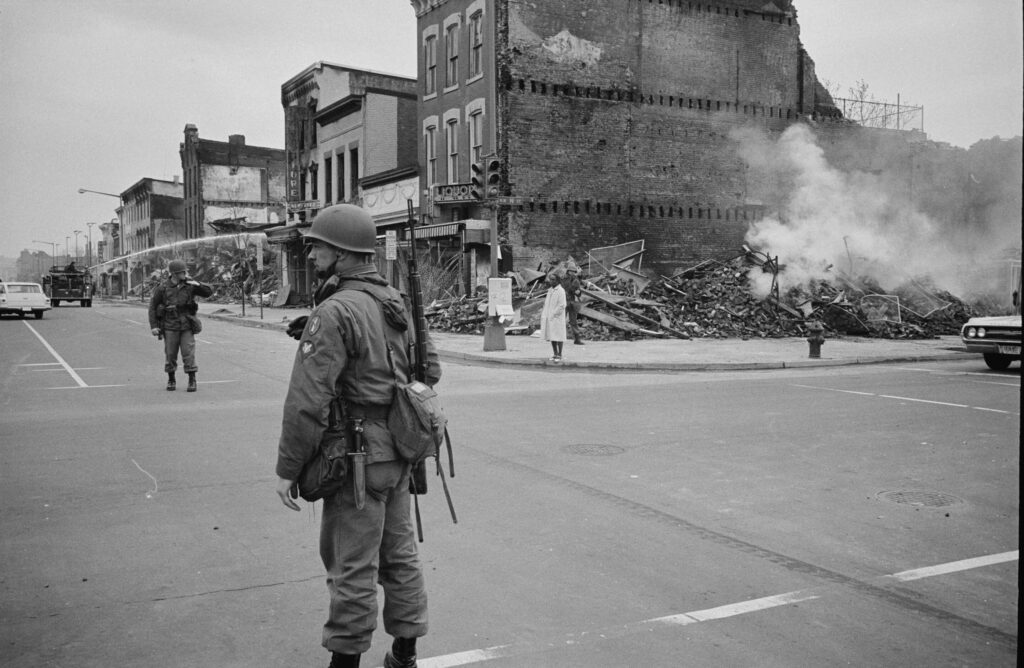
Like many communities at the time, Elkhart had racial conflict. This exploded on April 4, 1968 when King was assassinated. Within hours, a large group of Blacks gathered and marched on city hall to present a list of demands. In reaction, a group of White citizens, almost all of them blue collar workers, organized, and also marched. The local newspaper reported their number at 300. A day later I received a call from a preacher friend.
“You know about racial unrest?” Joe asked.
“Yes,” I acknowledged.
“Guess who the leader is of the Black group?” Joe asked. I didn’t know. “Simon Peter M.”
I should have known, it was the fellow related to my church.
“Guess who the leader is of the White group?” Joe asked. Again, I didn’t know. “Jim Sanders.”
I groaned. Jim was also from my church.
“You have to do something,” Joe insisted.
I pondered and thought what I should do was leave town.
I didn’t leave town. I called both men to see if we could convene a conversational group. And so we did. I was amazed at how well the conversations went. Several in the White group, mostly factory workers, had encountered police dogs on picket lines. A number were union members and sympathized when the Blacks charged the trade unions of being closed to Black members.
A friend offered help. Bob Dungy, an African American, was my daughter’s social studies 7th grade teacher. A graduate of Moody Bible Institute, he had studied Greek. We shared interest in Greek in common and wanted to keep our skills up to date and so got together on several occasions.
We spoke of the racial unrest and he offered to get involved. His idea? Talk to the mayor. He suggested he would go with me to see him. I was worried the mayor would not receive us well, but the opposite took place. The mayor was desperate for ideas. Bob suggested he would be happy to conduct some racial sensitivity training sessions with the police. It worked. As a by-product of our experiences, Bob became Methodist (then United Methodist) and soon entered the ministry. Afterwards, he headed the Upper Room in Nashville, then was appointed as a district superintendent in our conference. In short time he was elected as a General Conference delegate. Bob, it turned out, had a nephew, who became very well known in Indiana. Tony Dungy, who coached the Indianapolis Colts, still has a powerful Christian testimony.
But there was more intrigue (and controversy). The Good News movement was being launched about this time. I signed up early. Despite the fact that one of the first chairs of Good News, Jim McCally, was serving in a cross-cultural (Black-White) church, and despite that another early chair of the Good News board, Phil Hinerman of Minneapolis, was serving Park Avenue Church (the largest attendance in the Minnesota Conference) which at the same time was an integrated mega-church with 40 percent of its members being Black, Good News was accused of being right-wing organization with a racist agenda.
It was not only establishment liberal-types thinking this way. In the early 1970s Hinerman, Good News magazine Chuck Keysor and I were invited to Elkhart to meet with successful Elkhart businessman Ernie Sims. He was well-known in our Methodist conference and had associations with DePauw University. He also was the main figure behind Circuit Riders, a Right-leaning church group. Sims expressed interest in Good News and indicated he would like to make a contribution (he had donated a golf course to the city of Elkhart). Hinerman flew to Elkhart from Minneapolis; Keysor came from Elgin, Illinois, and I from Elkhart.
Those of us with Good News were not well-prepared. We knew that Sims was associated with Circuit Riders, but we knew far too little about how controversial Circuit Riders was.
Sims was also the author of a book, Which Way the Protestant Church? (1969). I read the book later and realized it was more about politics and culture than Biblical teaching. Our meeting, held at the country club, did not go well. Sims wanted to know what Good News was all about. We responded with our passion for Bible teaching and Sunday school material. Sims in reply kept steering the conversation back to cultural and political conservatism. Good News was obviously not what he hoped for. At the end of the meeting, Sims indicated he was giving $5,000 to Good News. At the time it was the largest gift Good News had received (the Good News constituency was mainly rural and Midwestern then). Only later, after I had done research on Sims and Circuit Riders, did I realize that $5,000 was only a mere pittance of what Sims originally had in mind. He could (and might have been thinking) of an amount 50 or 100 times that amount. It was probably a work of the Holy Spirit that we did not receive a large gift. Such a link with rightwing causes could have destroyed Good News.
This account is illustrative of God’s guidance in the evangelical stirrings within Methodism and mainline denominations. After Good News there would come organizations like LifeWatch, the Confessing Movement, Faith in Action and the Institute on Religion and Democracy. Plus, there would be conference organizations.
In Indiana several of us organized the Evangelical Fellowship, which was—at least in my opinion—well received and an encouragement to many. The Fellowship held a yearly two-day retreat over Labor Day, met monthly, and sought to add an evangelical presence to conference activities. Our early morning “Prayer and Share” gatherings at annual conference soon became part of the official program.
Meanwhile, denominational establishment institutionalism began to flounder. More on that and hopeful signs for United Methodism in the following articles.
Riley B. Case is a retired United Methodist clergy member of the Indiana Conference.

Comment by Qohelet on October 15, 2025 at 5:44 pm
Rev. Case I would suggest that the wisdom you showed in 1967 is what’s sorely missing in all the churches today.
You had a potential problem, but you assumed that all involved were men of good faith and your instinct was to get them talking.
I’m guessing they didn’t agree on everything, but they didn’t end up with rancor for each other.
I wish that could happen again.
Comment by Wilson R. on October 16, 2025 at 1:21 pm
I’m old enough to remember those years. What happened in Indiana simply could not have happened in most places in the South.
My father was a Methodist minister in Central Texas. Every town I lived in was deeply racist, some worse than others. In one, the church treasurer refused to send in the congregation’s apportionments (which support broader Methodist ministries, from boards and agencies to disaster relief) because some of that money might benefit “the blacks.” My dad, a relatively inexperienced pastor at the time, consulted his district superintendent, who told him to replace the racist treasurer. That wasn’t easy. The treasurer also was the local banker, and most of the farmers in the congregation had loans with his bank.
The congregation’s origins dated back to a Swedish Methodist church that served immigrants who arrived in the area around the time of the Civil War. The immigrants, like the Texas Hill Country Germans, were anti-slavery and not fans of Jim Crow. Among the families with Swedish roots, my dad found enough supporters to vote out the treasurer and elect a new one (a Swede). But he paid a price, both in terms of a divided church and being moved to a different church at the next annual conference.
It was like that everywhere in Texas and the South. If you were a Methodist preacher who took a stand, you were going to have to move. You’d get a reputation as a boat-rocker, and you might even have to worry about your family’s safety (e.g., someone trying to beat up your kids at school).
There’s an excellent book by Timothy Tyson, “Blood Done Signed My Name,” about the experience of being a Methodist preacher’s kid in a North Carolina town that experienced racial unrest. His father favored civil rights. It didn’t go well for him.
Comment by Glenn Wheeler on October 17, 2025 at 12:20 am
Although institutions with a house of cards for a foundation eventually collapse on their own, external factors can hasten that collapse. The 60s is when the unraveling of the mainline really began, in the context of the main issue highlighted in this article. It was all downhill from there…and still is (for what’s left of it).
Comment by Qohelet on October 18, 2025 at 11:24 am
Glenn the 1960s and especially the 1970s where when conservative churches stopped following Jesus and started following right-wing politics. 50 years on its pretty obvious that the Civil Rights movement was a good thing, and the Vietnam War was a bad thing. The conservative takeover of the Southern Baptist Church led to thousands of churches leaving and made Christianity so objectively mean and cruel that many moderate people of good character won’t set foot in any church today. Stop villifying the mainline. They did their best to straddle the cultural gap and that’s what destroyed them. But at least they were doing God’s work of bringing people together instead of dividing them for political gain.