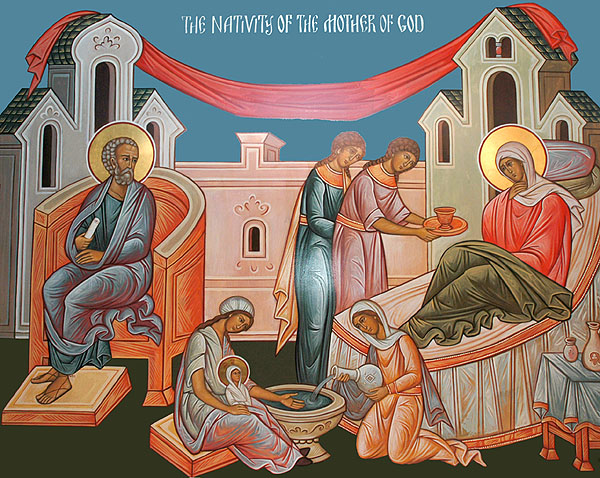

This past Monday, September 8th, the Church marked the first Great Feast of the liturgical year: the Nativity of the Theotokos (God Bearer). For Orthodox Christians, this is not a quaint commemoration of a distant figure, but a celebration that highlights the quiet beginning of the events that led to the birth of Christ and the fulfillment of God’s promises.
The Scriptures do not record the birth of the Virgin Mary or name her parents. Yet the Church has preserved this knowledge through living tradition that has been handed down in the Church’s liturgical life, hymnography, and iconography. The names of her parents, Saints Joachim and Anna, are proclaimed in the services of the Church, honored in the Synaxarion, and celebrated in their own feast days. Festal homilies from saints such as John of Damascus and Andrew of Crete reflect the same tradition, drawing out the theological meaning of this event.
The First Feast of the Year
The Nativity or birth of the Theotokos is the first Great Feast of the Orthodox year, setting the tone for the rest of the feasts of the year. It reminds us that salvation history begins not with human achievement, but with God’s gracious initiative. Before the Annunciation, before the Cross, before the empty tomb, there was the birth of a girl in a humble home, hidden from the eyes of the world, and chosen from before all ages.
Her life is a testament to the rhythm of God’s work that consistently underscores quiet, hidden beginnings that will one day be revealed in glory. The feast teaches us to look for His hand in the small and the unseen, trusting that He is always preparing the way for His purposes.
The hymns of the feast speak of joy breaking forth from long‑endured barrenness. Joachim and Anna, advanced in years and without children, are granted a daughter by God’s mercy. The daughter who would then become the Mother of the Messiah.
Mary’s birth is not simply the end of their sorrow; it is the beginning of the world’s redemption. In her, God prepared the living temple in which the Word would dwell. The troparion of the feast proclaims:
“Your Nativity, O Virgin, has proclaimed joy to the whole universe! The Sun of Righteousness, Christ our God, has shone from you, O Theotokos…”
The Life of the Theotokos
The Church’s tradition tells us that from her earliest years, Mary’s life was marked by holiness and dedication to God. At the age of three, she was brought by her parents to the Temple in Jerusalem, where she lived in prayer and purity, unknowingly preparing to become the dwelling place of the Most High. This event, which is celebrated on November 21st in the liturgical calendar as the Feast of her Entrance into the Temple, reveals her as the bridge between the Old and New Covenants as the new Eve.
Her humility and obedience shine most clearly at the Annunciation, when the Archangel Gabriel greeted her as “full of grace” (Luke 1:28) and announced that she would bear the Son of God. Her response, “Behold the handmaid of the Lord; be it unto me according to your word” (Luke 1:38) is the model of perfect trust in God’s will. In that moment, she freely offered herself, and through her “yes,” the Word became flesh for our salvation.
Throughout her life, the Theotokos remained steadfast in her “yes” through her presence at His first miracle at Cana, standing at the foot of the Cross, and gathering with the Apostles in prayer after His Ascension. She is the first and greatest disciple, because she is the one who “kept all these things and pondered them in her heart” (Luke 2:19). Her life is not only an example for women, but for every Christian a life of purity, prayer, courage, and unwavering faith.
Because she bore God in the flesh, the Church honors her above all the saints, calling her “more honorable than the Cherubim and more glorious beyond compare than the Seraphim.” She is our intercessor before her Son, as the one who continually prays for the faithful and guides us toward Him. Her importance is not only in what she once did, but in what she continues to do: leading us to Christ by her prayers and example.
A Feast of Hope
Ultimately, the Nativity of the Theotokos is a feast of hope. It proclaims that God’s promises are sure, even when their fulfillment seems delayed. This feast is the first in the liturgical year because her birth is the first light of our salvation. It calls us to rejoice with Joachim and Anna, to honor the Mother of God, and to give thanks to God for His providence.
As we begin the new liturgical year, the Nativity of the Theotokos calls us to set our eyes on the unfolding story of salvation, a story that begins in hidden places, grows in grace, and will end in the fullness of Christ’s Kingdom.
Joachim and Anna’s long years of waiting for a child were a part of the preparation for something greater than they could have imagined.
In the same way, the Church invites us to see our own seasons of waiting as fertile grounds for God’s work. The birth of Mary is His assurance to us that He is able to bring forth life from bareness, and joy where there has been only sorrow.



Comment by Seraphim I on September 12, 2025 at 10:55 am
A really well done piece. I love the direction the IRD has been going lately. I hope to see more of the Orthodox perspective in the future since its so underrepresented. Thanks for all you do! You’re a great writer.
Comment by April User on September 12, 2025 at 6:19 pm
Although not Eastern Orthodox (Anglican here) there is so much to draw from in this piece. Thank you so much!
Comment by David Gingrich on September 16, 2025 at 8:24 am
Strange that none of the writers of the Gospels mentioned this stuff. I wonder why.
Comment by Jon Wilson on November 10, 2025 at 11:14 am
Orthodoxy has claimed that Tradition must have a rootage in Scripture (and I include Deutero-canonical). However Mary in the Temple as a child, and the names of her parents are found in apocryphal Gospels outside Scripture. Here, Orhodoxy is patently in error as much as Romanists who are arguing over her being co-Redemptrix and Source of all graces. Ad Fontes, canonical Fontes at that.