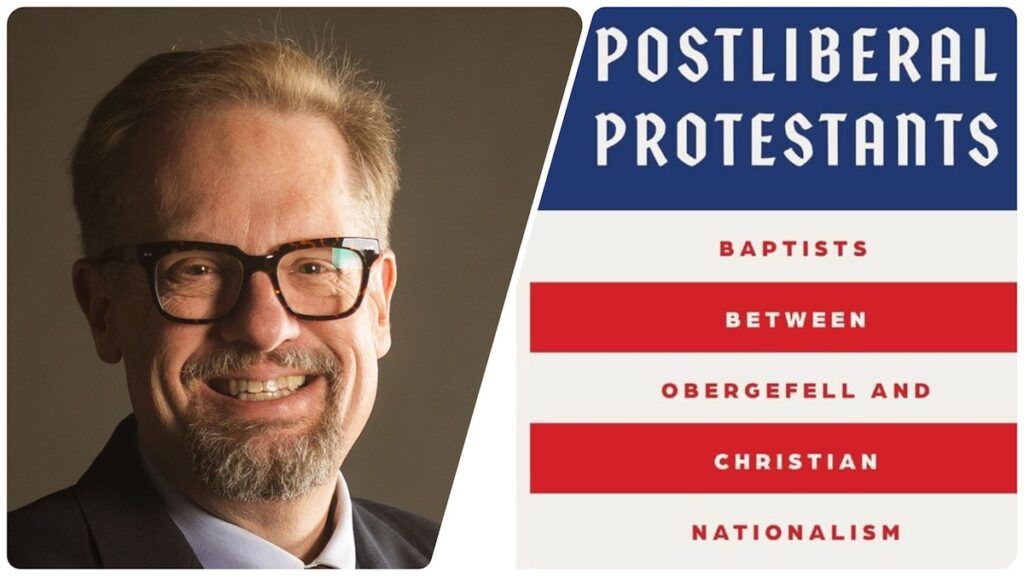
The advent of Christian Nationalism and the U.S. Supreme Court’s 2015 Obergefell v Hodges ruling mandating recognition of same-sex marriage are opposite ends of a society upending a liberal conventional wisdom that prevailed at the conclusion of the Cold War, according to a Baptist historian.
Author Hunter Baker joined American Reformer Editor Timon Cline and Executive Director Josh Abbotoy for the conservative publication’s August 13 podcast discussion centered around Baker’s new book, Postliberal Protestants: Baptists Between Obergefell and Christian Nationalism. Abbotoy and Cline customarily advocate for confessional state coercion. The former provocatively declared in 2023 the need for “a Protestant Franco,” a reference to Spain’s Generalissimo Francisco Franco who ruled Spain as a dictator from the Spanish civil war until his death in 1975, a period characterized by government-enforced Roman Catholic ideology. Baker, who also authored The End of Secularism, is a fellow of the Ethics and Religious Liberty Commission (ERLC), the public policy arm of the Southern Baptist Convention, which historically advocates religious freedom for all.
Abbotoy and Baker are both Baptists, Cline was raised by Southern Baptist missionaries and Baker serves as provost and dean of the faculty at South Carolina’s North Greenville University, a conservative Christian liberal arts college affiliated with the Southern Baptist Convention.
Cline pointed to the U.S. Supreme Court’s 2015 Obergefell v Hodges ruling as “a watershed moment” and asked Baker to describe and define post-liberalism. Recalling international relations scholar Francis Fukuyama’s determination at the end of the Cold War that “this is the end of history,” Baker defined liberalism as ideas centered around limited government, democracy, free markets and constitutional rights like freedom of speech, religion and press. Fukuyama asserted that, following the collapse of Communism, such liberalism would “be the political arrangement of mankind henceforth.”
Baker argued that Fukuyama’s idea of an “on the margins” contest between a dominant right liberalism (concerned with freedom) and a left liberalism (concerned with equality) was not the result. Instead, a “post-liberalism” of the right and the left emerged.
That post-liberalism of the right asks questions about nationalism, race, and religious composition (“who a people is”) while the post-liberal left argues that liberalism was a disaster “built on a rotten foundation of discrimination and inequality” that has to be dismantled, dismissing concepts like free speech as “a species of white privilege.”
“Those sorts of ideas are challenging this sense that liberalism is the end,” Baker stated.
“That’s some of the frustration with post-liberals with the current makeup of the Republican Party,” Cline interjected, describing the party as “wanting to talk about tax breaks” which he regards as non-fundamental or irrelevant. “[Former Speaker of the House and Mitt Romney running mate] Paul Ryan is not where most guys want to go now.”
“After the Cold War … we thought American values are completely ascendant,” Baker recalled. “That explains our approach to dealing with 9/11. We really did believe that we would go over to the Middle East, we would be greeted as liberators. We would fundamentally transform that area, not with our guns and our bombs, but with our values. And we also believed that opening up free trade with China was going to be the way to create the greatest liberal democracy the world had ever seen.”
Neither of those things happened, Baker observed. “Our Middle East adventures turned out to be a spectacularly expensive failure” and China continues “to be illiberal in the worst way” and “the rising hegemon that’s going to take us on.”
“It turns out that those values were not as transformative as we hoped they would be,” Baker determined. “Certainly, they didn’t possess the kind of inevitability that I think that Marxists once believed about their own philosophy. And we’re seeing the same as true of our values as well.”
Blinded by success in the Cold War, Americans were inattentive to domestic life, standards, and virtue, Cline suggested, with Baker adding that the end of the Cold War was bad for Americans.
“The Cold War caused us to have an intentionality about who we are,” Baker noted, recalling efforts to convince the population of America’s goodness, the value of our system of government, and the value of our Constitution in the face of opposing the Soviet Union or Mao’s China. “We just didn’t have this same relentless focus on deconstruction.”
“Once that ended, there’s a real kind of letting down of your guard and you’re just sort of drifting and all you really care about is prosperity,” Baker assessed.
Cline asserted a generational confusion or disagreement with young Americans unfamiliar with a time of prosperity or “total confidence” broken after the September 11, 2001 terrorist attacks.
“This is what the baby boomers lived through. There’s a totally reasonable explanation for why they are the way that they are and most of us can’t viscerally understand that,” Cline described.
Baker pointed to anti-Communist author Whitaker Chambers’ Witness, which noted 20th century totalitarian regimes aggrandizing the state.
“They were trying to be the family, the church and, in a real sense, they were trying to be godlike,” Baker assessed, contrasting that with an American way defined by freedom. “We allow for a society that has subsidiary, and all of that’s actually because we believe in God.”
Americans don’t need a state that has divine-like attributes of omnipotence and omniscience, Baker said, insisting that was “very much the defining struggle of the 20th century.”
“Perhaps it’s not as much the defining struggle today, but nonetheless created a generation of conservatives who really thought of Christianity’s government as being primarily about freedom and the government leaving room for the church to do its work.”
Conditions are shifting, Baker sees. He also described the small government semi-libertarian emphasis as never the right fit for Chambers, an anti-communist unsure that the small government free market is the path.
“He [Chambers] thinks that it’s too thin,” Baker notes. “And you need something stronger to oppose communism.”
There’s good reason to think that the general liberal thesis was correct as a historical matter, Baker adds, noting that optimism was high at the time. “But this has broken over time to get us to our current reassessment.”
Obergefell launches the post liberal left, placing Christian orthodoxy officially at odds with the Supreme Court’s interpretation of the American Constitution.
The Baptist academic identifies an increasingly aggressive left-wing secularism, replacing a positivistic secularism with what author Stephen D. Smith terms pagan secularism, prompting the revolution in human sexuality.
On the other side is Christian nationalism. Baker distances himself from what he sees as a hysterical criticism of Christian nationalism or Catholic integralism. But, he thinks that Baptists have largely been correct about the importance of separating the church from the state.
“The left was successful in making a lot of people, including the court, believe that the separation of church and state is secularism, right?” Baker asked. “It really is sort of cleansing the public square of religion.”
“I support the institutional separation of church and state that the church is never the dog on the leash held by the state,” Baker described, pointing to England as an example of an in-state Christian nationalism with state support and Church of England officials presiding over national events, such as royal weddings or seated in the House of Lords with voice and vote.
“But does it matter in that society at all?” Baker asked, quickly adding that it does not. In contrast, he sees in the United States a free church tradition with a church that is far more vital, unlike a Western Europe that is “the home of sort of Christian nationalism par excellence” but simultaneously “the most secular place on earth.”
Readers can find Baker’s book Postliberal Protestants here and can access the podcast episode in its entirety here.



Comment by CommentKing on September 9, 2025 at 3:16 pm
Good write up on a great conversation. Very refreshing to hear civil discourse across the classical liberal/post liberal divide.
I wish many more evangelical intellectuals had Dr. Baker’s intellectual bravery and curiosity.