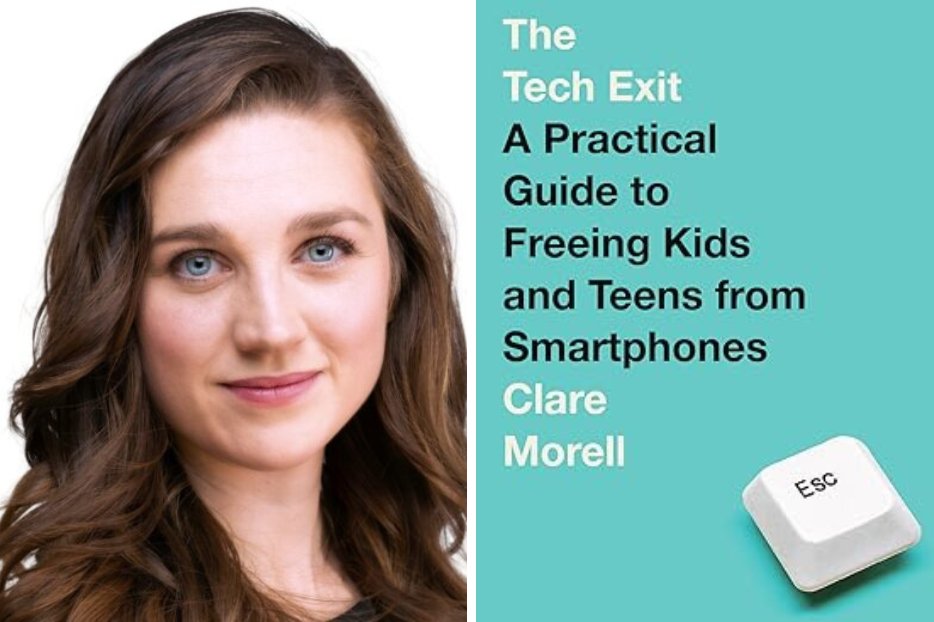

Raising children has become a challenge in a culture that is no longer supportive of and in some respects hostile to Christianity. Clare Morell, a fellow at the Ethics and Public Policy Center and director of its Technology and Human Flourishing Project believes that the elimination of smartphone and social media use by children and teenagers is important in forming decent, responsible citizens. She spoke at the Clare Boothe Luce Center for Conservative Women on her new book, Tech Exit: a Practical Guide to Freeing Kids and Teens from Smartphones on July 18.
While Morell believes that minors should completely abstain from smartphones and social media, she could find no book saying this. Instead, advice to parents was to limit use. It should be limited in the time spent on smartphones, and the resources available to children. But this is woefully insufficient to deal with the harm to the socialization of young people that social media is causing. Indeed, existing advice said or assumed that exposure to social media is inevitable for children and teenagers. Her interviews with “dozens of families, plus hundreds more” she’s heard about who pursue a smartphone free childhood show otherwise, she maintains.
Part of what Morrell has done is “recommending and advising lawmakers on needed changes in the law.” But also parents today “are looking for concrete, everyday advice.” This led her to write her new book. She argues that it is actually possible for children and teenagers to grow up without smartphones, and that the strategies tech companies sell to parents as being adequate to avoid harm are insufficient and in fact are conducive to social media addiction. Social media can of course be accessed from a personal computer at home, but a parent can have at least a degree of control over the PC which cannot be had with a smartphone. Morell seemed to treat the terms “smartphone” and “social media” interchangeably, however.
The Addictive Power of Social Media
Important in her new book is the discovery that social media are in fact addictive. Neurobiological research, she said, shows that smartphones work like “a highly addictive drug.” Brain scans of people who are heavy users of smartphones have shown that they are like those of heavy users of drugs. “The structural changes in the brain are the same,” she said.
The developing brains of children “are especially vulnerable.” About the age of 10 the brain’s dopamine receptors multiply causing children to “turn outward for social feedback [and] for peer approval.” Surveying sixth and seventh grade children who are heavy users of social media, it was found that they were “overly sensitive to the kinds of social rewards that social media gives.” This is called “sensitization.”
Neurological connections in the brain are affected by the lives we live. Particular experiences or behaviors we engage in reinforce those connections in the brain associated with the experiences or behaviors, in a process called “myelination.” A maxim the brain seems to follow regarding these connections is “what fires together wires together.” Other pathways deteriorate and are eliminated if not used, in a process called “pruning.” Cerebral development that gives people self-control is not complete until one is about twenty-five. Thus, for developing brains, use of an addictive substance or use of social media amounts to “all gas pedal and no breaks.” Unlike sugar, which can be taken in moderation, drugs should not be taken for pleasure in any amount. Social media is effectively a drug for children and adolescents. It releases high levels of dopamine on exposure and makes it difficult for children to develop self-control and emotional stability.
The dopamine surge given by social media leads to a “dopamine deficit” after one uses social media, as the body attempts to achieve homeostasis. Dopamine, she said, never “produces lasting satisfaction, it only produces craving.” Therefore “even if a child is on social media for only 30 minutes a day … they want to get back on it and do it again.” An additional problem is that children “live in the virtual world long after they leave it, because of the images it produces.” She pointed to psychiatrist Victoria Dunckley, who found that many children who came to her with symptoms of autism and ADHD (Attention Deficit Hyperactivity Disorder) had these symptoms induced by social media use, which desisted after social media use was eliminated. Dunckley found that for patients that truly had autism or ADHD, “just eliminating the screens for thirty days cut the symptoms in half.” She termed this phenomenon “electronic screen syndrome.” It is characterized by an adrenalin release and a “chronic stress state” because of the lack of physical exercise. By abstaining from social media use, a person can “detox … and come down off of those stress responses.” Thus, “screen time limits don’t work, because even a small amount of time is very destructive.” It is harmful to “the child’s developing brain and nervous system.”
Inhibiting the Development of Character
Another problem is that even with parental controls, social media “is habituating children to vice rather than virtue.” Social media companies work hard to persuade parents that with parental controls their children will be safe. However, with the controls they make available children must accept the parental supervision, and “they can cancel it at any time.” Even though parents will be notified of cancellation, it remains true that “the parent is not the one in the driver’s seat.” Further, the main limits offered are controls on the amount of time spent and control of privacy settings. But this is deceptive as well, since a parent has no way of knowing what a child is accessing. Morell said that there are “hundreds and thousands of apps in the app store. It’s impossible for parents to effectively lock down a smartphone because every app has its own portal” to outside social media. Complete strangers can communicate with children, and even in a Bible app teens can exchange photos.
“The cumulative effect” of existing social media is that “children are being exposed to violence … the entire environment” encourages teens to access sexual material and interact with strangers. It encourages minors to think about vice instead of virtue. Teens and tweens experience what minors their age have never experienced – a plethora of sexual material in their pockets. This is happening at a time when their brains are developing, and they are not developing self-control. Effectively, children are exposed to the “outside world without any parental controls.”
Morell said that “we are in a battle for the soul of our kids in this nation.” What parents want for their kids is also in the national interest, she said. And what parents want is to raise “free and virtuous citizens, who will be contributing members of society who will make their country a better place.” But the tech companies “are working to form a different kind of person.” The companies want children and teenagers’ “time and attention as much as possible.” They are training children to become “unthinking, dopamine addicted users.” The technologies “are creating dependence and addiction instead of independence and freedom.” Social media “rewards and celebrates self-focus and self-expression, rather than responsibility and service to others.” Children and teens are being trained to “skim and switch” their focus instead of focusing on one thing for an extended time. The discipline for extended and deep thought is not developed. Therefore, “the cumulative impact” of all this is that “the medium is the message.” Children are being wired “for consumption instead of production and training us to think that the purpose of life is entertainment and amusement … instead of fostering our creativity, our problem-solving abilities, and teaching us to love and serve others.”
What Parents Can Do
Morell believes that “we are at a hinge point in our culture.” Parents today “are in direct competition with these big tech companies.” Parents have “different goals” than the tech companies. Whoever wins the competition will determine “what kind of people are formed,” and thus what the nature of the country will be. Morell hopes that her book will “change the culture around social media and smartphones.” The object is to make social media “taboo” for children and teenagers.
Morell then asked what parents can do to achieve this end. She said that evidence shows with 30 days off of interactive media the brain’s dopamine levels return to normal as the body returns to “homeostasis” or physiological stability. She proposes that minors abstain from “social media, smartphones, tablets” (this, she said, was “controversial”) “or video games during childhood.” Children “can then begin experiencing the normal pleasures of life.” One problem is that compared to the social media experience, normal life seems boring, consequently, many young people today are depressed. But this will change after use of social media has ceased for some time. Detoxing and abstinence from social media “is possible for anyone at any age at any time.” Even minors who have used social media for several years can be weaned from it and become productive, involved persons. They can then “enter adulthood with the skills of self-control.”
A fair number of children and young people can be expected to resist leaving social media. They should be told “I’m sorry, we made a mistake, this technology is too powerful for you, and so we’re going to do a detox … so that you can experience pleasures in the real world.”
As a strategy parents can use for withdrawal, Morell uses the acronym “FEAST,” because in fasting (i.e., withdrawal) from social media. “We’re feasting on real life.” In this acronym, “F stands for find other families,” i.e., other families who are agreeing not to give their children smartphones. There are examples of this, and it can be a powerful tactic. In one case near Washington, D.C., children of these families who started going outside to play led to other children wanting to do the same thing.
“E” refers to explain, educate, and exemplify to children why they should abstain from smartphones. Parents should act in a relationship of “love and trust.,” making clear the dangers of the technologies and that they act for the good of the child. One claim made against abstinence from smartphones before college is that young people will overuse them in college. But in fact such kids are better prepared for the responsibilities of life and the demands of college than those who have been raised with smartphones, and smartphones do not come to dominate their lives in college. “Bingeing later is a myth,” she said.
“A” stands for adoption of other technologies than smartphones. There are phones that allow the user to call and text without social media or Internet access. Morell lists many varieties in her book. “S” is for setting up home and family screen rules. Children can use the family’s home computer to access the Internet “for very specific purposes.” People can be trained in computer science and become very tech savvy entirely without a smartphone. Indeed, a smartphone does not give one “tech skills,” they are products for entertainment, not production. Also, watching entertainment together as a family can be positive for families; Morell said “the bigger the screen, the better.” There should also be accountability for the use of communication channels, and “no completely private channel” of communication.
“T” stands for “Trading screens for real life responsibilities.” This involves building a social life with “real life friendships.” Social media by contrast provides “shallow connections” with others. Another important chemical for giving pleasure, in addition to dopamine, is oxytocin. This is generated as a result of friendships, is important in social bonding, and provides satisfaction. Developing a hobby can also be a way of participating in the real world. Involvement in the real world should teach children and teenagers to love others, and to understand their dependence on others. These things will not be learned from a screen.
Schools can be helpful in adopting media policies, and “provide more extracurricular options for kids.” If we want children to love God and neighbor, “one of the most important things we can do is get rid of these screens.” Getting rid of screens is only the first, hard task of “reclaiming childhood” and developing an outward looking life that involves “true human flourishing.”
Questions about Minors and Social Media
In response to a question, Morell said that a problem that social media has created is that people with a radically non-Biblical worldview can now access children in Christian or socially conservative families. By giving one’s child a smartphone, one is “inviting the entire world” into the life of one’s child. Children can be groomed into transgenderism. In fact, Morell said that all parents she knows who were struggling with a child who was trying to become a member of the opposite sex had children who use social media.“ It almost always started online,” Morell noted.
Another questioner asked about the exposure of children and teenagers to pornography on social media. Morell said that the dopamine surge resulting from viewing pornography demands strong and stronger “hits,” and corresponding depression after viewing. This means that people viewing pornography “are looking for more and more novelty.” She said that her husband is a pastor, and has found in counseling young men withdrawing from pornography that they first became involved not by directly using pornography, but were led into it by searching the Internet “for the next dopamine hit,” the next exciting novelty. As always, depression follows a dopamine hit, and the resulting craving for more.
It was asked how kids and teens should respond to pressure from peers or others at school to use social media. One strategy to deal with this is education about how our brains should develop for a good life. People, and especially young people and children, do not want to feel that they are being manipulated, but in fact they are being manipulated by the social media companies. This can help develop the will to leave social media. Again, people, and especially young people, want to be happy and have friends, and social media is an impediment to this.
Another question concerned the goals of the social media companies. Morell said that the business model of the social media companies is to break down the will power of users and get them to use social media as much as possible. Social media seems free, but the goal of the social media companies is to get users to view advertising. If children and teenagers become hooked on a particular social media product, then the company can present advertising to them “over the course of their lifetimes.” The point is to get a person “hooked as young as possible.”
Conclusion
Smartphones and social media, which could reasonably have been expected to open up the world to people and advance freedom of expression, especially for those in the middle and lower echelons of society, and to give them access to information resources and social connections they previously did not have, has in fact made many people more isolated, self-centered, and even hostile. This in turn fuels demands for censorship, which have increasingly come from the political and cultural Left in the last generation. Instead of enriching culture, social media seems to be eroding culture.
For those wondering, as did so many in the twentieth century, what the meaning of life is, social media intensifies the meaning already given in the wider culture, that the meaning of life is entertainment. The theme of entertainment has corrupted the presentation of news, which thrives on crisis, and has become a form of entertainment for many.
As Morell maintained, this is incompatible with the Christian message, which is that the meaning of life is love, and therefore duty first to God, and then to neighbor. It is first of all the duty of Christians to fulfill those duties, but beyond that love and duty to God and neighbor are the virtues that built the most powerful and prosperous nation on earth. Morell has excellent advice on keeping future generations of Christians faithful to God, and our nation free, virtuous, and successful.
More from IRD:
Technology in the Light of Providence




Comment by David on August 8, 2025 at 11:52 am
This is the second time in my life when there has been a moral panic over new technology. The first was in the 1950s and involved the dreaded television. Parents were urged to restrict viewing hours. The nefarious Howdy Doody show caused kids to leave the family dinner table. Over the years, this mortal threat to society ceased to be taken seriously.
Unlike TVs, smartphones are interactive. Kids can now communicate widely with others—something unknown in the past. As is the case for many things in life, this can be used for good or ill. It allows one access to a great library of information from one’s home, but it can also be a platform for bullying. The world is a great cafeteria and parents need to guide children to choose the good things.
Comment by Mike on August 9, 2025 at 9:44 pm
“It allows one access to a great library of information from one’s home”. Much of which is not suitable for minors, and much of which is downright abominable.
It is pretty much established fact by now that juvenile brains do not finish maturing until one is about twenty-five years old. Teens, especially, are prone to unwise decisions.
Also, too much use of smartphones (and incidentally too much TV viewing and computer use) takes kids away from interacting with other kids and learning how to socialize.
Comment by John on August 10, 2025 at 12:44 am
Mike,
You know, I hear that argument about young people’s brains all the time in regards to a lot of things. Not saying it isn’t a true statement, but I also feel like we use it as an excuse to be hyper-focused on the young without asking ourselves the obvious question. Are young people’s behavior and tendencies today really that different from the older generations or have we all become more anti-social and digitally-dependent? My parents are boomers and they’re on their devices more than me. I think the fact of the matter is smart phones and social media have fundamentally changed both communications and socialization in ways that will probably be permanent and affect us all. That doesn’t mean we shouldn’t do anything, but think we’re being naive or short-sighted if we think these issues will go away the moment a person becomes an adult. I’m also not sure if complete abstinence from social media until adulthood is necessarily the best solution and certainly not one that guarantees abuse won’t happen in adulthood.
Comment by Dan W on August 10, 2025 at 10:28 am
If only these smart devices had a “chip” that parents could use to block inappropriate content, and/or control the amount of time their children spend online. They could call it V-Chip or something similar.
Comment by David on August 11, 2025 at 6:34 pm
Some years ago, declining socialization was addressed in Robert D. Putnam’s book, “Bowling Alone.” He described the decline since about the 1950s in memberships in organizations, be they the Freemasons, Odd Fellows, Rotary, Knights of Columbus, churches, and bowling leagues. Americans became more insular even before the advent of Smartphones.
Comment by David Gingrich on August 13, 2025 at 7:28 am
Does this woman have children? If yes, I feel very sorry for them.
Comment by Qohelet on August 13, 2025 at 12:05 pm
There’s a lot of good in this article and then it descends into nonsense during the Q&A part.
As a teacher, I can tell you that objectively high school kids in 2025 are not the same as high school kids in 2010. A colleague once asked if our current students could pass our old tests and the room was quiet. My opinion is that some of the stuff cited above, specifically the drug like response is to blame. When we were kids there were things that were hard and boring and we had to stay focused on them. Now there’s a whole other world they can escape into and when that happens over and over again eventually you learn much less.
Where the article loses me is when it descends into the typical conservative idea that parents own their children and have the right to block access to knowledge.
Are cell phones bad for kids? Absolutely. Delay supplying them at least till 8th grade and have strict rules about when they’re used.
Are kids using them to access (and sadly create) pornography? Absolutely. This is where you have to talk to your kids about sex, human trafficking, what behavior is unacceptable on the part of adults, and things they should never agree to do with their phone (like take pornographic pictures of themselves or let someone else do that.) This is an uncomfortable conversation but it’s your job as a parent. As Grandmaster Flash once said “they didn’t take the time to tell you about sex so you had to learn about it in the discotheque.” There’s a reason the Bible belt is also the teen pregnancy belt. You don’t protect kids by hiding the world from them you protect them by talking about how to stay safe in that world.
Also, as anyone who has ever met a transgender kid knows, no one is “grooming kids into transgenderism.” Being transgender is really hard, especially right now. No transgender person is wishing that on anyone who isn’t transgender.
As for anything else your kid might learn on a smartphone that irks conservative parents? (evolution, vaccine safety, the misbehavior of senior figures in their church?) Your kid has a right to know what’s true and false and any true faith is strong enough to withstand demonstrable facts.