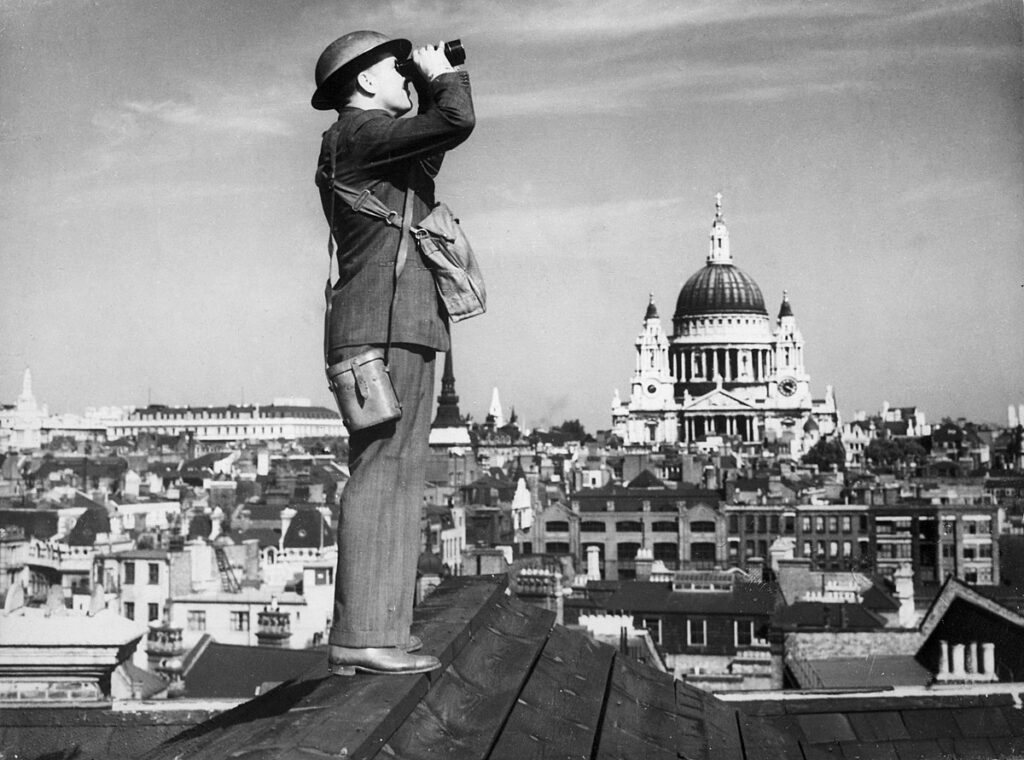

As bombs fell on London in 1940, the fate of the United Kingdom and Western Civilization balanced on a knife-edge. On the eve of the Battle of Britain, Winston Churchill spoke to the House of Commons and declared, “Upon this battle depends the survival of Christian civilization.” In a Europe increasingly divided between the genocidal and totalitarian governments of Stalin’s Soviet Union and Hitler’s Nazi Germany, the United Kingdom held out as a bastion of Western civilization.
While the United Kingdom and the West survived the fascist and communist onslaught, questions regarding the health of Western Civilization remained. C.S. Lewis wrote extensively on this subject during this time, and his insights are particularly valuable to modern Christians concerned about growing social and political upheaval within the West.
There is a growing belief that the West is in decline and that the root of this decline is spiritual. This assumption can be found among non-Christians and Christians alike. This includes a growing tide of “Cultural Christians,” non-believers who attach their allegiance selectively to ethics and values they find in Christianity. Agnostics and atheists such as Richard Dawkins are finding value in Cultural Christianity as a means of organizing and potentially saving Western Civilization, but are not believers themselves.
A similar conviction is rising inside the church itself. A growing number of believers argue that the moral and cultural renewal of the nation, and of the broader West, depends on a return to Christian ethics and a shared cultural identity shaped by those ethics. Figures such as Stephen Wolfe, have called for their unique version of Christianity to restore Western Civilization. While their theological commitments and strategies differ, together they signal the emergence of what might be described as a new form of Post-Modern Integralism, an attempt to reimagine the integration of religious values and public life in an age of cultural fragmentation.
While most Christians do not wholeheartedly embrace these views, many share a genuine concern about ongoing cultural and spiritual upheaval. This struggle is not new. During his life, Lewis wrote extensively about the “dechristianization of the West” and the perceived decline of Western Civilization. Lewis believed the illness that afflicted the West was spiritual. During his famous wartime radio broadcasts, which were later compiled into Mere Christianity, Lewis felt Britons had cause to be uneasy. With fascism on the rise and German bombers pounding London, he stated, “…I think if you look at the present state of the world, it is pretty plain that humanity has been making some big mistake. We are on the wrong road. And if that is so, we must go back.” Additionally, in a post-war letter, he expressed concern about the “moral condition of our times” and wrote, “This results from the apostasy of the great part of Europe from the Christian faith. Hence, a worse state than the one we were in before we received the Faith.”
However, while Lewis might agree with the Cultural Christians and Post-Modern Integralists on the diagnosis, he would strenuously disagree with their cure. In his essay “On Ethics,” Lewis directly challenges the underlying belief that Christian Ethics is needed to preserve civilization. His position is clear: “Though I am myself a Christian… I find myself quite unable to take my place beside the upholders of the first view,” he writes. “The whole debate between those who demand and those who deprecate a return to Christian ethics, seems to me to involve presuppositions which I cannot allow.”
What objections did Lewis have to these positions? First, and in response to Cultural Christians, Lewis would claim that while good-intentioned, the Cultural Christianity movement misses the point of Christ’s message. Those who want Christian Ethics without the Christian faith have turned Jesus into a mere moral teacher, another Historical Jesus, divorced from the Gospel. But as Lewis famously wrote in Mere Christianity: “Either this man was, and is, the Son of God: or else a madman or something worse.” Lewis observed that when writers of his day called for a return to Christian Ethics, they referred to a body of injunctions, not the source of those injunctions. Otherwise, they would simply call for a return to Christianity. This desire for divine law without faith turns God into a means to an end, a tool for social goals. In the words of the devil Wormwood from Lewis’ The Screwtape Letters, “Believe this, not because it is true, but for some other reason. That’s the game.”
Lewis would challenge the claims of Post-Modern Integralists, arguing they have confused moral priorities, elevating a second moral priority into the primary moral priority. In his 1942 essay, “First and Second Things” Lewis distinguished between first things, the ultimate good that gives everything else its place, and second things, real but subordinate forms of good. After exploring this concept, he turns his attention to the question: What has Western Civilization put first over the past 30 years? The answer is itself, “To preserve civilization has been the great aim; the collapse of civilization, the great bugbear. Peace, a high standard of life, hygiene, transport, science, and amusement — all these, which are what we usually mean by civilization, have been our ends.”
Elevating the survival of nations or civilizations, concepts often defined arbitrarily, places a created object above the creator. Efforts to “use” Jesus as a tool to save the West inverts the divine order and reduces the Savior into an instrument of human goals. As Lewis has Wormwood sneer in The Screwtape Letters, “For the Enemy will not be used as a convenience. Men or nations who think they can revive the Faith in order to make a good society might just as well think they can use the stairs of Heaven as a short cut to the nearest chemist’s shop.”
Does this mean there is no value in secondary things like culture or civilization? Not at all. A Medievalist and a lover of classical literature, Lewis treasured the legacy of the West and lamented Europe’s dechristianization. Yet he also believed that all love must be rightly ordered:
“It will be replied that our concern for civilization is very natural and very necessary at a time when civilization is so imperilled. But how if the shoe is on the other foot?—how if civilization has been imperilled precisely by the fact that we have all made civilization our summum bonum? Perhaps it can’t be preserved in that way. Perhaps civilization will never be safe until we care for something else more than we care for it.”
For Lewis, the priority was not the preservation of any one culture, institution, or nation, but the eternal destiny of the human soul. As Lewis wrote, “There will come a time when every culture, every institution, every nation, the human race, all biological life is extinct and every one of us is still alive. Immortality is promised to us, not to these generalities. It was not for societies or states that Christ died, but for men.” Although nations rise and fall, individual souls shall live for eternity.
If Lewis is correct, is there hope for the survival of nations or civilizations? He would say yes, but only if we love something more than these secondary things: namely God. So, what should patriotic believers do? First, resist the temptation to follow any historical Jesus that promises earthly, rather than heavenly salvation. Second, focus on loving God, loving your neighbor, and fulfilling the Great Commission. In his essay, “Mediation on the Third Commandment” Lewis makes this point with striking clarity “He who converts his neighbour has performed the most practical Christian-political act of all.”
More from IRD:
Restating the Modern Problem alongside Modern Giants
C. S. Lewis against the Darkness
‘That Hideous Strength’: a Fictional Tale Becoming Reality?



Comment by Colin Ross on July 30, 2025 at 8:40 am
How is Christianity required for the survival of civilization? Honest question. Civilization is many thousands of years older than that religion. By far the most advanced, stable and livable governments are all secular. Christianity has a rather large part to play in collapsing the most power government in its time (Rome) and when the church had the most power….well we affectionately call those the dark ages for a reason. CS Lewis wasn’t exactly the end of all philosophy. It might be easier with his famous Liar, lunatic, lord argument to just assume the first two…its the undeniably most likely scenario. Hell he lived through the world wars, where the christian monarchs nearly destroyed their own civilizations. We have never unironically referred to the west as christandom ever again.
According to whoever wrote the gospels (no one knows) Jesus promised to come back 2000 years ago. Hes not coming and hes not even going to bother calling.
Comment by Mike on July 30, 2025 at 9:07 am
Colin Ross:
I would suggest that you read II Peter chapter 3, and see if it is talking about you, especially vs. 3 and 4:
” Knowing this first, that there shall come in the last days scoffers, walking after their own lusts,
And saying, Where is the promise of his coming? for since the fathers fell asleep, all things continue as they were from the beginning of the creation.”
Comment by Colin Ross on July 30, 2025 at 9:34 am
Oh good Mike, you quoted the book that warns about scoffing at its god/gods.
First of all things don’t continue as they always have since creation, our universe is in constant motion.
Secondly, I dont mock the god whose name is Jealous I dont believe in, if anything I mock people who base their lives on a bronze age collection of writings about blood magic and its various uses to a supreme being who loved the smell of burnt flesh.
third: Spare me the nonsense, Christianity is collapsing in the west under the weight of the internet but it hasn’t been helped along by the endless supply of scandals and horrific unspeakable crimes by the so called leaders of this silly church. Anglican vs Episcopal? Who cares, they are both founded on all the family values of king henry VIII.
4th. CS lewis was 1/3 right. Jesus an apocalyptic doomsday teacher who told people to forsake their families, sell thier clothes to buy weapons, and called women dogs. If he existed at all, he was a lunatic.
I think CS Lewis was right: liar lunatic, or lord? Did you know Jerusalem has a special holding building specifically for religious apocalyptic preachers even in this day?
Comment by Mike on July 30, 2025 at 9:57 am
Colin,
Throughout history, every village has had its resident atheist. So it is on these boards.
I guess, for today at least, you are the resident atheist. You don’t believe. I do. I don’t feel threatened by your unbelief. If anything, I feel sorry for you.
Comment by Colin Ross on July 30, 2025 at 11:16 am
All good MIke.
Ya throughout history Christians have a pretty violently relationship atheist. Funny how Its not so much the resident atheist when half the population doesn’t believe in just a generation. The majority of the blog post on christian sites are pieces lamenting the irreparable collapse of so much of the church so quickly. As a former christian who grew up in the anglican/baptist tradition I find it hilarious just how little they seem to know about why we’ve left en mass. The I feel sorry for you reminds me so much of the “bless your heart” saying from my homeland that always meant something else.
The truth is atheist are not recruiting. When a preacher says the world is 6000 years old, we all spoke the same language until god was worried about us surpassing him, talk about a flood that didn’t happen…etc etc
Those children that hear that now have access to the internet and can find far better answers. Preachers have gone from one of the most respected professions in the 1970’s and now they might below politicians or terrorist. Frankly all three are usually intertwined.
“Whenever you find yourself on the side of the majority, it is time to pause and reflect.” Mark Twain
Comment by Gary Bebop on July 30, 2025 at 11:59 am
C. S. Lewis was shrewd in his apologetics. He never boasted in his polemics. He valued the contest, and he had friends among doubters and heretics. I think he genuinely pitied the determined atheist.
Comment by David on July 30, 2025 at 12:42 pm
“But you may wonder, ‘How will we know whether or not a prophecy is from the Lord?’ 22 If the prophet speaks in the Lord’s name but his prediction does not happen or come true, you will know that the Lord did not give that message. That prophet has spoken without my authority and need not be feared.”—Deut. 18:21-22
“But any prophet who falsely claims to speak in my name or who speaks in the name of another god must die.”—Deut. 18:20
Comment by Salvatore Anthony Luiso on July 30, 2025 at 6:36 pm
Thank you for this innformative, clarifying, and thought-provoking article. I agree with its main point.
I have two suggestions for improvement:
1. Provide the source of every quotation.
2. Clarify what Lewis and others meant by “civilization”. Civilizations have existed, and can still exist, without Christianity. Lewis, Churchill, and others were concerned about preserving *Christian* civilization.
Strictly speaking, Nazi Germany and the Soviet Union were both “civilized” countries. However, the prospect of Britain become like either of them was dreadful to most of the British, and for very good reason.
Also: I suggest the IRD publish an article about the Moral Re-Armament movement. I think the author knows that Lewis expressed his thoughts about it.
Comment by Donald R Bryant on August 7, 2025 at 8:43 am
Nothing new in this essay. It preaches to the choir and Christian Nationalists would essentially agree with it. The essay simply attaches one more railroad car to the “we’re concerned” squeamish train without making a difference. I have read plenty of these kind of article that go nowhere except remind everyone of what they already know and seek to do.