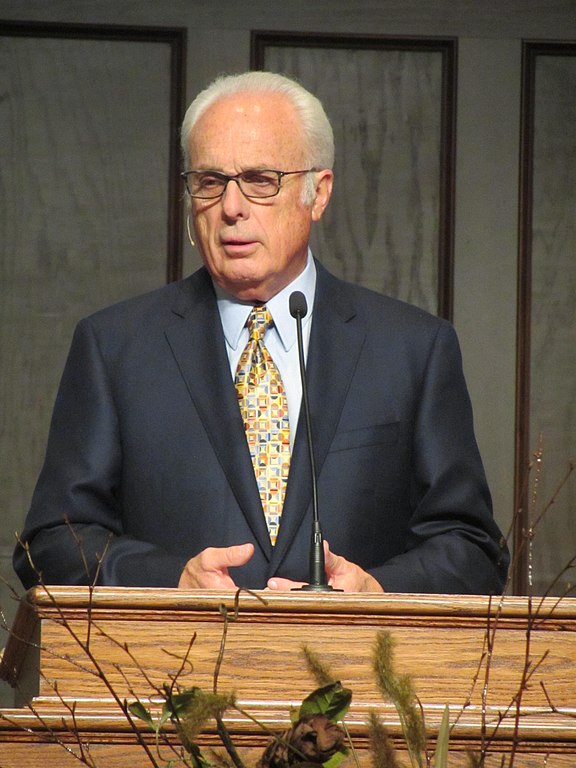

“Precious in the sight of the Lord is the death of his saints” Psalms 116:15
On July 14 California Pastor John MacArthur entered into glory at the age of 86, closing a monumental chapter in evangelical history. For over five decades, MacArthur was a pillar of biblical exposition, pastoral leadership, and theological conviction. His death marks the end of an era, yet his influence will continue to echo in pulpits, seminaries, and Christian homes for generations to come.
Born on June 19, 1939, in Los Angeles, California, John Fullerton MacArthur Jr. came from a line of ministers. His father, Jack MacArthur, was an evangelist and broadcaster, and his grandfather also served in ministry. It was clear from early on that John MacArthur was being shaped for a life of proclamation and pastoral care.
After earning his education at Bob Jones University, Los Angeles Pacific College (now Azusa Pacific University), and Talbot Theological Seminary, MacArthur was called to Grace Community Church in Sun Valley, California, in 1969. He remained there for 55 years, preaching verse-by-verse through the Bible with unwavering fidelity to Scripture. His expository preaching was not merely a method—it was a theological conviction rooted in his belief in the sufficiency, inerrancy, and authority of the Word of God.
MacArthur’s ministry was characterized by his deep commitment to biblical truth, even when it brought controversy. He famously preached through the entire New Testament—a feat that took over four decades—and published those sermons online for free through his media ministry, Grace to You. Millions around the globe have accessed his teachings, and his influence can be seen across denominations and continents.
But MacArthur was more than just a preacher. In 1986, he became president of The Master’s University (formerly Los Angeles Baptist College), and in 1986 he also founded The Master’s Seminary. These institutions became central to his vision for raising up the next generation of biblically grounded pastors. He believed deeply in the local church and sought to equip leaders who would not waver in the face of cultural pressure. His commitment to rigorous theological training was rooted in his belief that pastors are stewards of divine truth—and must be prepared as such.
MacArthur’s unwavering stance on doctrine often placed him at odds with broader evangelical trends. He opposed the seeker-sensitive movement, the prosperity gospel, and progressive theological trends that undermined biblical authority. In his 1993 book Charismatic Chaos, he offered a bold critique of the charismatic movement, insisting that biblical fidelity must never yield to experience-driven faith.
His 2018 Statement on Social Justice and the Gospel, co-authored with other conservative theologians, rejected the notion that social justice should be considered a part of the gospel message. For MacArthur, the gospel was clear: Christ crucified, risen, and returning. To conflate it with political or cultural aims was, in his view, to dilute the saving message of Christ.
Perhaps no moment demonstrated his courage more than during the COVID-19 pandemic. When government mandates sought to restrict worship gatherings, MacArthur and Grace Community Church defied California regulations, reopening their doors and declaring, “Christ, not Caesar, is Head of the Church.” His stand drew national attention—and lawsuits—but MacArthur remained unflinching, citing Acts 5:29: “We must obey God rather than men.” Ultimately, the state of California was forced to settle, paying the church $800,000 in legal fees.
Despite his critics—and they were many—MacArthur never wavered. He once said, “If you faithfully preach the Bible, you’re going to have a battle on your hands.” He embraced that battle not for the sake of conflict, but for the sake of the truth.
His legacy is not just found in the thousands of sermons he preached or the dozens of books he authored—including The Gospel According to Jesus—but in the pastors he trained, the churches he influenced, and the laypeople he discipled from afar. He was a theologian of conviction, a shepherd of souls, and a servant of the Word.
His death leaves an irreplaceable void in evangelicalism.
John MacArthur’s passing is a loss to the church on earth—but a gain to heaven. His last sermon was from Philippians 1:21: “For to me, to live is Christ and to die is gain.” That verse was not merely a text for him; it was a life philosophy. He lived for Christ—and now, he rests in Him.
In the years to come, it will become increasingly clear how much of an impact John MacArthur made on the shape of conservative evangelicalism in the late 20th and early 21st centuries. In a time when biblical truth is often diluted, his ministry served as a clarion call back to the authority of Scripture, the centrality of Christ, and the sufficiency of the gospel.
Grace to You, the teaching ministry of John MacArthur in a statement wrote, “Our hearts are heavy, yet rejoicing, as we share the news that our beloved pastor and teacher John MacArthur has entered into the presence of the Savior. This evening, his faith became sight. He faithfully endured until his race was run. 2 Timothy 4:1-8”
And now, he hears the words we all long to hear: “Well done, good and faithful servant. Enter into the joy of your master.” – Matthew 25:21
More from IRD:
John MacArthur vs Christian Nationalism
John MacArthur & ‘We’ vs. ‘They’



Comment by Chip on July 15, 2025 at 6:24 pm
The glowing language in this remembrance does not seriously engage with MacArthur’s mixed and complicated legacy. Convinced that he was expositing the plain meaning of Scripture, MacArthur normally believed that his interpretation of the text was the only one that faithful Christians could reach. He held this belief while he regularly shared conference podiums with other pastors and speakers he respected, including those of his own Reformed bent. Other Christians, he believed, were in error, and often seriously so
This belief seemed to increase and harden as he aged, as seen in a multiplicity of positions. In. 2018, he declared that to be faithful, Reformed Christians had to eschew amillennialism for premillennialism in their eschatological views. (He said amillenialism was fine for Arminian Christians, since they were from his vantage point already in error about election and free will ) In 1978, MacArthur’s first book on the charismatic movement, The Charismatics, was published with a closing chapter on the good things that could be taken from the movement. When the book was revised and republished under a new title, Charismatic Chaos (1992), that chapter was eliminated. His latest book on the movement, Strange Fire (2013), reportedly was even more negative. Other examples on other topics could be provided.
Nor was doctrinal certitude the only matter for concern. He became increasingly well-known for disparaging other Christians, perhaps the most well-known case being his 2019 attack on Christian author Beth Moore. Cases over the years of his church counseling female parishioners to stay in marriages where they were physically beaten became well-known in the early 2020s. Around the same time, it was revealed that while MacArthur at times preached on living a simple lifestyle, he actually owned three wealthy homes in southern California and a fourth one in Colorado.
MacArthur’s influence indeed was substantial, but it was a mixed one. May he indeed rest in peace and his good deeds be remembered and emulated, but his record is troubling on quite a few points..
Comment by Thomas on July 15, 2025 at 7:48 pm
Chip, you are right. I also could point that he was virulently anti-Catholic, which I find ironic because he was a great supporter of the film “The Passion of the Christ”, directed by a Traditionalist Catholic, Mel Gibson. He even wrote a book about it. When I write “virulently anti-Catholic” I really mean it. You can google his views on Roman Catholicism to see that.
Comment by Rose on July 17, 2025 at 1:00 pm
John MacArthur also protected pedophiles in his congregation, told their wives to remain married to them even when those men were abusing their children, and publicly shamed and excommunicated from the pulpit those women who did not obey. (See the cases of Eileen Gray and Wendy Guay.)
“If you’re in an abusive situation,” he said, “[and] there’s not adultery involved, it’s just abusive, cruelty, or something like that… I don’t think that’s grounds for divorce biblically. I think you have to hang in there.”
His disdain for women was strong and vitriolic, as he proclaimed that “When women take over a culture, men become weak… When all the men have been slaughtered, you [women] can sit there with all your jewelry and junk. You’ve been conquered, because you overpowered your protectors.”
Not to mention his dismissive answer to Beth Moore — a conservative teacher of women, at that point — where he mockingly, to a room of fellow pastors, snarked, “Go home!” and told her she may have the ability to sell jewelry on TV but she couldn’t share the gospel.
He also claimed that slavery was not objectionable, that it was “the perfect scenario,” and that the decedents of Ham in Africa earned their eternal submissive posture by following in their forefather’s wicked ways. “Christianity does not free slaves,” he proclaimed. “You are to submit.”
He also claimed “There’s no such think as PTSD, there’s no such thing as OCD, there’s no such thing as ADHD. Those are noble lies.”
MacArthur may have wrote and taught some good things, but his legacy is hardly one that is beyond critique, and there are lives that he destroyed by his carelessness and ego, women and children who were subjected to dreadful cruelty (on record, with police, and there are people in jail because of it) due to his heartless treatment of them.
I don’t celebrate his passing, but I do not mourn him, and I am glad that if nothing else, this teacher (who is held to a higher standard, biblically) is now fully aware of the damage his “ministry” caused over the decades.
May his memory be a warning.
Comment by Angelo on July 17, 2025 at 9:28 pm
R. I. P.
His anti-Pentecostalism became more extreme, even implying that charismatics were not really Christians.
Comment by John Rentz on July 25, 2025 at 1:08 am
Rose’s comment above is certainly noteworthy. I was shocked when I recently discovered the depth of abuse suffered by Eileen Gray and her children at the hands of John MacArthur and his church. According to the Roys Report, he never repented: https://www.youtube.com/watch?v=D3sOHi_ls6I – fast forward to 50:00.