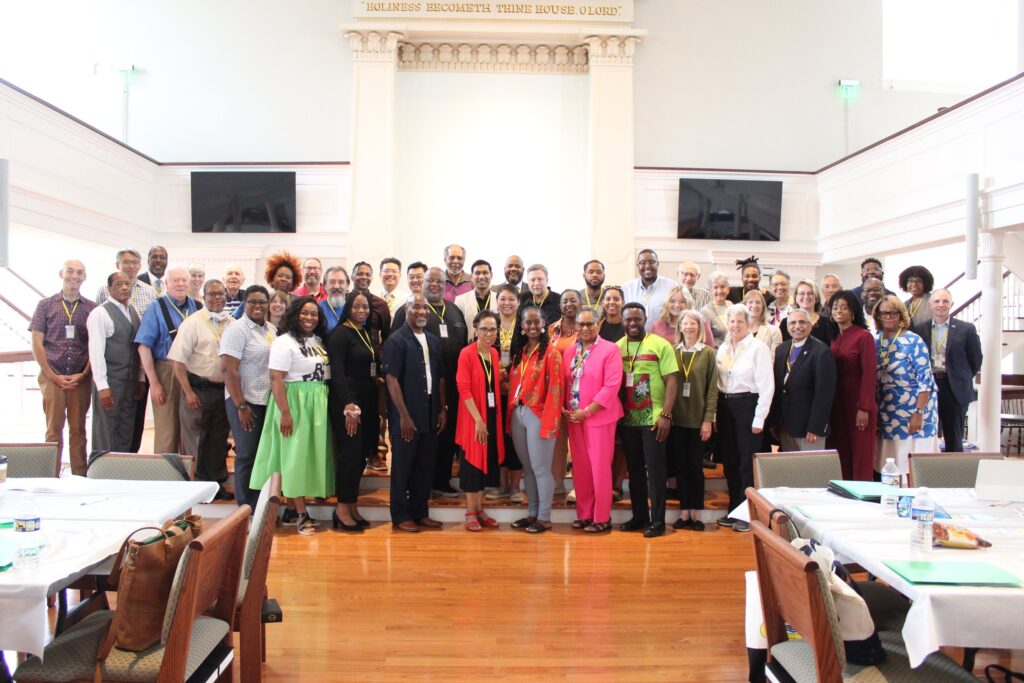

In cleaning out some of my files recently I came across a very fat folder labeled “CUIC.” Churches Uniting in Christ is an ecumenical effort to merge, covenant, or express unity between denominations. Not much from the past 20 years was in the folder but there was plenty before that.
It was intriguing enough that I believe reflection on ecumenism is worth a series of articles. We are, after all, in a time in which institutions (including church denominations) are rapidly changing. Perhaps some lessons from the past might help us to understand the present and prepare for the future.
I prepared the below question-and-answer sheet in 1996 just before our United Methodist General Conference when United Methodism would vote on the “Covenanting Proposal of the Consultation on Church Union.” I was a delegate to that conference and was part of an unsuccessful attempt to pull out, or at least delay, official UM approval for the proposal. More on that in the next article.
Questions and Answers about the COCU Proposal
Q: What is the COCU Proposal?
A: COCU stands for the Church of Christ Uniting, and is the proposal by nine denominations to enter into a “Covenant Communion” that will live out a visible unity which will be truly catholic, truly evangelical, and truly reformed.
Q: What do these denominations have in common?
A: Declining membership, hazy theology, entrenched out-of-touch liberal bureaucracies, and unclear purpose.
Q: Is “Covenant Communion” the same as merger?
A: No, it is a quasi- or half-merger. It is not the merger of church structures but a “communion of sacred things,” that is, a unity of faith, sacraments, ministry and mission. It is a visible church union without organizational structural union. Churches would recognize a common baptism, each other’s ministries as valid, and an open communion.
Q: Don’t United Methodists already recognize these things?
A: Yes.
Q: What then, is there to gain?
A: That’s what people are trying to figure out.
Q: Why not a full merger?
A: It won’t fly. For most of the past thirty-five years COCU has been proposing a full merger but no one seems interested. “Covenant Communion” supposedly allows distinct denominations to remain while the covenanting partners become truly one.
Q: Does this make any sense?
A: No.
Q: What will COCU mean practically?
A: To begin with we would need to be ritually “reconciled.” “Bishops,” or in the new jargon, “authorized ministers of oversight,” would have hands laid on them by “authorized ministers of oversight” of other denominations. Since this has no precedence in church history and since there is some ambiguity as to what it means the laying on hands would be administered in silence. The “presbyterial ministers of word and sacrament” and “ordained deacons and ordained ministers of governance” would be reconciled by a similar method. A lay person from another denomination would add a handshake or holy kiss. Ordinary church members would be recognized by coming together to reaffirm baptismal promises.
Q: In other words, I am not presently reconciled to all these other Christians. But, if a Disciples pastor lays hands on me I am then reconciled to all Presbyterians?
A: At least in the COCU way of thinking.
Q: What else?
A: Along with this, the gatherings would also inaugurate national, regional and local covenanting councils, organized to carry on the word of the covenant communions. Towns, cities and rural areas would also set up these covenanting councils.
Q: To do what?
A: To express visible unity and to carry out our mission initiatives. It has been suggested that local churches would get together four times a year to share the sacrament.
Q: Will anybody really do this?
A: If we look far enough surely somebody might be interested.
Q: What kind of mission initiatives will be undertaken?
A: Presumably more of what the liberal bureaucracies are already doing: fighting sexism, racism, handicapism, ageism, capitalism, and such things.
Q: This sounds like more layers of bureaucracy.
A: That is correct.
Q: Who is going to pay for all of this?
A: Church apportionments, how else?
Q: Who is for this, anyway?
A: Mostly bureaucrats of the various denominations.
Q: What is the doctrinal basis for COCU?
A: There is none, basically. The book entitled “the COCU Consensus” is supposed to represent the theological basis for COCU unity but is frighteningly vague. The book speaks much of unity and inclusiveness but nothing of such truths as Christ dying for our sins. It recognizes the Apostles’ Creed and the Nicene Creed as “witnesses of Tradition” but adds that these creeds are conditioned by the language and thought of their time. The prayers in the reconciling covenants speak of the triune God but address this God as “Creator, Redeemer, Helper,” and not as Father, Son and Holy Spirit. The real basis for the unity seems to be the sacraments and bureaucratic structure, not doctrine or a common confession.
Q: Are there other benefits from COCU?
A: We can add “The Church of Christ Uniting” on our church sign boards and stationary to indicate our new Covenant Communion relationship. We can also learn from the traditions and insights of our several denominations. The United Church of Christ, for example, has indicated by denominational resolution the gift they intend to share with the Covenant Communion is the ordination of gays and lesbians as pastors and the willingness to discuss alternative names in the baptismal formula besides “Father, Son, and Holy Spirit.”
Q: How much interest is there in Indiana in COCU?
A: At the February (1996) gathering at Christian Theological Seminary to celebrate COCU in Indiana, 64 people showed up, half of whom were dignitaries from the several denominations with responsibilities in the service. It might be pointed out that three weeks prior to that, 62,000 tickets for the June Promise Keepers gathering in Indianapolis sold out in three days.
Q: Why would we ever want to do this?
A: The Church sometimes does strange things.
Just for the record: the 1996 UM General Conference did approve the resolution to enter into a covenant relationship. It was strongly supported by the General Commission on Christian Unity and Interreligious Concerns of the United Methodist Church (GCCUIC), an agency which has since then gone out of existence. It also had the support of the Council of Bishops and 40 annual conferences.
In 2002 the new “relationship” officially known as Churches Uniting in Christ was officially launched. We now are living in this new relationship with the following groups: United Church of Christ, Presbyterian Church USA, Episcopal Church, International Council of Community Churches, Christian Methodist Episcopal Church, Christian Church Disciples of Christ, African Methodist Episcopal Zion Church, United Methodist Church, and African Methodist Episcopal Church.
But, are there other ways of being in unity with one another? More articles to follow.



Comment by Diane on April 10, 2025 at 7:00 pm
In the 1990s, I serving on a Disciples of Christ regional committee for ecumenical concerns as a layperson who, I confess, wasn’t all that informed about COCU, other than my denomination was pushing it. I was also participating on my own as a person of faith in support of lgbtq (back then, it was lesbian and gay) full inclusion. It was obvious to me, in my opinion, that mainline denominations were in denial about this issue. When I brought up the inclusion of gay and lesbian people as a “Christian unity” concern, the clergy on the committee literally gasped. Inclusion of gay and lesbian people was a discussion for the region’s social justice committee, they said. I was essentially scolded for having the audacity to believe LGB inclusion had anything to do with wider-church unity. Decades later, denominations have split over the full inclusion of LGBT people. Eventually, I got kind of fed up with clergy who believe lay folks are know-nothings, whose opinions aren’t valued.
Comment by Al on April 11, 2025 at 11:19 am
As I understood it, the “covenant communion” movement came from three priorities. The first had to do with the recognition of clergy. When I served a federated church, I had to go before a UMC conference’s ministry board, who examined me about my understanding and “tolerance” of Wesleyan beliefs and polity. I think a lot of my mainline clergy colleagues find such gatekeeping to be irrelevant, and the “covenant communion” was supposed to do away with it. The silent laying on of hands was a compromise because some denominations believe in a literal “apostolic succession” and don’t recognize those of us who consider it having more to do with faithful (however one wishes to define it) preaching and teaching instead.
The second issue was bringing not just local churches, but entire denominations on board to focus their social justice efforts. They believed that there was consensus on quite a few issues, but as the previous commenter noted, there was quite a bit of disparity at the time, and while some urged patience, others wanted a rapid embrace of the social justice (“woke”) agenda.
Finally, I believe the real reason for the “covenant communion” movement was that the full-scale merger of denominations that people envisioned in the early part of the 20th century had failed, and the ecumenical movement wanted to salvage something to show that their vision and work were not in vain. Because the dream of unity never became a reality, we see churches on the “right” transitioning more and more into independent nondenominational congregations that rise and fall (to a large extent) on the charisma of their lead pastors, and churches on the “left” being led more by the agendas of the social justice movements than by Scripture, tradition, or reason.
Comment by Tim Ware on April 11, 2025 at 4:02 pm
I remember COCU back in the earlier days when it was called “Consultation on Church Union.” Some of us used to refer to it as “Coo-coo.”
Comment by Larry on April 11, 2025 at 9:51 pm
What a blessing that denominations are simply dying. Congregations, on the other hand, are thriving. Not all, of course, but especially those who look to the Bible for their faith and practice. As denominations shrivel, churches are freed. “It is for freedom that you have been set free.” No need for COCU, in the past or in the future.