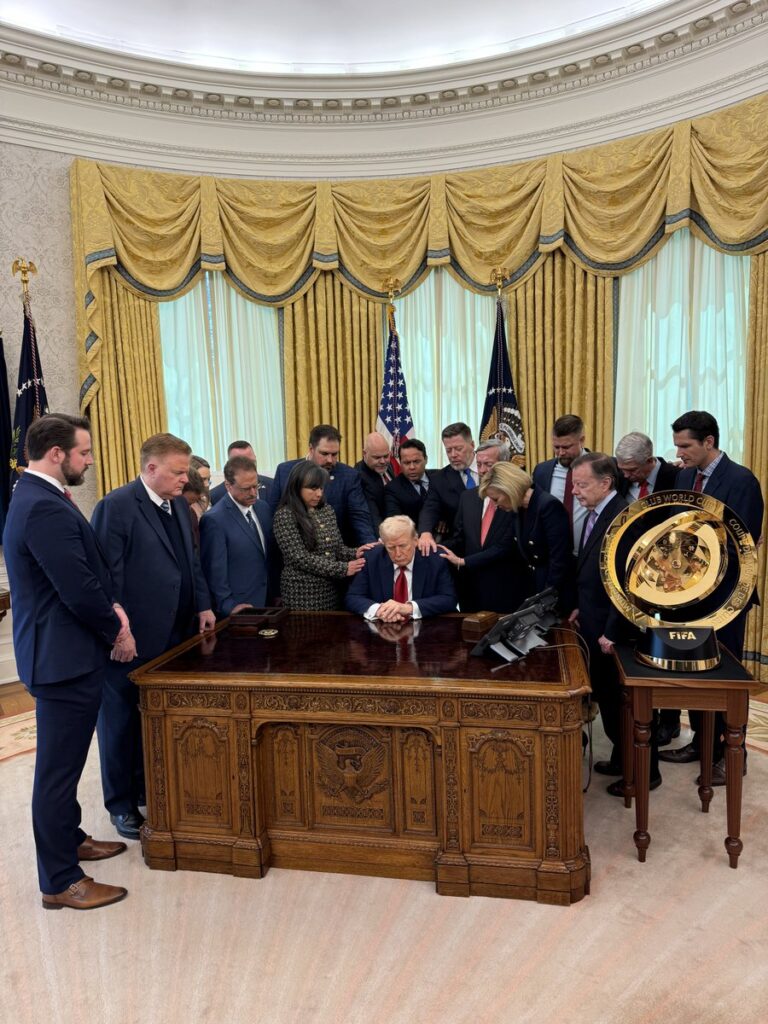
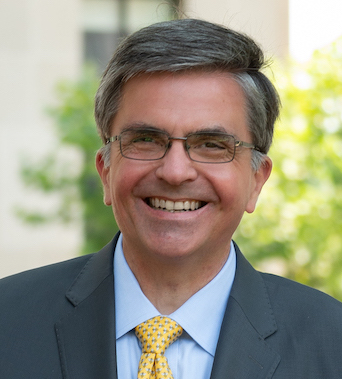
Of course, there’s been some controversy about the latest group of evangelical leaders meeting with President Trump, convened by White House faith advisor Paula White-Cain, a Pentecostal preacher. Seventeen persons, many of them clergy, are shown praying over him in a White House picture. Trump’s most supportive demographic is white evangelicals, who voted for him by 83 percent in 2024.
White-Cain is senior advisor to the White House Faith Office. Some evangelicals have complained that she is a “heretic” because of her ardent Prosperity Gospel views and allegedly heterodox views on the Trinity. But what of it? There are no religious tests for public office, and she’s one of the President’s most prominent and perhaps effective religious supporters whom he personally admires. The person who fills such an office can be of any kind of religion. She seems to suit the role the President prefers.
Some have complained that the male evangelicals, laity, and clergy, were being led in prayer by a female preacher. (Female clergy are widely accepted among Pentecostals). Online complaints have focused on one participant, an outspoken online provocateur who leads a group opposing any female leadership roles in the Southern Baptist Convention. But, again, what of it? The gathering was in a government building and was a mostly political event. Politics convenes disparate personalities and views for mutually beneficial purposes. Theological and ecclesiastical standards in politics cannot be reasonably expected. Politics is chiefly about building electoral coalitions.
Such gatherings of supportive religionists in the White House are not unusual. In 1995 the National Council of Churches led a church delegation to pray with President Bill Clinton in the Oval Office so that he could be “strong for the task” as he battled the new Republican Congress. At the time, we at IRD strongly critiqued the church council for its partisan exploitation of prayer. The church council, comprised mostly of Mainline Protestant denominations, was already in long, sharp decline, but it was still able to make occasional news, purporting to represent millions of church members. Today the church council barely exists, justifiably ignored. Its political activism at the expense of more traditional church work accelerated its decline.
The National Council of Churches meeting with Clinton was of course publicized with an Oval Office photo, although their shot did not show the actual prayer, just denominational officials standing alongside Clinton. This week’s scene with evangelicals in the Oval Office showed them in prayer, laying hands on Trump. Typically, such a laying on of hands would have the recipient in the middle of the circle as the others surrounded him. But in this scene, everyone is standing behind the subject and his desk, for the benefit of the photo. Such is to be expected. Everything that happens in the Oval Office is by definition political. And all official photographs there are definitely political.
Politicians cannot be faulted for being political, which is intrinsic to their profession. But to what extent should church leaders, especially clergy, participate in the details of political optics? Is close alignment with political power good for religion?
Reinhold Niebuhr thought not. In response to President Richard Nixon’s hosting Sunday worship services in the White House, with preachers and audiences he personally selected to reward supporters, the architect of Christian Realism was scathing in an article titled “The King’s Chapel and the King’s Court.” He warned “a combination of religious sanctity and political power represent a heady mixture for status quo conservatism” that evokes a “new form of conformity.”
“It is wonderful what a simple White House invitation will do to dull the critical faculties, thereby confirming the fears of the Founding Fathers,” Niebuhr wrote. He derided Nixon and his friend Billy Graham for regarding “all religion as virtuous in guaranteeing public justice.” This view, he said, “seems indifferent to the radical distinction between conventional religion – which throws the aura of sanctity on contemporary public policy, whether morally inferior or outrageously unjust – and radical religious protest, which subjects all historical reality…to the ‘word of the Lord,’ i.e. absolute standards of justice.” And Niebuhr noted that “established religion, with or without legal sanction, is always wary of criticism, especially if it is relevant to public policy.”
According to Niebuhr, “It was this type of complacent conformity that the Founding Fathers feared and sought to eliminate in the First Amendment.” He further observed:
It made our high degree of religious pluralism compatible with our national unity. By implication it encouraged the prophetic radical aspect of religious life, which insisted on criticizing any defective and unjust social order. It brought to bear a higher judgment, as did the prophet Amos, who spoke of the “judges” and “rulers of Israel” who “trample upon the needy, and bring the poor of the land to an end (Amos 8:4).
Niebuhr may have been overly harsh. He despised Nixon. And chaplains in the king’s court can have utility. Not all religionists must be on the outside, like John the Baptist, metaphorically throwing rocks against the walls of the king’s palace. But Niebuhr of course has a point about the price of excessive collegiality between rulers and priests.
As organized Christianity continues its decline in America, the focus needs to be on winning new souls to faith, not fierce prophetic denunciation of or affirmatively chaplaining the king. The most important prayers usually occur in private, without photos.


Comment by Tim Ware on March 22, 2025 at 12:46 am
Just another example of how organized Christianity, in whatever time period and in whatever location, has, throughout history, tended to act as chaplain to society; in other words, to lend an air of divine sanction to whomever is in power and to whatever is current in society at that particular time. Organized Christianity has always been a very malleable and flexible thing, always able to discover a scriptural interpretation that just happens to match the mood of the moment.
Comment by DM on March 22, 2025 at 7:06 am
Yes, this sort of church appears to have an future in these United States. However, this is not faith. It is a circus, but it does adapt itself to what only fools would want – a savior who is far more a sweet daddy for his ‘special’ little ones.
I have reached my own special condition; namely – if the organization is calling itself an church, I am plainly not ‘special’ enough of these clowns. Reinhold Niebuhr was no fool.
Comment by Wilson R. on March 22, 2025 at 9:50 am
Whatever else these people are doing, they most assuredly are not “affirmatively chaplaining” Donald Trump.
Comment by Gary Starkey on March 22, 2025 at 4:23 pm
Mark Tooley’s writeup is always thoughtful and (a little) provocative. Even though the Oval Office optics may scandalize the mainline liberal sect, the customary commentary from that sect is overwrought and factitious. The mainline has long dabbled in political machinations, influence, and deceit, and maintained offices in Washington D.C. for that purpose. In fact, the mainline has subverted or reframed gospel ministry to satisfy its coordinated political agenda. Conservative voices of any influence were purged, at first gradually, then in a flood of “good riddance” without nuance.
Comment by Different Steve on March 23, 2025 at 7:23 am
Me: This is a response to the above article, please critique: Whatever else these people are doing, they most assuredly are not “affirmatively chaplaining” Donald Trump.
GPT-4o mini: This response is brief and direct, but it could benefit from further development to enhance its effectiveness. Here are some points to consider in the critique:
Clarity and Context
The response opens with a clear statement that challenges the assertion made in the original article. However, it lacks context or elaboration. Readers may not fully understand what the author means by “affirmatively chaplaining” Donald Trump without additional explanation. Providing a brief definition or context for this term would strengthen the response.
Argument Development
The response is quite succinct, which can be effective in some contexts, but it may come across as overly simplistic in this case. To engage more deeply with the original article, the author could expand on why they believe the evangelical leaders are not “chaplaining” Trump. This could involve discussing the nature of their prayers, the political implications of their actions, or the motivations behind their support.
Tone
The tone is assertive, which can be effective in making a point, but it risks sounding dismissive or confrontational. A more nuanced tone that acknowledges the complexity of the situation while still presenting a counterargument could foster a more constructive dialogue.
Engagement with Original Arguments
The response does not engage with the original article’s arguments or examples, such as the historical context provided or the philosophical insights from Reinhold Niebuhr. Addressing these points directly would demonstrate a deeper understanding of the original piece and strengthen the response’s credibility.
Conclusion
In summary, while the response effectively challenges a specific claim from the original article, it would benefit from greater elaboration, context, and engagement with the original arguments. By expanding on the reasoning behind the assertion and adopting a more nuanced tone, the response could become a more compelling and thoughtful critique.
Comment by Different Steve on March 23, 2025 at 9:37 am
Went looking for insight on the phrase “affirmatively chaplaining”; DDG Assist came up with this:
Affirmative chaplaining involves using positive, life-affirming prayers to support individuals in their spiritual journeys. This practice focuses on recognizing the divine presence in every situation and helping others connect with their inner strength and truth.
https://www.unityspiritualcenter.com/prayer-chaplains
https://unityoffairfax.org/prayer-chaplain-ministry
Comment by robert on March 23, 2025 at 11:29 am
Remember that Thomas More lost his life because he didn’t go along w/ the flow and challenged the king on his self proclaimed authority. I suspect their “thy kingdom come” looks a whole lot different from “His kingdom come”. Will we rue the day that we apparently are willing to entertain a king (Saul comes to mind)
as did the Israelite’s.
Comment by Gary Bebop on March 23, 2025 at 8:30 pm
Rusty Reno (First Things) has aptly reported on the Rainbow Reich entwining itself around the organs of state power under a feckless Biden. The danger to America comes from the subtlety of the Left, not from conservative enthusiasts. Mark Tooley is part of a mainline that only recently lost its hegemonic influence in American life. He knows the score.
Comment by Colin ross on March 24, 2025 at 2:03 am
Who cares? It’s all just a show while they rob everyone blind. Something organized religion kind of specializes in.
Comment by Salvatore Anthony Luiso on March 24, 2025 at 4:57 pm
Regarding “As organized Christianity continues its decline in America, the focus needs to be on winning new souls to faith, not fierce prophetic denunciation of or affirmatively chaplaining the king”: When the ancient Israelites declined, were they in need of “fierce prophetic denunciation”?
I would say they most certainly were. God sent them prophets who delivered that to them.
I would also say that the church in America is also in need of it. She needs to be awakened, and she needs to be warned–especially about political idolatry.
Fierce prophetic denunciation is not only compatible with winning new souls to the faith, it can be integral to winning new souls to the faith.
Comment by Mark E Roberts on March 24, 2025 at 5:43 pm
I recognize only a few pray-ers. Those I recognize are conservative Christians but not deceived by any Trump religiosity. They seek genuine evangelical awakening in America and pray the God they believe spared the President’s life will now give the President wisdom and courage to enact policies domestic & foreign that will renew America spiritually, morally, socially, economically, and as a potent influence for bordered liberty globally. While orgs such as Freedom from Religion see a latent theocracy hiding behind every bush, these pray-ers will be happy for a President that defends religious liberty here and abroad and otherwise influences our country toward the kind of morality that aligns with the natural law, whether it is speaks more in the tones of Aristotle’s Nicomachean Ethics or of the Hebrew Ten Commandments. I doubt any there seek a theonomistic theocracy.
Comment by George on March 25, 2025 at 4:12 pm
Why wasn’t Benny Hinn invited? He would have been right at home with the other charlatans. Using the Lord for political motives stinks.