
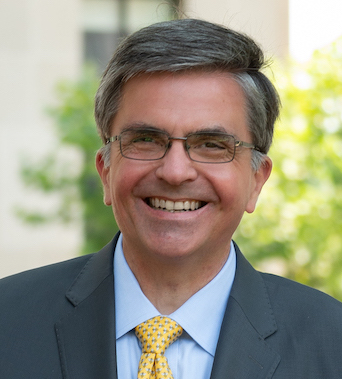
Here’s my chat with Jerome Copulsky, research fellow at the Berkley Center for Religion, Peace, and World Affairs at Georgetown University, on his new book American Heretics: Religious Adversaries of Liberal Order.
Copulsky examines Christian groups across American history favoring a Christian confessional state for America. Unlike the Founders, they have believed that Christianity should have been written specifically into the Constitution. In our current post-liberalism, such voices are more prominent than ever.
I hope that you enjoy our conversation viewable from IRD’s YouTube channel below. Downloadable podcast audio is also available via IRD’s SoundCloud account.
Transcript:
Hello! This is Mark Tooley, president of the Institute on Religion and Democracy, here in downtown Washington, DC. on a beautiful Friday afternoon, with the pleasure of conversation with the author of an important new book that I commend to you very timely American Heretics: Religious Adversaries of Liberal Order. The author is Jerome Copulsky who is affiliated with the Berkeley Center at Georgetown University. Jerome. It’s good to be with you.
Jerome Copulsky
Great to be here with you. Mark thanks for having me.
Mark Tooley
Now, Jerome, this book is a historical overview of illiberal religious movements in America across 250 years, very relevant for today in that these movements, perhaps, have even more influence than they’ve ever had before in our current post-liberal moment. Could you explain?
Jerome Copulsky
Yeah, you know, the book is about a tradition of religious thought in America that looks at the project of liberal democracy and rejects it on theological grounds. So, I begin during the revolutionary era with the Church of England Loyalists, and I move up to today where I look at people in the post-liberal camp, the National Conservative camp, who, for different reasons are rejecting the liberal democracy that America has developed into and are offering a more religiously grounded alternative to our politics.
Mark Tooley
And these post-liberals, whether they’re religious and some of them are not religious, believe that America’s experiment rooted in the Declaration of Independence and the Constitution were flawed from the start. That was at least the original argument of Patrick Deneen in his famous book of several years ago, which was called Why Liberalism Failed. And although Deneen does not self-identify himself as an integralist, the Catholic integralists have been, have become influential. Perhaps their best-known figure is Adrian Vermeule at Harvard Law School. And then we also have their Protestant equivalent, Calvinist advocates of a Protestant confessional state have become more prominent than ever before, and then, joined by the wider National Conservatism movement, headed by my friend, or started by my friend, Yoram Hazony, a very intelligent Israeli thinker. And his books and their manifesto essentially advocate some kind of established, legally established Christianity in America, with religious minorities functioning in their own sphere. All of this seems rather jarring and maybe shocking to some of our listeners. Where did all of this come from? But, as your book points out, there is a long history of these sentiments, dating back to the very beginning.
Jerome Copulsky
Yeah, this idea that the United States was not properly grounded in religious truth or religion was not properly constitutionalized, has a long history, and, as I said, I trace this history back to the Church of England Loyalists, and their opposition to the American Revolution, and their opposition to the ideas that were animating that revolution, the ideas that are articulated in the second paragraph of the Declaration of Independence. And I trace this through religious rejections of the constitutional order, the argument that the American Constitution, the national Constitution, did not properly constitutionalize religion or Christianity. It did not acknowledge God, but it also, through Article 6, Section 3, prohibited a religious test for federal office, which meant that government officials, including the President, could be non-Christians, could be infidels. The failure to establish a church, or the failure of religious establishment as such. And the First Amendment meant that for many of these thinkers that the government was not fulfilling its obligations to the church, and the free exercise clause of the First Amendment meant that the government was protecting, or maybe even allowing to flourish, infidelity. So, this complaint about American liberal democracy not being properly grounded in religion is not new. But I think what is new, perhaps, is the access to power that contemporary post-liberals or National Conservatives have today.
Mark Tooley
And going back to the early years, you talk about the arch Presbyterians who dislike the absence of Christianity in the Constitution. The vast majority of Presbyterians endorse the new order specifically the Constitution, and they even amended their Westminster Confession, dating back to the 1640s, to remove the part stipulating that the civil magistrate had an authority to uphold religious truth. That was the majority. But you described the minority who rejected that, and whose voices never really went away. But for the majority of Presbyterians and other religious believers in the early republic they were largely fine with the separation of church and state, the non-establishment, the absence of a specific reference to Christianity and to God in the Constitution, even though the Founders overwhelmingly were religious, and most of them identified as Christians. Why were they comfortable in omitting specific references to God and Christianity in the Constitution?
Jerome Copulsky
Well, you know, we can’t get in the heads of the people who participated in the Constitutional Convention of 1787. There’s a famous quip, perhaps apocryphal, by Alexander Hamilton, attributed to Alexander Hamilton, that they forgot to provide an acknowledgement of the Deity in the Constitution. I suspect that they thought deeply about the relationship of religion in the new state and realized that it was prudential not to create a close tie between the Constitution that they were drafting and the religious environment within the country, which was, of course, one that had a great deal of pluralism, and that the idea of religious freedom and the idea of a separation of church and state was really in the air in the last couple of years of the 18th century going into the 19th century. So, in a sense, they accepted this general trend towards this non-establishment.
Mark Tooley
Now, these objectors to the original non-establishment of religion as mentioned, they never go away in American history. And so, there’s a movement during the Civil War and beyond again to insert specific references to Christianity into the Constitution, and Abraham Lincoln ponders the possibility, but ultimately decides not to endorse, and it doesn’t happen. It continues for some years after the Civil War. What was that debate all about?
Jerome Copulsky
So, you know, we mentioned the Covenanters, Reformed Presbyterians, which were a fringe sect of Protestants who endorsed the Revolution against Great Britain. But they were unhappy with the Constitution that came out of Philadelphia in 1787, and they were unhappy, as I mentioned, because of its failure to acknowledge God. They also were abolitionists, and they felt that the Constitution was a pro-slavery instrument which was allowing the continuation of human bondage during before the Civil War. There, you know, in the early decades of the 19th century, they decided to stay aloof from politics, right. Their way of dealing with the godless constitution, as we might call it today, was to not participate, a kind of conscientious objection to the nation, to the government. But during the Civil War they saw the conflict as God’s judgment upon the nation for these sins. And so, they came together with a number of other Northern ministers to lobby Lincoln and Congress for an amendment to the Constitution, essentially a rewriting of the preamble that would acknowledge God Jesus as ruler of nations, and then, in a later iteration, the Bible as the source of law. And they believed that this was a form of penitence for the nation but also would bring the nation into line with their understanding of what the relationship of the church and state should be. Now they failed during the Civil War. This option was not taken up by Lincoln or Congress, but they continued the push for it in the 1870s, under something called the National Reform Association, the first NRA, and they lobbied Congress, and there was a petition drive across the country to make those changes to the Constitution. And at this point of time their argument was that such a constitutional amendment was needed to preserve the Protestant nature of the United States from the threat of Catholicism, from the threat of Socialism, from the threat of secularism. And so, there were people in the United States who, they believed were exploiting the Achilles heel of the Constitution, the 1st amendment, the establishment clause, and the free exercise clause to establish a regime of Secularism or non-Christian or non-Protestantism, and an amendment would be needed to protect the nation from those people.
Mark Tooley
Almost from the start the substitute for officializing Christianity in statute, or having a confessional state, is a form of civil religion advocated by church leaders and by politicians, where public conversation includes references to the deity and the Bible without getting too specific, so that it’s inclusive of all Protestants, and eventually can draw in Catholics and Jews and others in a very inclusive way. There’s a reaffirmation of this civil religion tradition, especially after World War II, when church attendance soared. And so, we have this successful movement to inscribe “In God We Trust” on the currency, and to add “under God” in the Pledge of Allegiance. So, what was that all about?
Jerome Copulsky
Yeah. So, you know, when, when the National Reform Association is lobbying Congress, lobbying the country for a Christian amendment, the Covenanters who I mentioned earlier, the Reformed Presbyterians believe that the nation was never adequately Christian. But a lot of the people that they were working with, a lot of their allies in this movement, believe that the nation had been Christian, and but now that Christianity was being challenged. So they wanted to move from a kind of a de facto, Christian civil religion to something that was du jour to make explicit and to protect all of those Christian practices., right? You know that there were chaplains and prayers in school and Bible readings, all those things they felt needed to have a constitutional grounding. Now, if we move to the Cold War war period, where we’re at a high watermark of civil religion, particularly in the United States battle against godless atheist communism. Right? So, there was a felt that there was a need to express America’s religious dimensions, right? That the country was animated by religious ideals. Now, at this point, sometimes it’s called the Judeo-Christian tradition against the godless Communist tradition which they were fighting against in the Cold War. Now, at the same time these civil religion things are being legislated by Congress, “In God We Trust” in the currency, Lincoln’s phrase “under God” from the Gettysburg Address being placed in the Pledge of Allegiance. At the same time that’s happening, there’s also a push in the courts towards a legal secularism of the country. So, the idea that prayer in school, Bible reading in school these things are violating the First Amendment’s establishment clause. So both of these things are happening at the same time, and the remnants of the people who are still holding up this idea of a Christian amendment at this time, are also lobbying Congress again to change the Constitution to explicitly mention God and Christ in the Bible, to again affirm, in a much deeper, more explicit way America’s religious foundation more explicitly than these civil religious rituals that you mentioned.
Mark Tooley
And of course, dissatisfied with that form of civil religion and broad reference to God, are the Christian Reconstructionists, who emerged especially in the 1970s and to the 1980s, who are advocating what they would call Biblical law, a return to, I suppose, the Hebrew theocratic state, much more than just a confessional state, but the actual enactment of punishments prescribed in the Old Testament as Christians refer to it. The Christian Reconstructionists, who were they? How influential were they? They’ve all faded from the scene. So, what happened to them?
Jerome Copulsky
There were a small group of radical Calvinists. Their, I guess, intellectual guru was a guy named R. J. Rushdoony, and he developed this idea of Christian Reconstructionism, which was based on his notion that the Biblical law, the law that is spelt out in the Hebrew Bible, the law of ancient Israel, still pertained, that Christians were still under, still incumbent upon them to live under most of these laws unless they were explicitly abrogated by Jesus. So, what he wanted was a fully Christianized society along these lines. And in this way, he and his followers were very different from conservative Protestants like Jerry Falwell or Francis Schaeffer or Pat Robertson. Those men, really, when they were talking about a Christian America, were thinking about a return to the status quo. But they were thinking about a return to the Christian America that was there before the feminist movement, before the Civil rights movement, before the Vietnam War, to bring America back, to say, maybe the forties or early fifties. They’re restorationists, in a sense, even if what they wanted to restore was part of their nostalgic imagined America. Rashdoony and his followers, what were they? They weren’t trying to restore an America of the past, but they were trying to provide a path to what they felt would be a fulfillment of America in the future which would be done through the slow development, slow Christianization of American society. And this would be done, not by the top down, because they didn’t believe that they ought to capture the state and impose their view of Christianity onto the citizenry, but through the constant conversion of Americans, American Christians to their view of what true Christianity was, and how it was to be practiced. Now, at the same time, they were deeply influential on the emergence of the religious right, because they were interested in showing the political dimensions of the Christian tradition. So, even though people like Pat Robertson, Jerry Falwell, Francis Schaeffer did not go as far as to advocate for a theocracy, as I say, a rule by Biblical law that the Reconstructionists were advocating, for they were still reading and expressing some of the historical and theological claims that were being made by the Reconstructionists.
Mark Tooley
As the Reconstructionists literally faded from the scene, they were replaced by a new generation of religious thinkers on the Protestant side, they sometimes call themselves “political Protestants.” They believe in a Protestant confessional state as intrinsic to Protestant teaching. On the Catholic side you have the integralists who believe that the Catholic Church should be paramount in society, including in civil law, and then you have a wider political movement, sometimes called National Conservatism that endorses this religious confessional state perspective. Believing that the founding, in some sense, as Patrick Deneen argues in his book, Why Liberalism Failed, had been flawed from the start in terms of being liberal and not building on Christian specifically Christian foundations. And so National Conservatism, even though it’s not specifically religious and founded by my friend Yoram Hazony, an Israeli thinker, very intelligent and very successful in promoting his perspective. But even though Jewish, he essentially backs America being a Christian society where Christianity is paramount, and non-Christians have liberty in their own spheres, but accept that Christian dominance. So, all of these forces are coming together in this wider post-liberal movement, giving people who otherwise might be marginal, greater political, cultural influence. What is that all about?
Jerome Copulsky
Yeah, I you know, I think, that there was this rise and development of religious liberalism that we see in the works of people like Rod Dreher, Adrian Vermeule, or Patrick Deneen, or Yoram Hazony. A lot of this was began as a kind of frustration with the success of liberalism, you know, if we see, like the high watermark of liberalism, was the Supreme Court’s decision on same-sex marriage back in 2015. Books like Why Liberalism Failed and The Benedict Option can be read as a response to that response to a belief that well, in fact, the United States is no longer a place that’s hospitable to traditional Christians or traditional Jews, or what have you now? People like Deneen and Dreher made the argument that in fact, this was, in a sense had to happen that America itself was founded on liberal Enlightenment principles. It was founded as a rupture from traditional Christianity, and what they were seeing in the 2010s was really the bitter fruit of that break. If you look at someone like Yoram Hazony or Adrian Vermeule, they have a sort of a different historical account. But after the election of Donald Trump in 2016, there seemed to be a shift from a what Dreher called the Benedict Option, which was essentially withdraw from the liberal order, create intentional communities to protect and preserve the Christian heritage from the, you know the floods of liberal modernity to a more let’s take the country back stance where, rather than withdraw, to try to rebuild. And in the first administration of Donald Trump you saw a lot of people engaging in projects of rethinking the relationship, not only the ideology of the Republican Party, the ideology of conservatism, but the relationship of religion and politics that would happen there. So, in a very famous essay that Adrian Vermeule wrote in response to Why Liberalism Failed, Vermeule argued for something called integration from within, that the proper response to the success of liberalism was to send conservatives into liberal bureaucratic institutions and remake them. Yoram Hazony’s and the National Conservatism Manifest, one of the planks is for a reassertion or revitalization of public religion. He doesn’t explicitly say an establishment of religion, but it sound gets kind of close when you look at the details as he spells them out in his book on conservatism. So, I think what began as a way of understanding why America had become thoroughly liberal, turned to a project for remaking the country and remaking its politics along religious, conservative along these kinds of illiberal religious, conservative lines.
Mark Tooley
Paradoxically, these movements have emerged. As America has become less religious, the latest Pew Survey shows 62% of Americans self-identify as Christian. That would have been 90% not more than a few decades ago. So, what’s being proposed by the religious illiberals seems extremely unlikely. And yet the decline of the Christian presence in the American population seems to have just spurred them on, so are they just living in a fantasy land, or is there a strategy behind their thinking?
Jerome Copulsky
One of the questions to ask is, what is the theory of change, you know, if you, if we look back to people I’m writing about in the sixties and seventies. The theory of change for the Christian Reconstructionists like Rushdoony wasn’t going to happen anytime soon. His son-in-law, Gary North, who at one point broke away to form his own Christian Reconstructionist group, said, well, this process of Christianizing society might take a couple hundred years, maybe a thousand years. They’re really thinking in the long term, someone like Brent Bozell, who was the editor of the radically traditional Catholic magazine Triumph, believed that the United States was at a form of crisis, that its institutions might collapse, and so was preparing a cadre of conservative Catholic intellectuals who’d be there to become leaders in such a time that vacuum opened up and presented itself. I think if you look at today’s integralists or NatCons, they see an opportunity in their proximity to power. They’re not lonely figures, lonely prophets shouting at the margins, but they’re very close to the halls of power, and some are perhaps working within those halls of power right now, as we speak. So, you know how that happens. Vermeule talks about using the bureaucracy, using the administrative state to nudge people in the right direction. Other people are involved in projects of, you know, recruiting young men and women to join more religiously conservative and illiberal congregations and movements. Whether this happens on a mass scale is yet to be seen. But there’s a lot of intellectual energy and a lot of political energy behind it.
Mark Tooley
Well, as president of the Institute on Religion and Democracy, which was founded to advocate for democracy, human rights, and religious people for all people, these illiberal movements that seem to want to privilege some religious groups over others are obviously of concern. And I’m sure that most Christians in America do not support these illiberal movements knowingly and are largely unaware of them. So hopefully this conversation can help to enlighten and to expand the conversation. Jerome, thank you so much for this exchange, and once again a copy of his book, American Heretics: Illiberal Religious Adversaries of Liberal Order. Jerome, thank you again.
Jerome Copulsky
Mark. Thank you. So much pleasure to be here.



Comment by David Gingrich on March 26, 2025 at 7:10 am
It sounds like all the people who would “improve” the U.S. Constitution would “improve” it with only their own brand of Christian theology. No thank you. Thank you, Founders.