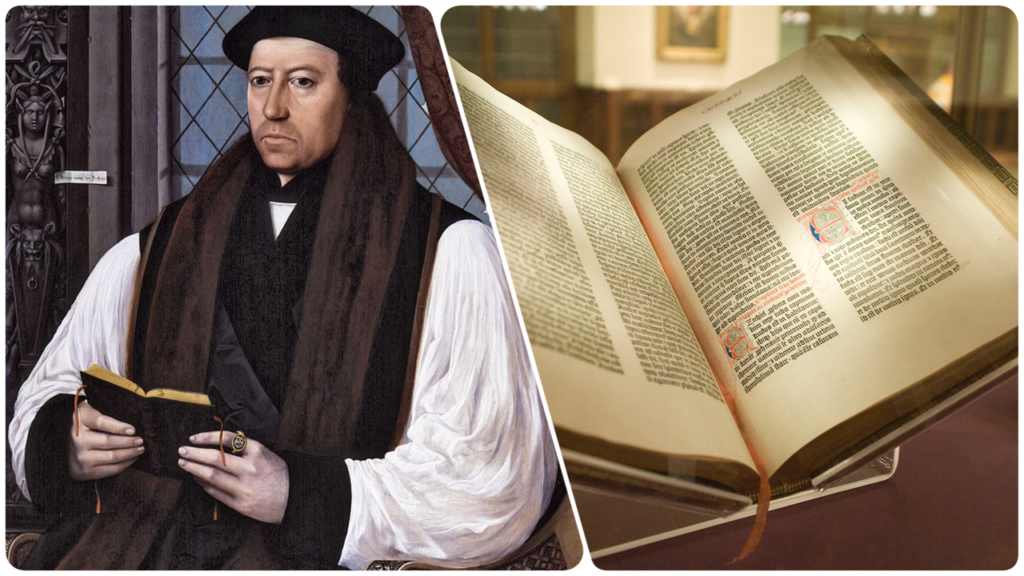

Following the death of King Henry VIII, Edward VI, Henry’s son by his third wife, Jane Seymour, became King. Archbishop of Canterbury Thomas Cranmer had the opportunity to reshape biblical interpretation and push for theological reform. During these years preceding the reign of Roman Catholic Queen Mary, many writings developed which helped bring about Reformation doctrinal reform. Critical to these writings were the Book of Homilies, the Book of Common Prayer 1549 and 1552 editions, and the Articles of Religion.
The Falls Church Anglican (TFCA) Rector Sam Ferguson spoke on doctrinal reforms and expounded upon the history and practice of the English Reformation at History and Hope: Reformed Theology in the Anglican Tradition. The February 4 Reformed Theological Seminary collaboration with TFCA focused on the reformational roots of Anglicanism and its doctrinal convictions. Part I – History (English Bibles, Refuted Clericalism, and Reformation Anglicanism) may be accessed here.
Word of God
Chief among these reformation doctrines is a focus on the word of God which set apart Christianity in England from other medieval trends. Cranmer established that the Bible is not only God’s word but is sufficient, powerful, satisfying, and authoritative.
Scripture is Sufficient
The first homily in the Book of Homilies by Cranmer was A Fruitful Exhortation on the Reading of Holy Scripture. It declares that Holy Scripture is sufficient for knowing all we need for salvation.
Stated plainly, “There is no truth or doctrine necessary for our justification and everlasting salvation but that is or may be drawn out of that fountain and well of truth, the Bible.”
This focus on the sufficiency of scripture for all things salvific was an attack on a late medieval church belief that Church leaders, filled with the Holy Spirit, could declare new authoritative teachings. Reformational doctrines, emphasizing the word of God and its sufficiency, would reject this Roman Catholic belief. Instead, Scripture became understood as solely sufficient for salvation.
Scripture is Powerful and Satisfying
In the same homily, Cranmer describes the power of Holy Scripture through the images of light, food, and fire. Further, he describes that Scripture is wholly satisfying.
“As a drink is pleasant to them that be dry and meat to them that be hungry so is the reading, hearing, searching, and studying of Holy Scripture to them that be desirous to know God.”
Scripture is Authoritative
Among the most important doctrines developed in the Reformation was in Scriptural authority. The reformers reaffirmed Scripture’s authority over the church, contrary to trends in late medieval Christianity which claimed otherwise.
For the Church of England, this truth was articulated in the 39 Articles of Religion:
20. Of the Authority of the Church.
“The Church hath power to decree Rites or Ceremonies, and authority in Controversies of Faith: and yet it is not lawful for the Church to ordain anything that is contrary to God’s Word written, neither may it so expound one place of Scripture, that it be repugnant to another. Wherefore, although the Church be a witness and a keeper of Holy Writ, yet, as it ought not to decree anything against the same, so besides the same ought it not to enforce anything to be believed for necessity of Salvation.”
Although reason, Scripture, and tradition are often seen as a “three-legged stool” in the Anglican tradition, Ferguson explained that a more proper analogy for the church’s authority would be a garden bed. In this example, Scripture is the garden bed, and reason and tradition are tools to unlock its beauty. Reason and tradition are seen within Anglican Christianity as tools for biblical revelation, but not equal in authority to biblical revelation itself.
Justification by Grace Through Faith
Ferguson explained the reformational doctrine of justification by grace through faith, compared with the late medieval church’s understanding.
While the reformers believed that grace permutated the entire process of salvation, especially justification, Roman Catholics believed that since works of penance must remit the temporal consequences of sin, the process of justification is not wholly grace.
This was stated explicitly at the Council of Trent:
“If anyone saith, that justifying faith is nothing else but confidence in the divine mercy which remits sins for Christ’s sake; or, that this confidence alone is that whereby we are justified; let him be anathema.”
The Reformers took these words and compared them to biblical passages such as Ephesians 2:8-9 (NIV).
“For it is by grace you have been saved, through faith — and this is not from yourselves, it is the gift of God — not by works, so that no one can boast.”
The 5 Solas
Ferguson concluded with a re-focusing upon the “5 Solas” of the Reformation, describing how they all play a role in the grace-filled salvation that the reformers reaffirmed.
It is by Scripture alone that rests full authority and is how God presents Christ to us, which includes everything necessary for salvation. It is grace alone that God works out salvation. By faith alone, we trust the person of Christ for salvation. It is Christ alone who sufficiently cleanses all one’s sins. It is to the glory of God alone that all things are done.
These Solas are: Scripture alone, Grace alone, Faith alone, Christ alone, and Glory to God alone.




Comment by Wolfgang Conrad Eisenhut on February 27, 2025 at 2:47 am
Reformation ist all überall das Kirchengebilde der REVOLUTION.
Comment by Wiltley on March 2, 2025 at 2:35 pm
Jawohl Herr Haupmann!