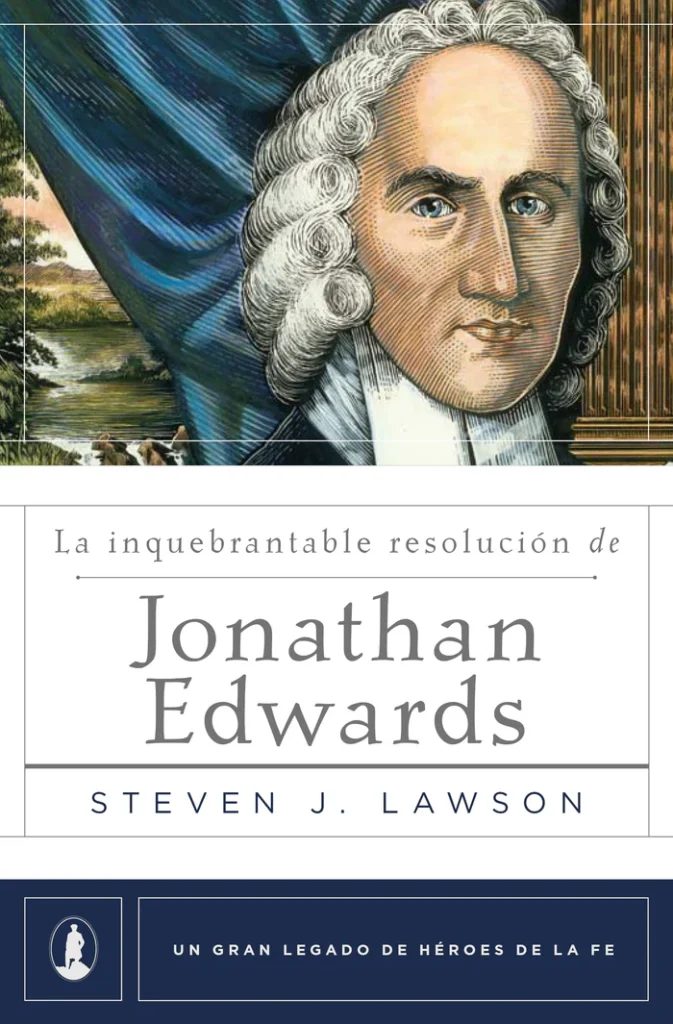

The second in the series “A Long Line of Godly Men”, looks at The Unwavering Resolve of Jonathan Edwards. These short biographical sketches each focus upon one aspect of what made the subject great in his time and mightily used by God.
“Considered the towering figure in American Colonial church history–arguably the greatest pastor, preacher, philosopher, theologian and author America has ever produced–Edwards lived with an enlarged desire to experience personal godliness. In this pursuit, he became a model of discipline worthy of our emulation,” author Steven Lawson writes.
As a young man and a recent convert to the faith, Edwards drafted a list of seventy resolution, purpose statements that he carried with him throughout his life. These statements and his stubborn desire to keep them, shaped him.
“Here is the key,” Lawson writes, “to his spiritual growth–Edwards disciplined himself for the purpose of godliness. He understood that growth in holiness is not a one-time act, but a lifelong pursuit, one that requires a daily determination to live according to the truths taught in Scripture. In accordance with his ‘Resolutions,’ Edwards consecrated himself in all things in order to glorify God and gain the incorruptible crown.”
Because those Resolutions so shaped Edwards, Lawson uses them to structure this book. After a brief biographical sketch of Edwards, he introduces the Resolutions, grouping them under six main headings: Pursuing the Glory of God, Forsaking Sin, Making Proper Use of God-Allotted Time, Living with All His Being for the World, Pursuing Humility and Love and Making Frequent Self-Examination. Each heading becomes a chapter and, in each, Lawson discusses a few of the associated Resolutions. In looking at Edwards’ life and legacy, he shows that Edwards is one of those men who belongs not just to his age, but to all time.
“Edwards possessed a rare combination of Reformed theology, extraordinary giftedness, and fervent piety. However, it was this latter virtue–his true spirituality, marked by a fixed resolve–that positioned him to be used so mightily by God. Few have equaled his relentless pursuit of personal holiness. Edwards’ godliness fitted him to be the mighty instrument in the hand of God that he was,” Lawson writes.
This book then uses Edwards resolutions as a starting point and includes material from his diary and his “Personal Narrative” to see how he implemented these resolutions in his life.
Detailed but simple outlining of the life and legacy of Edwards leads into the resolutions themselves. The first section deals with the purpose and historical setting of the resolutions as well as the theological roots behind them. Then Lawson looks at the resolutions under the broad categories of the prerequisite of faith, the priority of God’s glory, the putting away of sin, the precipice of eternity, the passion of discipline, the practice of love, and finally the posture of self-examination.
Especially important for today’s believers is the last section. The Puritan practice of self-examination is lost in today’s generation. The journals and diaries of various Puritan authors outlining their lives and highlighting where improvement could be made is a valuable discipline that most today have lost. Journaling our spiritual lives is something of great value as we continue to grow in Christ that we can learn particularly from Edwards.
Lawson highlights the major importance of studying Edwards today and learning from him for a new generation in his conclusion.
He writes, “In this day, some three hundred years after Edwards’ time, there is a desperate need for a new generation to arise onto the scene of history that will prize and promote the glory of our awesome God. Beholding the soul-capturing vision of this all-supreme, all-sovereign, and all-sufficient God transforms in life-altering ways. This is what we learn from Edwards, and this is what we must experience in our own lives. Our lofty theology, centered on God Himself, must be translated into daily living in practical ways.”
In the opening pages of The Unwavering Resolve of Jonathan Edwards, Lawson writes, “The ultimate goal of this book is to challenge a new generation of believers to pursue holiness in their daily lives. My aim is to fix our sights on how we must be disciplined in this pursuit.”
Lawson achieves that goal well. Though short, the book offers a valuable survey of Edwards’ thoughts. Readers learn that what set Edwards apart was not necessarily an enlarged intellect or an abnormal family heritage, but rather an enlarged desire to submit his life to his Savior. This was his motivation: to bring glory to God.




Comment by David Gingrich on August 27, 2024 at 7:27 am
Hmmm. Holiness can be an idol. As a young man, Edwards makes a list of seventy things he will work on. Why not 100? 1,000?
Christ gave us a clear definition of Holiness: Love the Lord your God with all your heart and all your mind and all your soul and all your strength and love your neighbor as yourself.
Amen
Comment by David D Wilson on August 27, 2024 at 9:43 am
Just wondering . . . Where does ‘Sinners at the hand of an angry God’ fit into this narrative? What does Lawson have to say about that famous or as some portray it , infamous sermon?
Comment by Diane on August 27, 2024 at 11:14 pm
My dad grew up in a Congregational church named for Edwards. This review failed to mention that churches named for Jonathan Edwards are on the hot seat in their communities, trying to decide whether to re-name their congregations. .Why was it this review omitted an inconvenient truth? Edwards was an enslaver. Worth pondering.
Comment by Mike on August 28, 2024 at 4:37 pm
Diane:
How many slaves did Edwards have? He was not a farmer, or a planter, and Massachusetts never had many slaves.
I wish people would stop judging people of three centuries ago by today’s standards.
Maybe Edwards would not approve of your views on human sexuality. I am certain he would not.
Comment by Diane on August 29, 2024 at 2:29 am
Mike, I’m certain Edwards wouldn’t agree with my views on sexuality. An enslaver was blind to the humanity of people deemed less. And certainly, there were folks who didn’t share Edwards views during his day. He might not even approve of your computer use, as the father of computer science was a gay man. Then again, using the labors and gifts of others while trashing them is your style. Exactly what merits or privileges your use of lgbtq Alan Turing’s gifts?
Comment by MikeB on August 29, 2024 at 5:40 am
Diane…
While I am not in agreement with Mike on Edwards, and believe Edwards to have been wrong, and in sin no matter how few slaves he had or how well he treated them.
Your Turing statement is just ridiculous. Cheap fantasy coupled with a weird notion of ownership of discoveries to the most famous person you think owns a topic.
Babbage was the founder of computational thought, and many more hands developed the logical and computational processes over the years including Turing. If indeed you think people should not use machines created by people they disagree with, I recommend you evaluate Babbage, though I know you don’t follow the rules you try to set for others.
Comment by Mike on August 29, 2024 at 9:33 am
Diane, the point is that Edwards, like George Washington and many others, was a man who immensely benefitted this country, influencing it in positive directions. I don’t know the details of Edwards’ slavery ownership. I’m sure that he would not have been classified as an abusive master. But Edwards’ life was overall very positive, unlike the lives of so many liberals.
“(U)sing the labors and gifts of others while trashing them is your style.” What on earth do you mean by that? Because I do not approve of homosexuality does not mean I “trash” homosexuals; I have friends and acquaintances who are gay.
Comment by Diane on August 30, 2024 at 4:19 am
Because you and others disapprove of anything that’s outside of heterosexuality, you put pressure on families and lgbtq folks to conform to your beliefs – you willfully participate in punitive systems when lgbtq people don’t conform to your standards. . Just fyi, I’m mourning the recent suicide of a 53 year old man – married to a woman, 4 children, successful businessman, active in church and community. Sixteen years ago I was in the church where he was an active member – my two dear gay friends were there, they’d driven from another state, as my moms memorial service was in that church that Sunday afternoon. After church, we went to lunch, where my gay friends declared the young guy serving at the communion table (married, 4 kids) was gay. Like straight folks who connect with body language/ eyes, this young married father was, in his own discrete way, connecting throughout worship with my two friends. I’m someone who through the years has had premonitions about terrible things happening in the future, including death. I had such a premonition upon learning this married man was gay – I had a gut feeling that one day, this young guy’s marriage would fall apart and things would not be good….in the least. He and his wife looked like the perfect straight couple, happy family. I did not assume suicide, but I knew this guy was trapped trying to conform. He might be alive today if he’d had a very different message of love and affirmation. I’ve been to multiple funerals of lgbtq people who took their lives – in every case, their parents and church told them they needed to change to be loved of God. Your beliefs contribute to suicide. Btw, I don’t believe enslavement is ever good from the viewpoint of the enslaved. I notice you thought Edwards was a good enslaver.
Comment by Mike on August 30, 2024 at 8:28 am
Diane:
Your story proves the point that homosexuality is wrong and brings its own condemnation.. The Bible is very clear that homosexuality is an abomination before God, and no sob story will ever change that. It is simply wrong for two men to love each other in that way. It is not my beliefs that lead to suicide-it is the innate realization that they are doing wrong and their unwillingness to give up their self-chosen course of living.
I did not say that Edwards was a “good” enslaver. Stop trying to put words in my mouth.
Comment by MikeB on August 30, 2024 at 9:40 am
Diane,
Suicide is Satan’s ultimate goal, he wants to drag people away from God and then finish the job.
This man assuming you haven’t completely made up the story with your own projections, obviously went to a hyper liberal church. Those same people enabled him to dive deeper into sin. He was just a normal person who needed to come to Christ and accept forgiveness. There is no inborn gayness, people aren’t born gay.
The human brain has a chemical reward mechanism where things like dopamine trigger us to desire more of the behavior that rewards dopamine. It’s not love or sexuality it’s literally biochemistry. If your brain got tied to heroin or slapping yourself, you would have the same addiction responses.
But rather than allow this man to see what it was, and that it was simply adapted chemical reactions that drove him to thoughts and actions that are not in God’s plan, people like you have spread the lie that he was born gay and that there was nothing he could do about it. Your words and actions as well as those of others like you attacked that man’s family, exposing them to dangers and driving him further from God’s Grace.
The people were born that way argument is used by abusers who want to believe that the other person was that way anyway. In truth the abuse imparts those chemical pathways onto the abused who will now need to deal with those heroin like pathways for life.
A lot of suicide is linked to past abuses, and the church needs to embrace those people and help them past their abuse and the dopamine and related reward mechanisms that have been corrupted. But most of all the church needs to tell them that Christ died for them, and that indeed they can get past their abuse and live for God, and follow his word and his ways. When they fall into sin, their brethren are there to help them move forward and Christ’s sacrifice covers their sins.
The same as any other sin such as gossip…