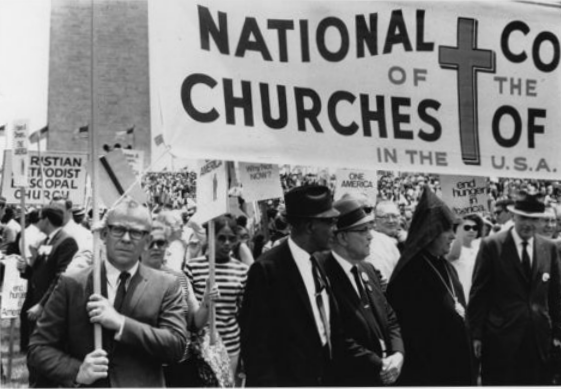

What to call new denominations emerging from Mainline Protestantism?
Such denominations of recent history include, among others, the Presbyterian Church in America (with nearly 400,000 members and founded 1973), the Anglican Church in North America (with about 125,000 members and founded in 2009), the North American Lutheran Church (with about 140,000 members and founded 2010), the Global Methodist Church (with hundreds of thousands of members and founded 2022), the Evangelical Presbyterian Church (with 125,000 members and founded in 1981), Lutheran Congregations in Mission for Christ (with 300,000 members and founded in 1981), and A Covenant Order of Evangelical Presbyterians (with 130,000 members and formed in 2012.)
These denominations, with others, broke from liberalizing Mainline Protestant denominations. Some of the newer denominations formed in the 1970s and 1980s. Others formed later directly in response to, or in anticipation of, changed denominational policies on marriage and sexuality.
Their theology, liturgy, ecclesiology, and overall dispositions are still closely descended from their mother churches. But they cleave to orthodox theology and ethics. Should they still be called Mainline Protestant? Or can “mainline” only mean liberal Protestant, as some pollsters define it?
Mainline Protestant is a term for major historic Protestant denominations in the U.S. that dated to or before America’s founding and liberalized theologically early in the 20th century. Sometimes “mainline” is confused with “mainstream.” Mainline did equal mainstream for many decades, but it specifically applies to what are now seven denominations: United Methodist, Evangelical Lutheran Church in America, Episcopal Church, Presbyterian Church (USA), American Baptist, United Church of Christ, and Christian Church (Disciples of Christ). Sometimes the Reformed Church in America is also counted.
There are maybe 12-13 million members, at least on paper, remaining in Mainline Protestantism, down from 30 million 60 years ago. The more traditional newer denominations include maybe 1.5 to 2 million members. According to Ryan Burge, for the first time, Mainline Protestants are now less than 10 percent of the U.S. population, down from 50 percent in the 1950s, currently comprising about 9 percent. Even this number is inflated by counting all who identify as Mainline. Actual church members equal about 5 percent of U.S. population.
Vague theology that deemphasized evangelism and exacting standards helped to reduce Mainline Protestantism from paramountcy to marginal. But Mainline Protestantism indelibly shaped America for centuries. Its influence is incalculable. It has no clear successors as chief pillar of American religion and American civil society. Mainline Protestantism after sixty years of decline has a grim future, with some Mainline Protestant denominations likely not to functionally exit in a decade or less.
Will the Mainline Protestant torch in at least small way pass to the new descendant denominations? Should they identify as Mainline? What is their demographic and institutional future?
American Protestant Christianity is becoming strongly nondenominational. Nondenominational Christianity is the only growing segment of U.S. Christianity. It is typically Baptist in ethos and theology but with autonomous congregations that do not directly identify with any major Protestant tradition, identifying usually just as Christian.
The new spin-offs from Mainline Protestantism offer an alternative to nondenominational Christianity. They too are theologically traditional and usually can be described as evangelical. But typically, these denominations have more traditional worship with liturgy and sacrament, usually although not always in traditional sanctuaries. Usually, they have a more connectional ecclesiology rather than congregational autonomy. No less importantly, these Mainline descendants evince a strong connection to the historic church, compared to most nondenominational churches, which are assertively contemporary, stressing the Bible, but usually not connecting overtly to a particular Christian tradition.
In this sense, the new spin-offs are a bridge between the evangelical world and the old Protestant denominational world. But are they Mainline Protestant? Should they want to identify as such? The answer is complicated.
They are historically and culturally Mainline. They are also in the best sense theologically Mainline, minus 20th century progressive theology. All human associations, including churches, carry with them a corporate memory and unspoken assumptions. These spin-offs are not new evangelical or post denominational bodies but largely are in continuity with the old Mainline Protestant world.
That world was in many ways wise and beautiful. It connected America to the Protestant Reformation of Europe but through new structures adapted to spread the Gospel in a new land and on the frontier. The Mainline world believed in creating and sustaining multigenerational institutions and multigenerational loyalties. This long term, confident perspective empowered the Mainline to shape and lead America into a great Christian civilization.
The problem was that as the Mainline got too confident about its place in society it lost sight of its Gospel-focused purpose. No longer focused on making converts and discipling believers, it became arrogant and sclerotic. Even after losing many millions of members, it remains institutionally in denial about its own collapse.
Many in the new spinoffs might equate “mainline” with progressive, arrogant, or sickly. They understandably do not want the association. But the new spinoffs should be aware of their antecedents and be willing to carry the responsibility of sustaining great traditions. They should not just focus on how the Mainline failed but also recall what made the Mainline formidable and great. In some ways, Mainline Protestantism created the world’s most successful and powerful society, no small achievement.
America needs Protestants who are committed to sustaining and perpetuating important traditions that will shape generations and wider society. The old Mainline Protestantism was often a magnificent steward of American society. The new Presbyterians, Anglicans, Methodists, Lutherans, and others perhaps can be called reformed Mainline, or post Mainline, or new Mainline, but in some sense, they are Mainline in their DNA and ecclesial habits. May God bless them no less powerfully than he deployed the old Mainline across two centuries.




Comment by Scott on May 23, 2024 at 7:41 am
Reformed Mainline, or post Mainline, or new Mainline…
How about Based Line?
established, grounded, or focused on a specified principle or belief, fact, method, etc
Slang. true to one’s self or secure in one’s beliefs regardless of what others think, especially when those beliefs fall outside of the mainstream