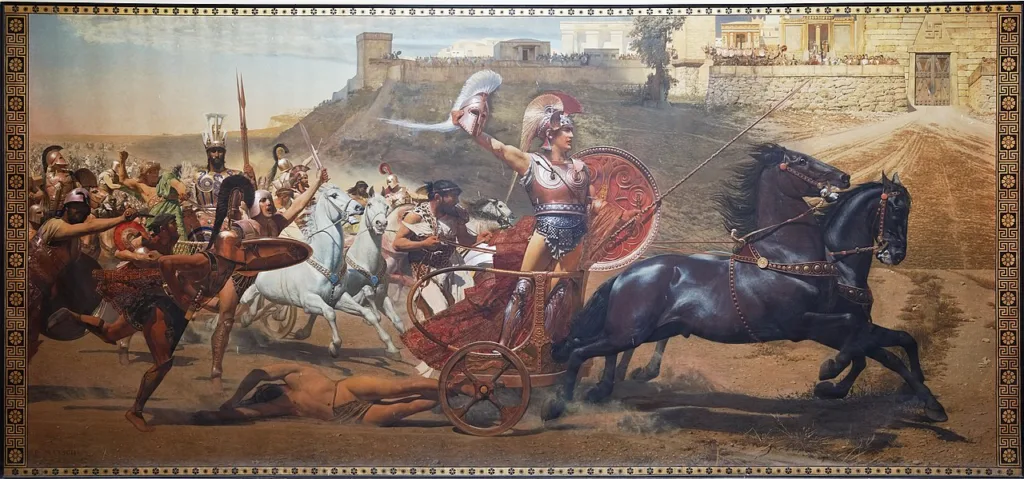

Late in the Iliad, the Trojan Lycaon begs Achilles to spare his life on the battlefield. Achilles refuses his supplications:
Come, friend, you too must die. Why moan about it so?
. . . And look, you see how handsome and powerful I am?
The son of a great man, the mother who gave me life
a deathless goddess. But even for me, I tell you,
death and the strong force of fate are waiting.
There will come a dawn or sunset or high noon
when a man will take my life in battle too—
flinging a spear perhaps
or whipping a deadly arrow off his bow.
Achilles exemplifies the Ancient Greek morality of struggle and victory, wherein glory cannot exist apart from winners and losers, killers and their slain. Vitalist thinkers from Nietzsche down to Bronze Age Pervert have found in this portrait of pagan warrior virtue a compelling antidote to the enervating force of modernity, which they blame on Christianity. Indeed, as moderns, we are conditioned within a Christian humanist paradigm of solicitude for victims. Under this paradigm—at least in its current, grotesquely swollen form—we aren’t supposed to see anything glorious in an Achilles exerting himself over weaker men. But we need not spurn empathy or embrace an ethic of “might makes right” for this scene to resonate, and even inspire.
“Man was called by his original God-given vocation to be master of the created world,” writes Edith Stein in her essay “Separate Vocations of Man and Woman.” “Hence his body and soul are equipped to conquer it.” Masculinity requires competition—against oneself and others. Likewise, victory and mastery mean nothing without the risk of defeat. The masculine desire to develop capacities for expansive action in the world is a given of the created order; as such it is good, as is the attendant desire to foster development in others. This latter, Stein notes, is most fulfilling in child-rearing, where “man’s more intense drive and potential for achievements make him responsible for guiding the child to fulfill his particular potentialities, to ‘make good.’”
Stein’s description of men flies in the face of the therapeutic language constraining most “crisis of masculinity” discourse. The therapeutic worldview, according to Philip Rieff, seeks to reconcile individuals to their own desires (and pathologies), rather than to their families, communities, or the created order. Under therapeutic logic, the innate orientation of men toward pursuing excellence and dominion is a cause of psychological distress. For example, the American Psychological Association reframes the natural givens of masculinity as “traditional masculinity ideology,” which promotes “anti-femininity, achievement, eschewal of the appearance of weakness, and adventure, risk, and violence.” The APA counsels us to reject these norms and instead to affirm denatured, diverse “masculinities.”
This approach to masculinity does not resonate with many men, despite its ubiquity in the broader culture. Men do not want to have their feelings of failure and weakness validated if it will not make them less of those things in reality. Men do not want to hear that life is about finding happiness and inner peace by accepting oneself as one is, regardless of the quality of one’s character.
Continue reading at First Things here.




Comment by Wilson R. on December 5, 2024 at 12:13 pm
Is this how Jesus behaved as a man? Shouldn’t I model my behavior more on Jesus than Achilles?