Over the past few years, the phrase “Christian Nationalism” has become all-but-ubiquitous in religion and politics. When employed by the political left, the phrase is often overused and applied without precision to politically conservative Christians in general. Those who self-identify as Christian nationalists, however, have more particular positions in view, usually involving state-established religion.
As noted in the article linked above, many self-proclaimed Christian nationalists are within the Reformed tradition. There is intramural debate about who is truly Reformed and who is not, but the term most broadly refers to Calvinists, especially presbyterian and Dutch Reformed Christians who adhere to a particular understanding of biblical covenants and the nature of the Church. There are many subdivisions and denominations within the Reformed tradition, but most Presbyterians adhere to the Westminster Standards: the Westminster Confession of Faith (WCF), Westminster Shorter Catechism, and Westminster Larger Catechism; most Dutch Reformed Christians adhere to the Three Forms of Unity: The Belgic Confession, the Canons of Dort, and the Heidelberg Catechism.
Among American presbyterians, a key element of debates surrounding Christian nationalism is the Westminster Confession of Faith’s Chapter 23: “On the Civil Magistrate.” This can be seen in a recent conversation between several prominent voices in conservative American presbyterianism.
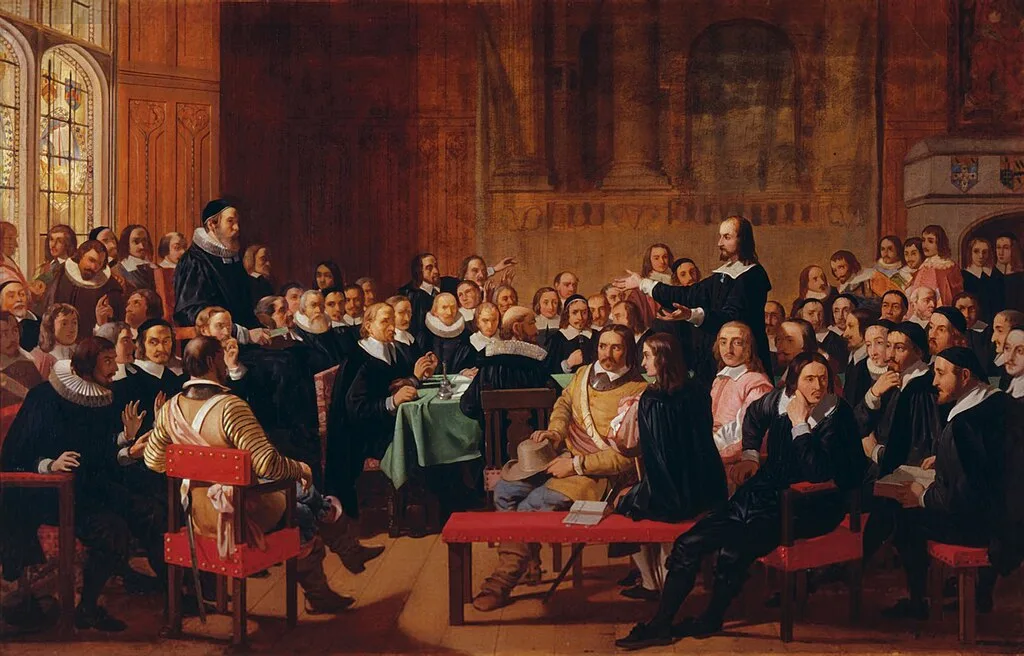
The conversation was hosted by Presbyterian Church in America (PCA) ruling elder Brad Isbell’s podcast Presbycast, which is well-known in Reformed circles. Joining Isbell were American Reformer Editor-in-Chief Timon Cline, Hillsdale College history professors Dr. Darryl G. Hart and Dr. Miles Smith IV, and Case for Christian Nationalism author Dr. Stephen Wolfe. Cline is a member of the Orthodox Presbyterian Church (OPC), a denomination in which Hart is a ruling elder. Smith grew up in the PCA but is now a vestryman at an Anglican Church in North America (ACNA) congregation. Wolfe indicated he attends an unspecified church with membership in the North American Presbyterian and Reformed Council (NAPARC), an association of presbyterian and Dutch Reformed denominations including the OPC and PCA.
The OPC and PCA were both formed in the twentieth century by churches which broke away from the Presbyterian Church (USA) because of the latter’s unfaithfulness to Scripture and the Westminster Standards. The PCA is the largest conservative presbyterian denomination in the United States; the OPC is much smaller, but is generally more conservative than the PCA.
When the PCUSA was first formed in 1788, some revisions were made to the confession, most notably section 3 of Ch. 23. The original confession, c. 1646, stated:
“The civil magistrate may not assume to himself the administration of the Word and sacraments, or the power of the keys of the kingdom of heaven: yet he hath authority, and it is his duty, to take order, that unity and peace be preserved in the Church, that the truth of God be kept pure and entire; that all blasphemies and heresies be suppressed; all corruptions and abuses in worship and discipline prevented or reformed; and all the ordinances of God duly settled, administered, and observed. For the better effecting whereof, he hath power to call synods, to be present at them, and to provide that whatsoever is transacted in them be according to the mind of God.”
While this paragraph is clear that magistrates have no authority to administer worship and the means of grace contained therein, they nonetheless have authority to “[suppress] blasphemies and heresies,” “[reform] abuses in worship and discipline,” and call and preside over theological councils.
When this section was revised amidst the American founding, it became:
“Civil magistrates may not assume to themselves the administration of the Word and sacraments; or the power of the keys of the kingdom of heaven; or, in the least, interfere in matters of faith. Yet, as nursing fathers, it is the duty of civil magistrates to protect the church of our common Lord, without giving the preference to any denomination of Christians above the rest, in such a manner that all ecclesiastical persons whatever shall enjoy the full, free, and unquestioned liberty of discharging every part of their sacred functions, without violence or danger. And, as Jesus Christ hath appointed a regular government and discipline in his church, no law of any commonwealth should interfere with, let, or hinder, the due exercise thereof, among the voluntary members of any denomination of Christians, according to their own profession and belief. It is the duty of civil magistrates to protect the person and good name of all their people, in such an effectual manner as that no person be suffered, either upon pretense of religion or of infidelity, to offer any indignity, violence, abuse, or injury to any other person whatsoever: and to take order, that all religious and ecclesiastical assemblies be held without molestation or disturbance.”
This updated paragraph still refers to civil magistrates as “nursing fathers” of the Church, but removes express permission for them to restrict or dictate actions of churches within their jurisdiction.
Both the OPC and PCA subscribe to the 1788 WCF, and Cline, Hart, Isbell, and Wolfe debated whether its removal of express permission for activities described in the 1646 WCF constitutes a ban on such activities.
Wolfe argued that the 1788 WCF does not necessarily eliminate the possibility of an established religion, though he clarified that he does not think an established religion is necessary or beneficial in all situations. Cline largely agreed with Wolfe. Hart and Isbell, in contrast, argued that the exclusion of the powers assigned to the civil magistrate by the 1646 WCF implies that the 1788 WCF assumes these powers do not exist.
Though confessional interpretation is not exactly flashy, it is nonetheless a vital piece of presbyterian debates about Christian nationalism, and the disagreement between thoughtful, well-read presbyterians like Cline, Hart, Isbell, and Wolfe reveal that such interpretation is not always straightforward. Though OPC and PCA members are not required to adhere to the Westminster Standards, ministers/teaching elders/pastors, ruling elders, and deacons are (though some exceptions are allowed). It is thus especially necessary for any presbyterian church officers wishing to weigh in on Christian nationalism to know what their doctrinal standards say and what implications that has for both their churches and society at large.



Comment by David on April 23, 2024 at 5:59 am
Despite the Dutch Reformed Church, the Dutch West India Company, which colonized the area around present-day New York City, could be quite liberal in the matter of religion.
“Further giving and graunting. And by vertue of these presents. We do give and Graunt, unto the said Patentees, their Associates, Heires, Executors Administrators Successors and Assignes, upon the said Land to build a Towne, or Townes, with such necessary
fortifications, as to them shall seeme Expedient ; and to have and Enjoy the Liberty of Conscience, according to the Custome and manner of Holland, without molestacon or disturbance, from any Magistrate or Magistrates, or any other Ecclesiastical Minister,
that may extend Jurisdiccon over them…”—Charter of Vlissingen (Flushing, NY), 10 Oct. 1645.
A subsequent Director General of the colony, Pieter Stuyvesant, opposed religious pluralism and sought to suppress Baptists, Lutherans, Quakers, Jews, etc. Upon the appeal of the inhabitants, he was directed by the Company, “You may therefore shut your eyes, at least not force people’s consciences, but allow everyone to have his own belief, as long as he behaves quietly and legally, gives no offense to his neighbors and does not oppose the government.”