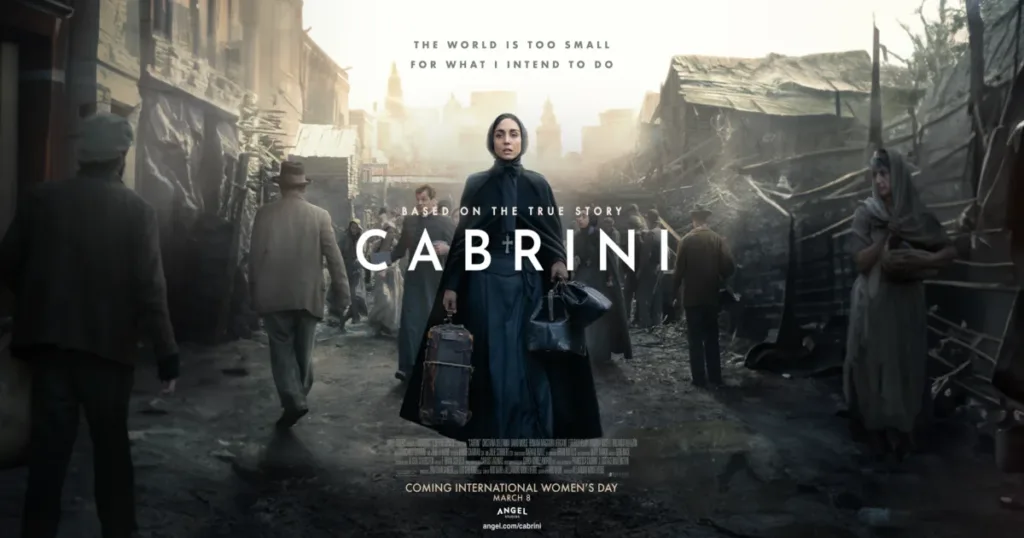

The new film about Catholic Saint Mother Cabrini is, by common vulgar contemporary standards, an anti-American film. She’s a frail but indomitable Italian nun who comes to New York City in 1888 to minister to Italian immigrants, founding an orphanage and a hospital. New Yorkers treat her and other Italian immigrants like trash.
An opening scene shows a small Italian boy pleading for help while desperately wheeling his dying mother in a wagon amid indifferent well dressed New Yorkers. A prim hospital that doesn’t serve Italians turns them away. Police officers seize her body for a pauper’s grave, disdaining the pathetic orphan because he can’t speak English. He then lives with other Italian orphans in the alleys and sewers of the filthy and overcrowded Five Points neighborhood to which Italians are consigned.
Mother Cabrini wants to serve in China, but the Pope sends her to help Italians in New York where he thinks she’s more needed. The immigrants had expected riches but find misery. She and her fellow nuns spend their first night in a New York bordello for lack of alternatives. The Archbishop of New York, who is Irish, insists she stay among Italians and not further inflame anti-Italian animus. New Yorkers on the street mock the Italian nun for her dark skin and accent. The city, an official tells her, no matter her charities, will not help people who look and smell like her. Rats live better than Italian children in New York, she tells a newspaper. She’s forced to move her orphanage north of town and out of sight.
A workplace explosion kills Italian immigrants who lack a decent hospital. Cabrini valiantly raises money for a hospital even though banks will not loan to Italians. Her donors are sympathetic immigrant businessmen and the Italian government. But the hospital suffers arson. And an Italian fundraising festival is broken up by police. The city seizes money she raises. The sinister mayor is all the time plotting against her behind the scenes, knowing most New Yorkers have contempt for Italians.
Undeterred, Cabrini confronts the mayor in his ominously dark office overlooking the city, offering a political alliance while also threatening the wrath of an emerging Italian voter bloc. The mayor respects her audacity and acknowledges her wisdom. He will help her! Cabrini builds her hospital, only one more step towards an international empire of charity she would build over the next three decades. Twenty years after her death she is recognized as a saint in 1947. By the time of her canonization Italian Americans are mainstream. Frank Sinatra, the son of Italian immigrants, is a celebrity singer. His sidekick in the legendary “Rat Pack” was Dean Martin, born Dino Paul Crocetti, also of immigrants. When Martin was a boy in Steubenville, Ohio, the Ku Klux Klan in 1924 precipitated a riot, with Italians and others as targets.
Does the Cabrini film exaggerate anti-Italian animus when she arrived in New York? In 1888, the year of her arrival, a Congressional committee convened in New York to investigate the “immigrant invasion” with Italians in mind. It concluded:
They are of a very lower order of intelligence. They do not come here with the intention of becoming citizens. . . . They live in miserable sheds like beasts; the food they eat is so meager, scant, unwholesome, and revolting, that it would nauseate and disgust an American workman, and he would find it difficult to sustain life upon it. Their habits are vicious, their customs are disgusting, and the effect of their presence here upon our social conditions is to be deplored. They have not the influences, as we understand them, of a home; they do not know what the word means; and, in the opinion of the committee, no amount of effort would improve their morals or “Americanize” this class of immigrants.
Such conclusions would not age well. Within a decade three quarters of New York’s construction workers went from being Irish to Italian. The Italians were more than Americanized. In the film, Cabrini prophesies to the mayor that inevitably New York will have mayors and governors who are Italian. Of course she was right.
Not all the details of the Cabrini film are historical. Devious “Mayor Gould” is not a real person but a metaphor for political resistance against Italians. The film is accurate in portraying New York and America as often contemptuous of Italian immigrants, who were deemed inferior to America’s older stock.
Yet Italians like Cabrini and millions of others blasted away against this prejudice with their perseverance, faith and hard work. They understood and loved America more than their too proud opponents. They knew America offered difficulty but also almost unlimited opportunity. Within decades they were ensconced within American society, prosperous and respected.
In the final scene Mother Cabrini shares a drink with the mayor who’s now her ally, with all New York spread before them in the twilight. It’s a fictional encounter that’s metaphorically true. America is a tireless engine of economic and political uplift. Prejudice and discrimination always exist, as privileged groups naturally disdain outsiders. And yet the gates ultimately always open, and millions more amazingly pour through, their children often forgetting there had been any struggle at all.
Mother Cabrini, in her endless good works of orphanages and hospitals, served the Greatest Story Ever Told. America, in an earthly sense, with its endless, churning incorporation of new peoples into its success, is maybe the second greatest story ever told. For those with eyes to see, the Cabrini film illustrates the power of both stories.




Comment by Dan on March 12, 2024 at 1:18 pm
This speaks to the volume of immigrants that our nation can assimilate and bring into the mainstream of social, civic, and political life. One thing all these immigrant groups had up until recently, is that they were from a Jewish or Christian background. That makes them essentially different than many current immigrant groups. America decided that immigration needed to halt from the 1920s until Ted Kennedy changed the law, so that we could assimilate the vast number of immigrants.
Two questions are key to current immigration. How many can we take in what period of time and still retain the essentials of American life? Second, how do we deal with immigrant groups that want no part of American culture or life; e.g., fundamentalist Muslims? If we cannot answer these two questions in a way that preserves what it is that make American, quintessentially American, the we are doomed and America, as we know it is lost. We have only to look at Western Europe to see what this means.
Comment by David on March 12, 2024 at 5:01 pm
Italian immigration was somewhat different than that of other groups.
“Unable to earn a livelihood in their home countries, they were migratory laborers. Most were young men in their teens and twenties, who planned to work, save money, and return home. They left behind their parents, young wives, and children, indications that their absence would not be long. Before 1900 an estimated 78 percent of Italian immigrants were men. Many of them traveled to America in the early spring, worked until late fall, and then returned to the warmer climates of their southern European homes in winter. Overall, 20 to 30 percent of Italian immigrants returned to Italy permanently.”—Digital History
Many hospitals in the US were established by ethnic groups for their members. “Free beds” were created by the charitable for indigents. However, these hospitals were not always welcoming of persons outside their group.
Comment by Dan W on March 12, 2024 at 6:04 pm
That little Italian boy grew up to be Al Capone. (Not literally true, but metaphorically true.)
Comment by C. Cisterna on September 2, 2024 at 6:28 pm
He was the real mayor then and he was a horrible person. This is a true story, there’s no symbolism. However, if it helps you sleep at night think of it that way. This is exactly how my ancestors were treated. I’m second generation American, my great grandfather emigrated here. The only anti-American thing is the Americans acting like pigs. They are as are those now who act this way, anti-American. You by your own writing have become the same. Italians were treated no different than black people were back then. It was only later that Italians were considered white.