
Along with its many other inadequacies, theological liberalism never has had much of a doctrine of the Church. Not that there is an orthodox doctrine of the Church, but the various evangelical and catholic theologies at least hold in common that the people of God are gathered into the body of Christ which is called the Church, and distinctions are made between the saved and the lost, or between the redeemed and the unredeemed. Catholic-inspired theologies hold there is no salvation outside the church.
But theological liberalism never has gone for ideas that emphasize the redeemed as over against the unredeemed, or which speak of heaven and hell, or saved and unsaved. Nor, for that matter, has theological liberalism had much to say about sin, especially Original Sin, and blood atonement. To put it another way, theological liberalism tends to deconstruct the whole idea of salvation so that it is interpreted basically as this-worldly and connected with ideas like wholeness and social justice. And if the idea of salvation is deconstructed and redefined then the doctrine of the Church must be deconstructed and redefined as well.
It was not always so for groups like the Methodists, especially in early years. It can be argued that the Methodists and Baptists basically defined the word “evangelical” for Americans. The word became associated with camp meetings and revivals and a new understanding of the “altar,” with hymns addressed to sinners (Come Sinners, to the Gospel Feast” #339 UM Hymnal) and “born-again” language. During those early years Methodists (and evangelicals) leaned toward a sectarian doctrine of the church. Methodists were so successful that by 1890 approximately 12 percent of Americans identified as Methodist (Stark and Finke, The Churching of America 1776-1990, p. 146).
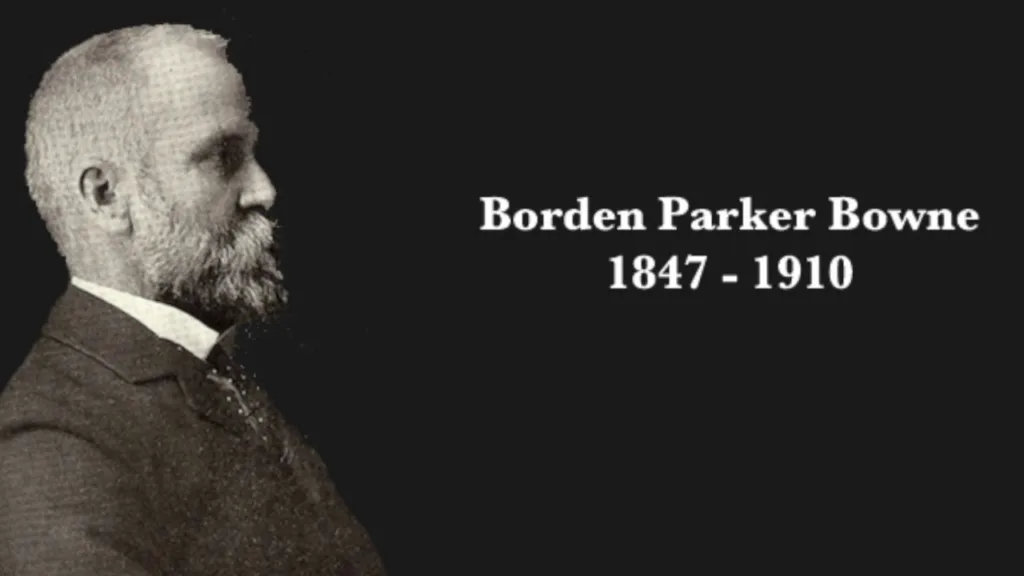
This changed with the rise of liberalism. Persons like Christian philosopher, Methodist minister and theologian Borden Parker Bowne (1847-1910) from Boston, who did as much as anyone to introduce modernism to Methodism, scarcely wrote or spoke about such matters as “redeemed” or unredeemed.” For Bowne the purpose of religion was to understand the nature of things (more like philosophy than theology) and to use spiritual forces to bring enlightenment and progress to the world. His battles were waged not against sin but against ignorance and superstition, and he believed that superstition was found in the Church as much as elsewhere. Consequently, neither Bowne nor other liberals wrote much about the Church except as an institution which was in the business of helping to bring about higher civilization and a new social order, which was popularly known as the Kingdom of God.
The modernists were caught up in the new theology. By the 1920s every Methodist Episcopal seminary, in a survey conducted by Minister’s Monthly, identified its theological orientation as “liberal.” When the 1935 Methodist Hymnal was published the baptismal service was significantly changed. Instead of the words, “Forasmuch as all men are conceived and born in sin, and that our Savior Christ saith. Except a man be born of water and of the Spirit he cannot enter into the kingdom of God…” the new theology substituted: “Forasmuch as all men are heirs of life eternal and subjects of the saving grace of the Holy Spirit; and that our Savior Christ saith, Suffer the little children to come unto me….” Sin, salvation, redemption, the cross, atonement—it was excised and has been so ever since then.
Fast forward to the present day and the more recent progressive theology. Progressives today speak of the Church as being a truly inclusive community which models the kind of world God intends for all nations. In this view, the Church is not primarily about redemption but about acceptance and affirming of diversity. From this perspective the United Methodist Church’s advertising slogan, “Open Hearts, Open Minds, Open Doors” means the church does not ask embarrassing questions about whether a person has had a salvation experience and believes the doctrines and teachings of the church and is committed to its moral teachings. All who want to be members should be welcomed. There is no place for gatekeepers (such as pastors) in the progressive understanding of the Church. Open hearts and open minds and open doors means in the end there are no standards. Membership vows do not stand in the way because the prospective members can interpret them to mean whatever they want them to mean.
John Wesley, we submit, would not be amused. John and Charles Wesley, for sure, believed that the invitation to the gospel was for all (and in that sense is inclusive). In the seventeen-verse version of “O For a Thousand Tongues to Sing” (UM Hymnal, #58), a song about redemption, the altar call takes six verses. The appeal is made to the deaf, the dumb, the blind, the nations, harlots, publican, thieves, murderers and “all the hellish crew.” The appeal is not that persons understand they are acceptable as they are but that they believe in the Savior and feel their sins forgiven and experience life-changing love.
Perhaps John Wesley’s best statement on the Church is in the sermon, “Of the Church.” In this sermon he deals with Ephesians 4:1-4 and also with the statement in the Articles of Religion. The sermon is about the Church universal and Wesley is broad-minded enough to include Roman Catholics as part of the great church body.
But while Wesley is broad-minded about other denominations and groups (as in his sermon “The Catholic Spirit”), he is dogmatic about the necessity of living a redeemed life.
How clear is this! If the Church, as to the very essence of it, is a body of believers, no man that is not a Christian believer can be a member of it. If this whole body be animated by one spirit, and endued with one faith, and one hope of their calling; then he who has not that spirit, and faith, and hope, is no member of this body. It follows, that not only no common swearer, no Sabbath-beaker, no drunkard, no whoremonger, no thief, no liar, none that lives in any outward sin, but none that is under the power of anger or pride, no lover of the world, in a word, none that is dead to God, can be a member of the church (“Of the Church” #74)
It is a good thing Wesley is not a pastor today in the United Methodist Church in America. He would be considered exclusivist, dogmatic, judgmental, and unloving.
Because of disaffiliations, United Methodism today is speaking of new life, new direction, new energy, and new commitment. We pray that might be so. But let us have some conversation about our doctrine of the Church.
Riley B. Case is a retired United Methodist clergy member of the Indiana Conference who has for many years authored articles for the Confessing Movement. His articles are published in the Methodist Voices series appearing on Juicy Ecumenism, the blog of the Institute on Religion & Democracy.


Comment by David S. on October 11, 2023 at 3:24 pm
“There is no place for gatekeepers (such as pastors) in the progressive understanding of the Church.”
Based on my personal experience with the mainline Presbyterian denomination, this is the only quibble that I have with this article. Gatekeeping does occur. If you do not affirm whole-heartedly theological liberalism and particularly, the so-called “Progressive Christian” understanding of it, then you are branded with name your leftist epithet as has occurred with Jesus in the heretical eisegesis of Matthew 15 that is currently in fashion.
Comment by David on October 16, 2023 at 7:05 pm
Good article…until the last paragraph. United Methodism and it’s decadent liberalism is done. The is no hope…they have has build their own coffin and dug their own hole. They have destroyed a once exceptional denomination and and have joined with the ways of the world and evil.
Comment by SUSAN WEHR LIVINGSTON on October 17, 2023 at 4:05 pm
Thank goodness for Methodist liberalism, otherwise I would have to become a NONE.