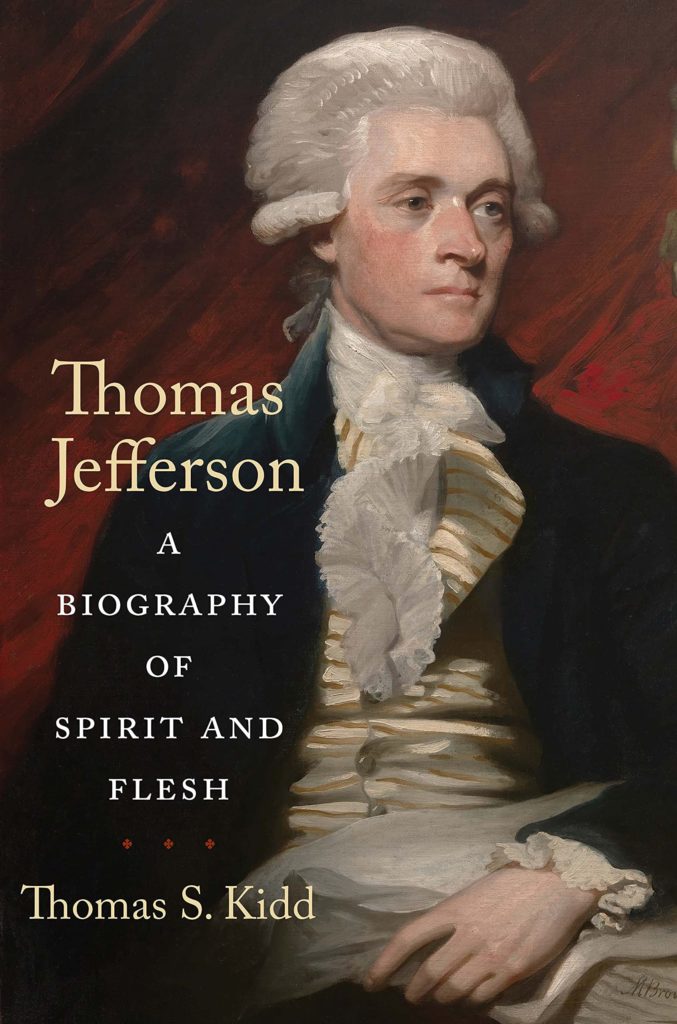

Here’s my interview with scholar of American religious history Thomas Kidd of Midwestern Baptist Theological Seminary on his new book Thomas Jefferson: A Biography of Spirit and Flesh. Podcast here. The book’s examination of Jefferson’s spirituality, intellect and ethics is especially timely. Transcript below.
Download podcast audio of the interview on IRD’s SoundCloud account below:
Transcribed by Sage Showers:
Mark Tooley: Hello, this is Mark Tooley, President of the Institute on Religion and Democracy, with the pleasure today of talking with my old friend Thomas Kidd, a long-time historian of religious history in America. He has taught many years at Baylor university. Eventually, he is moving to Midwestern Southern Baptist Seminary in Kansas. His new book is a biography of Thomas Jefferson called Thomas Jefferson: A Biography of Spirit and Flesh, which I’m going to ask him some questions about. Tom, thanks so much for joining us.
Thomas Kidd: Thanks for having me, Mark.
Tooley: You have previously written a biography of Patrick Henry who was notably a very orthodox Christian. Thomas Jefferson comes from a different spiritual direction, of course, which you cover in your book at it seems to be firstly that I should ask you that; Thomas Jefferson has always been controversial, but perhaps more so at this time, with people in the more liberal side dismissive of him, since he was a slave owner. But now, some people on the ride are dismissive of him because he was obviously an advocate for liberal democracy and many perhaps post-liberals find that troubling. So, how do you address these issues and biography?
Kidd: Well, he is very complicated, and from a traditional Christian perspective, he’s problematic. There have been a number of evangelical Christians popularizers that have tried to claim him as a Christian, but for me that seems like a wrongheaded approach. I mean, when you think that he denied the Trinity, he denied the divinity of Christ, he denied the resurrection, he denied the reliability of scripture, he’s definitely coming from an unorthodox perspective in a historic Christian sense. Of course I don’t have to tell you that there’s some issues there about, not only his slave owning, but we think almost for sure that he had a long-term sexual relationship with Sally Hemings that produced a number of children. But, in this day and age, I think all that, especially the slavery part, would give a lot of people, especially on social media, impetus to cancel him, as we say these days. I have to say that I find Jefferson to be troubling personally in some important ways, but I am also trying to offer a model for how we think, even empathetically, about someone like Jefferson: just trying to understand where he’s coming from, rather than pulling down statues and renaming schools and all that; we seem to be so good at that today. I don’t think we’re very good at understanding the complexity of people in the past. I don’t think someone who’s a fan of Jefferson’s will like my book very much, but I don’t think people who want to cancel my book, they might not like my book either. So I guess I’m kind of an equal opportunity offender that way.
Tooley: Now is this book a comprehensive overview of Jefferson’s life, or is it more focused on him spiritually and intellectually?
Kidd: I think of this as a sort of moral biography of Jefferson, or a biography of Jefferson’s ethical and moral universe. There are definitely other biographies, I think, that are sort of your classic, you know, thousand page doorstop type of biography of everything, great man biography, everything he did politically, sort of blow by blow. And that’s not my approach, I certainly trace his political career in the book, but I’m really trying to answer a question that I think a lot of people have about Jefferson, in particular, but about a number of the Founders these days. Which is, you know, how could Jefferson have said that all men are created equal, and then, and have other brilliant, wonderful political writings and inspiring the way that he is, and yet his life seems to have at least from a modern perspective contradicted a lot of those values. And, you know a lot of people today will say Jefferson was a hypocrite. And I mean that’s fine, but I think it’s more useful from a strictly contemporary perspective. If we look back on him from our modern perspective, he certainly looks hypocritical, but I think there’s a lot more to say about the sort of moral universe in which he lives, and also the different sort of worldviews and moral philosophies that he has, in his kind of intellectual library as it were, that are tugging at him and producing a certain kind of incoherence, and the way that he lived his life personally.
Tooley: If you had to list the top four or five spiritual and intellectual influences on Thomas Jefferson that made him who he was, what would they be?
Kidd: I think probably number one if I was pushed would be the code of gentility that he grew up with as a boy in colonial Virginia. And, and of course that code is informed by Christianity, and you know honor culture, and those sorts of things, but it seems to me that when push came to shove, he tended to abide by the code of gentility that required him to, you know, always spend money when it required a gentleman to spend, and and to put on a sort of, you know, a cultivated air that finds its apex, I suppose in Monticello, that was an ingenious project but also absolutely debilitating to him financially to take on. And then I mean Christianity, for sure which is as I said, connected in some ways to that code of gentility. He came to believe, fairly late in his adult life, that Jesus was the greatest moral teacher in world history, but he grew up in a profoundly Christian Anglican culture in colonial Virginia, and that made a deep imprint on him, as did the King James Bible, and the Book of Common Prayer. But you know there’s the Enlightenment–you know, historians debate what in the world the Enlightenment was, if there really was such a thing as the Enlightenment–but you know this kind of cosmopolitan ideal, especially his time in France as a diplomat makes a deep imprint on him about the kind of French enlightened ideals; they’re coming out at that time. And then, the classical tradition as well, I think, especially stoicism and the avoidance of pain in the ideal private life, the apolitical private life, made a huge impact on him. So just that list itself, I mean you can see that he’s got a lot going on, intellectually and philosophically, and I think that he never gets all those different priorities completely sorted out.
Tooley: And if you were pressed to list Jefferson’s four or five most important contributions to contemporary political life, the world today, what would they be?
Kidd: Well, for me, as a Baptist I think religious liberty would be my personal favorite, and the one I would emphasize as basically an unalloyed good coming out of Jefferson’s thought. He has this kind of wonderful partnership with evangelical Christians, especially Baptists, in the fight for religious liberty and disestablishing the state churches, the Anglican Church in Virginia, in particular. And Jefferson is coming at that issue from a more enlightened, Lockeian type of perspective, but the Baptists are coming at it from the perspective of people who had been persecuted by the state churches, but either way they get to what I think is the right, the right place, which is “picking no favorites” in terms of Christian denominations and in law. I think that you know Jefferson’s agrarianism is one of his most attractive parts of his political philosophy; that kind of small, republican ideal of the independent agrarian life and very small government is very appealing, of course. With Jefferson’s case, like most of the Founders, it’s attached in a way to slavery, so that that makes it morally problematic. But that is an issue, agrarianism, that he did not win out on, I think Alexander Hamilton won out on what kind of country we were going to have. But still I confess a certain nostalgia about agrarianism from Jefferson. I mean we could list many others, you know, I think that there’s the more problematic issues, obviously, about his fundamental political and personal commitment to slavery. And you know, it’s hard to say what he would have thought about the growing kind of southern sectionalism that’s developing at the very end of his life. He doesn’t even make it to the nullification crisis in the early 1830s–he’s dead by then–but he certainly is used by southern sectionalist partisans and defenders of slavery, as a champion of what became eventually confederate ideology. So, he contributed to that whether that was something he would have approved or not as is harder to say; but that’s maybe his most problematic legacy, his connection to slavery and southern sectionalism.
Tooley: Jefferson seemed to think that the Declaration of Independence was his most important legacy. He claimed the declaration was simply a distillation of what everyone thought in America at the time. Is that really true, or is the Declaration actually a very personal articulation from Jefferson to man?
Kidd: Yeah, I mean later on Jefferson said that he was trying to articulate the harmonizing sentiments of the day, in the Declaration, and I think he did that, and I think that he writes something that is meant to motivate politically-engaged people in 1776 to support independence. And I think that’s part of the reason why he’s relatively free in using theological claims, in spite of his own personal skepticism in that document. And so when you compare it to the Virginia Declaration of Rights, which had been issued a month before the Declaration of Independence, that document says that “all men are by nature equal.” Which, you know, it’s fine, and a common sentiment of the time, but not nearly as inspiring or theologically specific as “all men are created equal, and actively endowed by their Creator with certain unalienable rights,” I think when he says that, he is being in a way multivalent. He is speaking as a kind of enlightenment, more skeptical enlightenment philosopher, but he’s speaking in a way that religious traditionalists, which was the majority of the population at that time, at least those who are involved with the revolution, can appreciate and understand. So traditional Christians could hear “All men are created equal” in a very traditional way, even though the document itself doesn’t say anything specifically about Christianity. It is a harmonizing document, though obviously not harmonizing for Loyalists. They just don’t buy it–they’re not convinced–but for those who were going to be involved in the Patriot movement, I think it does exactly what Jefferson hoped it would do, which is rally people to support a very difficult revolutionary cause.
Tooley: Who were the people most important to Jefferson in his life? Who most shaped him: family, personal friends, political allies or adversaries?
Kidd: Right, well, I think the best known, and it is absolutely true, is that he and Madison had a very long-standing and relatively unruffled partnership politically and friendship too, that really stands out because Jefferson had such difficult relationships with many other leading politicians at the time. He was at one time an ally with John Adams, and then had a terrible falling out, especially because of the 1800 presidential election. You mentioned Patrick Henry before: Jefferson absolutely hated Patrick Henry. I do not think that’s too strong a word; he hated Patrick Henry’s guts. It was partly, I think, born out of jealousy, that Henry was just always a much more popular politician, then Jefferson was in Virginia. And Henry just always seemed to be on the other side of Madison and Jefferson on almost every political issue, and in Madison’s case, most importantly on the Constitution, since Henry was the most influential Anti-Federalist in Virginia. And I think that his relationship with his wife Martha was very, very important to Jefferson, but it was cut short by her death in the 1780s. I think that in that relationship he depended a lot on her, just emotionally, and the things that you would expect from a healthy marriage relationship and and, but I think it was devastating to him that that she died, and that explained some things I think about his relationship with Sally Hemings, who we know for sure was Martha’s half sister; they have the same father. And so that relationship I think looms as a shadow over Jefferson’s life. On religion, I think, the most important relationship is with Joseph Priestley, who was a unitarian minister and also a very accomplished scientist, a more accomplished scientist than Jefferson. And I think Priestley’s really the one, in the early 1800s, that gave Jefferson a vision for a sort of purely naturalistic Christianity that focused almost exclusively on Christian ethics, rather than any kind of supernatural claims about the divinity of Christ or miracles and so forth. So I think if there’s a person who makes the most direct contribution to the later shape of Jefferson’s religious beliefs, it’s definitely Joseph Priestley.
Tooley: And then finally Tom, what is your book–so many books written about Thomas Jefferson across 200 years–what does your book say that previous Jefferson biographies have not said?
Kidd: Well, you know, you’re right, I mean, maybe Lincoln has surpassed Jefferson in terms of the number of books written about him, but there are many, many books. But I think that what I do is to trace through Jefferson’s biography; and the things that those long political biographies would touch on are the high points of that story; but to trace through his moral and ethical development, answering that kind of “how could he?” question. I think that maybe the most common type of question that people have about Jefferson today is, “how could he, you know, own slaves, but say all men are created equal?” And lesser known things about Jefferson is, you know, how could he be a Christian skeptic and yet be deeply, deeply conversant with the Bible; so much so that he produces the Jefferson Bible, which is condensation of the Gospels into a sort of naturalistic version. Or how could he, for instance, talk constantly about the virtue of frugality, but be just a total disaster himself financially and to die within today’s money about $2.6 million of personal debt? He is just a bundle of contradictions, but I think if we sit with his competing philosophies and understand him in the context of his time, not ours, we can start to at least absorb some of where those contradictions came from.
Tooley: Would you hold your book up, Tom?
Kidd: Oh sure absolutely. Here it is.
Tooley: Thomas Kidd, author of Thomas Jefferson: A Biography of Spirit and Flesh. Thank you so much for an edifying conversation.
Kidd: Thank you, Mark.




Comment by David Connon on May 17, 2022 at 3:08 pm
I enjoyed your conversation, Mark Tooley.